WS Capital was registered with the SEC. That sentence was the whole machine.
Thomas Aaron Signorelli sold a sentence, not a strategy. The sentence was true on its face and a lie in its meaning, and it carried more than $1.9 million in losses before a federal judge in San Francisco closed the file.
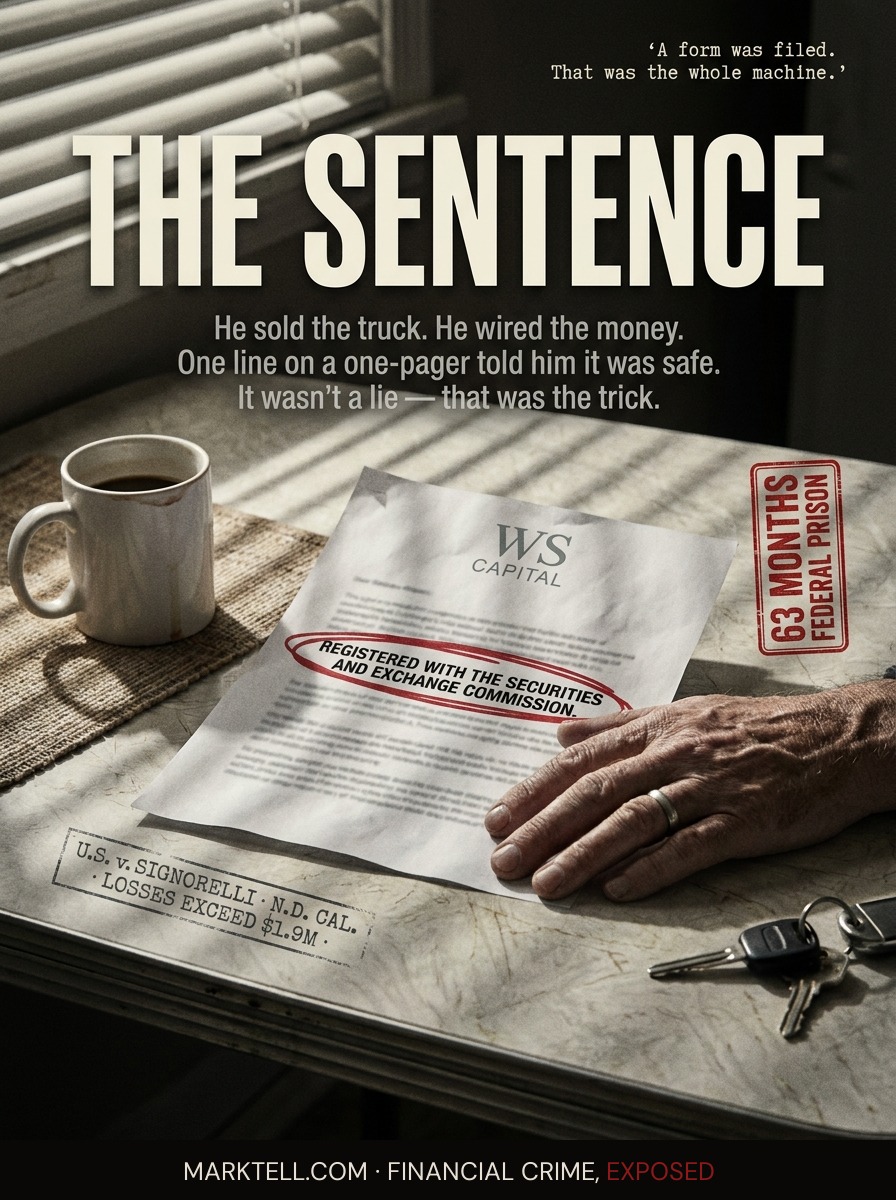
Frank read the sentence twice.
He was sixty-seven years old, sitting at the kitchen table in a two-bedroom ranch in Boca Raton, the coffee in front of him already past warm. The one-pager on the placemat had a clean logo at the top, a phone number, a paragraph about capital solutions, and one line halfway down that did all the work.
The line said the firm was registered with the Securities and Exchange Commission.
Frank had spent forty-one years running a plumbing business. He had not gone to college. He knew what registration meant the way he knew what a permit meant. It meant somebody had checked. It meant a government office somewhere had a file with this company's name on it. It meant the firm was inside the fence, not outside it.
He had sold his second truck two weeks earlier. The money was sitting in his savings account, waiting to be put somewhere. His brother-in-law had sent him to the firm. The firm was called WS Capital. The man who ran it was named Thomas Signorelli.
Frank wired $185,000 the following Tuesday.
He is a composite. The case file describes the kind of person who was in the room. The room was real.
I.
On June 1, 2026, in the federal courthouse in San Francisco, U.S. District Judge James Donato sentenced Thomas Aaron Signorelli, 48, of West Palm Beach, Florida, to 63 months in federal prison. Three years of supervised release would follow. The prosecution was brought by the U.S. Attorney's Office for the Northern District of California. The case had been investigated by the FBI, IRS Criminal Investigation, and the Small Business Administration Office of Inspector General.
Signorelli had pleaded guilty on November 25, 2024, to bank fraud, wire fraud, conspiracy to commit wire fraud, theft of government property, obstruction of justice, and money laundering conspiracy.
According to the Department of Justice, total losses from his conduct exceeded $1.9 million. His plea agreement had referenced investor fraud of more than $2.5 million.
That is the file. The file is closed.
The sentence on the one-pager is still out there. It is still the move. It is the move every week, in every state, in some new office with a new logo.
II.
Here is what "registered with the Securities and Exchange Commission" actually means, in plain English.
It means a form was filed. It does not mean the firm was audited. It does not mean the strategy was reviewed. It does not mean the principals were vouched for. It does not mean the money is insured. It does not mean anyone at the SEC has read the pitch deck, met the founder, or seen the receivables.
It means a form was filed.
The form is the credential. The credential is the sentence. The sentence is what sold Frank.
Signorelli ran a company called WS Capital. According to the DOJ, he told prospective investors WS Capital could help them raise funds, secure loans, and find profitable investments. He told them their money would purchase accounts receivables. Receivables are unpaid invoices a business is owed. Buying them at a discount and collecting the full amount is a real business. It is also a clean wrapper, because the asset is invisible to the buyer. You do not see the invoice. You see a paragraph describing the invoice.
The receivables did not exist.
Signorelli admitted he did not raise capital. He did not obtain loans. He did not secure profitable investments. He used the money for personal and living expenses, and he used some of it to pay earlier investors back. That is the second sentence everyone in the room should learn. When new money is used to pay old money, the structure has a name. It is not investing. It is the oldest machine on the floor.
He shared funds with a co-conspirator named David Scott Cacchione. Cacchione pleaded guilty on August 14, 2024 and was sentenced on November 4, 2024 to 40 months.
III.
Frank did not know any of this at his kitchen table.
He knew the one-pager. He knew the sentence. He knew his brother-in-law, who had been told the same thing by someone else, who had been told it by someone else. The chain of belief was long enough that nobody at the end of it remembered where it started.
This is the part of the story I want you to read slowly.
Frank was not stupid. Frank had run a business for four decades. Frank had read contracts, hired lawyers, fought insurance companies, and won. Frank checked the box he had been trained to check. The box said: is this firm registered. The answer was yes. The box was checked.
The box was the wrong box.
The right box would have asked different questions. Not whether a form had been filed. Whether the receivables he was buying existed. Whether anyone outside the firm had verified them. Whether the firm had ever sent a single dollar out the door for the purpose described in the paragraph.
Those are the ugly questions. Those are the questions nobody at hour two wants to hear. Frank did not ask them, because the sentence had already done its job.
IV.
While the investor money was moving, another pipe was running alongside it.
In 2021, Signorelli submitted applications for a Paycheck Protection Program loan and an Economic Injury Disaster Loan on behalf of a Napa real estate venture he controlled. The applications contained false statements about employee counts and annual revenue. The loans totaled $61,725. They were never repaid.
That is the COVID line. Sixty-one thousand seven hundred and twenty-five dollars. The number is small next to the investor losses. It matters because of what it shows. The same hand that was writing the receivables paragraph for Frank was writing the payroll number on the federal form. The same person. The same week. The same machine, two valves.
There was a third valve.
An undercover law enforcement agent approached Signorelli posing as a drug trafficker with proceeds to launder. Signorelli agreed. He took $150,000. He did not launder it. He stole it and spent it on himself.
Read that again. He stole from the person he believed was a drug dealer. That detail tells you what the room looked like. There was no plan beyond the next dollar. There was no long game. There was the sentence, and there was the next wire, and there was whatever he wanted to spend the money on that month.
V.
In August 2022, Signorelli learned the FBI had a warrant for his mobile phone.
He opened WhatsApp and deleted his messages with Cacchione. He knew those messages were evidence. He deleted them anyway. The deletion is the obstruction of justice count. It is also the moment the structure became visible to him, before it was visible to anyone else. He saw the machine from the inside, in the second the door cracked, and he tried to close the door.
The deleted messages did not save him. Federal agents tend to recover what they came for.
That is the moment the file in San Francisco started its real chapter. Investigators already had enough of the picture. The deletion gave them the rest, because it told them what he knew was on his phone.
VI.
Frank found out the way most of them find out. Not from a letter. From silence.
The updates from WS Capital had been monthly at first. Then quarterly. Then a single email saying things were taking longer than expected. Then nothing. Then a call from his brother-in-law, who had gotten a call from someone else, who had heard a name on a list.
Frank logged into his bank one morning to look at the wire he had sent. The reference number was still there. The wire had gone through. The destination account had received the money. The money had then gone somewhere else, and somewhere else, and somewhere else, and at no point along the chain had it bought an invoice from a business that owed somebody money.
Frank sat at the same kitchen table where he had read the one-pager. The placemat was the same placemat. The coffee was a different cup but the same cooling.
He had sold the truck. The truck was gone. The money was gone.
Frank is sixty-seven years old. He has a wife. They had a number in their heads about when he could stop taking small jobs and when they could drive to see their daughter in North Carolina without watching the gas gauge. That number moved. Not down. Out.
VII.
The sentence on the one-pager is the chapter title of this whole book.
"Registered with the Securities and Exchange Commission."
It is not a lie. That is the trick. A lie can be checked. A true statement that means something different from what the listener believes it means cannot be checked, because the listener will not check what they already think they know.
Registration is a filing. Audit is a process. Custody is an arrangement. Insurance is a contract. The four words sound similar to a person who has not had to learn the difference. The four words are not similar at all.
If you are about to wire money to a firm because the firm says it is registered, stop. Open a separate tab. Go to adviserinfo.sec.gov. Type in the firm name. Read what is actually on file. Look at the disciplinary history. Look at the assets under management. Look at whether the firm is even what it says it is. Then read the Form ADV, which is the document that describes what the firm actually does, in the firm's own words, under oath.
Then ask the question Frank did not ask.
Ask where the receivables are. Ask who else has seen them. Ask whether you can call the businesses that owe the money. Ask for the names of the businesses. Ask for the invoices. Ask for the statements.
If the answer is a paragraph instead of a document, you are not looking at an investment. You are looking at a sentence.
VIII.
Sixty-three months is more than five years. The DOJ release names the agents and the prosecutors. Assistant U.S. Attorney Patrick O'Brien handled the case, with Lynette Dixon and Mimi Lam. United States Attorney Craig H. Missakian announced the sentence. FBI Acting Special Agent in Charge Matt Cobo and IRS-CI's David Lowe stood next to him.
The Department of Justice created a National Fraud Enforcement Division on April 7, 2026. The same week Signorelli was sentenced in San Francisco, a federal jury in another courtroom found Andrew Left of Citron Research guilty of securities fraud. A month earlier, Carmine Gotti Agnello was sentenced for defrauding the SBA of around $1.1 million in EIDL loans.
The machines are being arrested faster than they used to be. The machines are also still running.
Frank's number is in a column on a sentencing memorandum. The column adds up to more than $1.9 million. The column does not include the truck. The column does not include the trip to North Carolina.
The sentence is still on a one-pager somewhere this week. Different logo. Different number. Same six words.
Read it slowly. It was never a credential. It was the body of the pitch.
- U.S. Department of Justice, U.S. Attorney's Office, Northern District of California | June 1, 2026 | Press release on Thomas Aaron Signorelli sentencing
- DOJ Plea Agreement | November 25, 2024 | Signorelli guilty plea
- DOJ release on David Scott Cacchione | November 4, 2024 | Sentencing of co-conspirator
- Regtechtimes | June 2026 | "Thomas Aaron Signorelli sentenced for fraudulent COVID loans, investor fraud, and obstruction of justice"
- U.S. Department of Justice | April 7, 2026 | Announcement of National Fraud Enforcement Division
- DOJ release | May 7, 2026 | Carmine Gotti Agnello EIDL sentencing
- SEC IAPD / adviserinfo.sec.gov | reference for investment adviser registration verification
Editorial Notice
MarkTell is a true crime publication about financial fraud. Some scenes, dialogue, and sequential details are reconstructed from court filings, enforcement actions, news reports, and public records. Where the public record does not provide exact details, editorial reconstruction is used to convey the documented pattern of events. Names of private individuals may be changed to protect identity. All factual claims are sourced to public documents cited in the Evidence Trail above. MarkTell does not provide investment, legal, or financial advice. Nothing published here constitutes a recommendation to buy, sell, or avoid any investment. Allegations described in active cases have not been adjudicated and defendants are presumed innocent until proven guilty. Readers should conduct their own due diligence before making financial decisions.