Two sisters, eighty thousand dollars, and a phone full of numbers that were never theirs
Federal prosecutors say Ashley Brown and Amanda Brown Lundquist ran a two-year gift card and identity theft scheme across three Western Washington counties. The mechanism was small. The pattern is not.
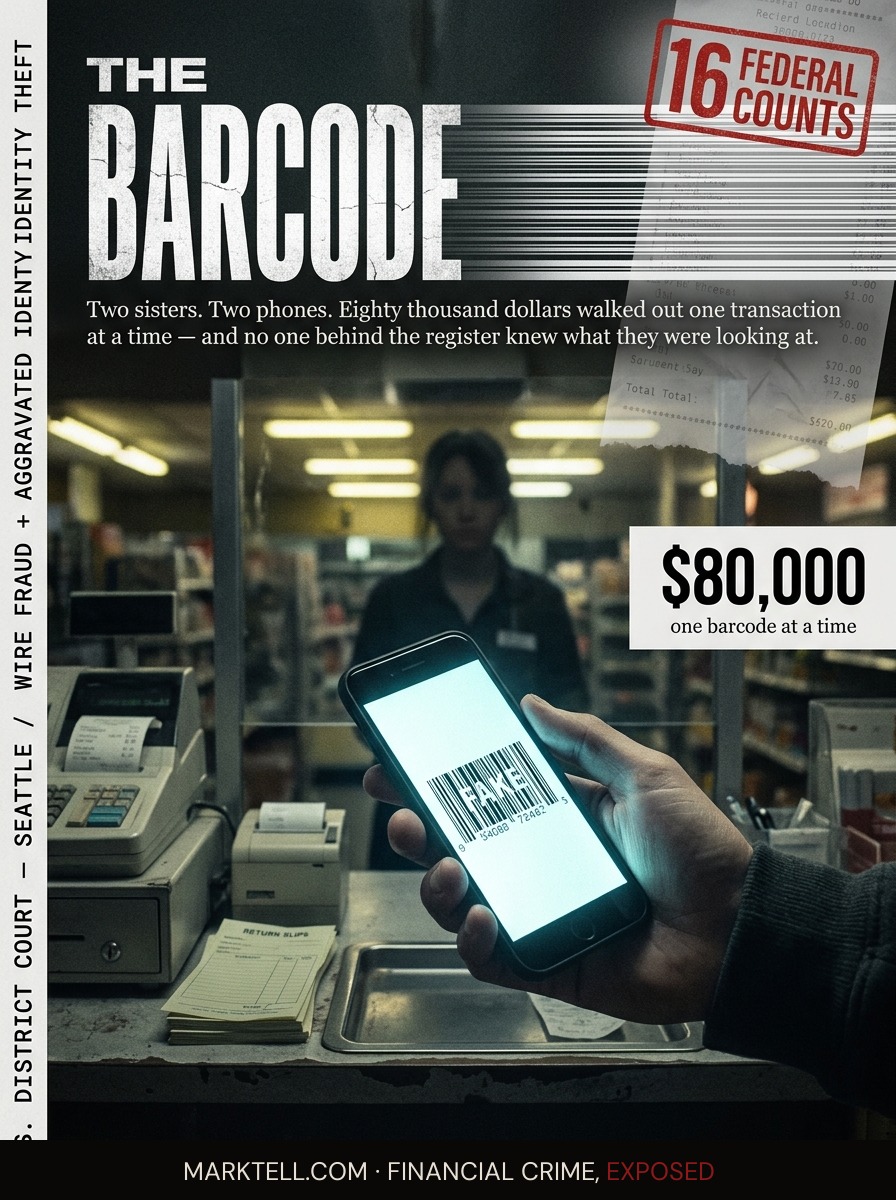
Karen is fifty-eight. She has run the same store for nine years, a national chain location off the freeway in Lynnwood, the kind of place where you can buy a television, a curtain rod, and a bag of dog food in the same trip. She wears the same lanyard every day. She knows which cashier closes the fastest and which one will still be counting drawer at 10:30.
On a Tuesday night in late 2024, she is standing at the return desk after close, going through receipts. The shrink number for her store has been climbing for eighteen months. Not falling off a cliff. Climbing. Two hundred dollars one week. Four hundred the next. Six hundred the week after.
She is not a fraud investigator. She is a store manager. But she has the receipts in her hand and she is looking at them in order, and she sees the same thing she saw last week. A customer paid with a gift card on her phone. The customer came back four days later and returned the item for cash. The customer's signature on the return slip is loose and fast.
Karen does not know yet that the gift card on the phone was never purchased.
She does not know yet that the federal government is about to indict two sisters from Snohomish County on sixteen counts.
She just knows the number on her back office monitor keeps climbing and somebody upstairs is going to ask her why.
I.
The federal indictment was unsealed in U.S. District Court in Seattle in June 2026. Ashley Brown, 34. Amanda Brown Lundquist, 30. Sisters. Sixteen counts. Wire fraud and aggravated identity theft, with an additional charge against Amanda for unlawful possession of a firearm. Her prior felony convictions prohibit her from owning one.
Both sisters pleaded not guilty. That is where the legal posture sits. Indicted. Charged. Not convicted. Allegation is not adjudication.
According to the indictment, the scheme ran from 2023 to 2024 across stores in Snohomish, Pierce, and King counties. The total loss to a single unnamed national retail chain: more than $80,000.
That is the number. Eighty thousand. Stop there.
It is not the number that makes this story. It is the size of the number relative to the mechanism. Two people. Two phones. Two years. Eighty thousand dollars walked out of a retail chain one transaction at a time, and the people behind the registers did not know what they were looking at.
II.
This is what the indictment alleges, and you need to read it slowly because the mechanism is the entire story.
The sisters obtained gift card numbers they had not purchased. The indictment does not say where the numbers came from. That is one of the open questions. Stolen at the rack. Bought on a forum. Skimmed from a database. The record does not say.
They loaded those numbers onto their smartphones.
Picture the phone. The wallet app open. The barcode on the screen. The barcode looks identical to a barcode generated by a card someone paid forty dollars for. The cashier scans it. The system reads the number. The number has a balance. The transaction completes.
They bought merchandise. Then they returned the merchandise for cash. Or they sold it to someone else.
That is the loop. That is the entire machine.
A phone. A barcode. A return desk. A cashier who has been on shift for six hours and has a line of four people behind the customer at the counter.
The fine print of how a gift card works is the body disposal plan. The card number is not tied to the person who paid for it. The cashier is not trained to verify that the phone screen represents a paid transaction. The return system processes the cash payout because the original purchase posted. The fraud lives in the gap between when the number was activated and when the chargeback arrives.
Karen sees the chargebacks. She does not see the activation. By the time the loss shows up on her monitor, the customer is in another county, in another store, with another barcode on her phone.
III.
The case also involves stolen debit cards. The indictment alleges the sisters used stolen debit cards to make additional purchases worth hundreds of dollars. At the time of Amanda Brown Lundquist's arrest, according to court filings, she allegedly possessed identity information belonging to several people.
That is the second machine, running parallel to the first. The gift card scheme is the volume play. The debit card and identity information is the inventory. Both feed the same return desk.
This is where the federal government gets interested. An $80,000 loss at a national chain, on its own, does not pull in the FBI. Identity theft does. Aggravated identity theft, under federal law, carries a mandatory two-year consecutive sentence if convicted. That is why the FBI Seattle field office is on the press release. That is why W. Mike Herrington, the Special Agent in Charge, made a statement about holding fraudsters accountable. That is why the ATF is in the file, because of the firearm.
Lynnwood Police Chief Coleman Langdon said the municipal investigation revealed criminal activity beyond a single agency's scope. Translation. They started looking at one woman, in one store, and the trail kept going.
IV.
Karen sees the convergence before the federal government does. She just cannot prove it.
She has the receipts. She has the return slips. She has the security footage of two women, different visits, different stores, same pattern. She has called the chain's loss prevention number three times. She has filled out the form. She has been told they are aware.
The shrink number keeps climbing.
This is what gift card fraud looks like from inside the store. It is not a heist. It is a slow leak. It is one cashier at a time, one transaction at a time, one return at a time. The chain absorbs the loss. The chain charges it back against the store's P&L. The store manager gets the email asking why her numbers are off.
Karen does not get a copy of the indictment. She finds out the way everyone else does. A news article, in June 2026, with the names of two sisters and the number eighty thousand. She reads it on her phone in the break room.
She does not feel vindicated. She feels tired.
V.
This is not an isolated case. The pattern is the story.
In August 2024, Lynnwood Police arrested a different woman, Hayley Natasha Brown, 28, for what they called an elaborate gift card fraud scheme that caused nearly $100,000 in losses to one business and its customers. No relation to the sisters in this indictment, as far as the public record shows. Same county. Same mechanism.
In June 2024, five other Snohomish County sisters were indicted federally on a $1 million scheme that exploited online return policies at a major clothing retailer. They received refunds, often in gift cards. Different machine. Same exit door.
The Federal Trade Commission reported over 41,000 fraud reports involving gift cards and prepaid cards in 2024, with consumer losses of $212 million. That number does not include the losses to retailers. Those losses sit on the chain's books and trickle down to the store level, where Karen explains them to her district manager.
Washington State ranked 11th nationally in scam losses in 2025, with over $458 million reported.
Lawmakers in 22 states introduced at least 30 bills in 2025 targeting gift card fraud. The bills propose criminal offenses for shelf tampering. They propose requirements that merchants post fraud notices near gift card displays. They propose new rules about activation.
None of those bills, if they pass, will get Karen's eighteen months back.
VI.
Here is what to look at. Not the exciting questions. The ugly questions.
When a cashier scans a barcode off a phone screen, what does the system check?
When a return is processed, does the system verify that the original purchase was funded by a card the customer actually paid for?
When identity information for multiple people is found in a single arrest, what happens to those people? Are they notified? Do they get a letter? Or does the case proceed and their names sit in an evidence locker and they never know their information was on a stranger's phone?
The federal indictment will work its way through U.S. District Court in Seattle. The sisters will have counsel. The prosecution will present evidence. A jury or a plea agreement will decide what happened. That is the system working as designed.
The mechanism is not on trial.
The mechanism is in your pocket right now. The wallet app on your phone. The barcode that looks like every other barcode. The return desk that has to move the line.
VII.
Karen is fifty-eight. She closed the store at 10:47 PM on the night the news broke. She turned off the back office monitor. The shrink number was still on the screen when the monitor went black.
The sisters are charged. They have pleaded not guilty. Their case will proceed.
Karen is not in the indictment. Her name is not in the press release. The unnamed national retail chain absorbed the eighty thousand dollars and the FBI got the headline.
She drove home. She did not think about the two women on her security footage. She thought about the cashier she had to write up six months ago for processing a return that turned out to be fraudulent. She thought about whether that cashier had found another job.
That part may be the saddest.
The machine in this case is not a hedge fund. It is not a crypto token. It is a barcode on a phone. It runs the same way every time. It will run again next week, in another county, under another name, with another phone.
Karen will see it first. She always does.
She just cannot prove it until the federal indictment unseals.
- KOMO News | June 2026 | Snohomish County sister duo indicted on $80K gift card, ID theft scam
- U.S. District Court, Western District of Washington | June 2026 | 16-count federal indictment, United States v. Brown and Brown Lundquist
- U.S. Attorney's Office, Western District of Washington | June 2026 | press statements by First Assistant U.S. Attorney Neil Floyd
- FBI Seattle Field Office | June 2026 | statement by Special Agent in Charge W. Mike Herrington
- Lynnwood Police Department | June 2026 | statement by Police Chief Coleman Langdon
- Snohomish County Superior Court | 2019, 2022 | prior felony convictions of Amanda Brown Lundquist
- Federal Trade Commission | 2024 | Consumer Sentinel Network Data Book, gift card and prepaid card fraud statistics
- KOMO News | August 2024 | Lynnwood Police arrest of Hayley Natasha Brown, $100,000 gift card fraud scheme
- DOJ Western District of Washington | June 2024 | indictment of five Snohomish County sisters, $1 million online return fraud
- Washington State Attorney General's Office | 2025 | state scam loss rankings and reporting
Editorial Notice
MarkTell is a true crime publication about financial fraud. Some scenes, dialogue, and sequential details are reconstructed from court filings, enforcement actions, news reports, and public records. Where the public record does not provide exact details, editorial reconstruction is used to convey the documented pattern of events. Names of private individuals may be changed to protect identity. All factual claims are sourced to public documents cited in the Evidence Trail above. MarkTell does not provide investment, legal, or financial advice. Nothing published here constitutes a recommendation to buy, sell, or avoid any investment. Allegations described in active cases have not been adjudicated and defendants are presumed innocent until proven guilty. Readers should conduct their own due diligence before making financial decisions.