Tomas thought he was trading. He was inventory in a room the FCA had already closed.
Nearly 1,700 UK investors filed suit in London's High Court against Binance and Changpeng Zhao, alleging the exchange sold them high-risk crypto derivatives it was never authorized to sell. The claim is £150 million. The pattern is older than that.
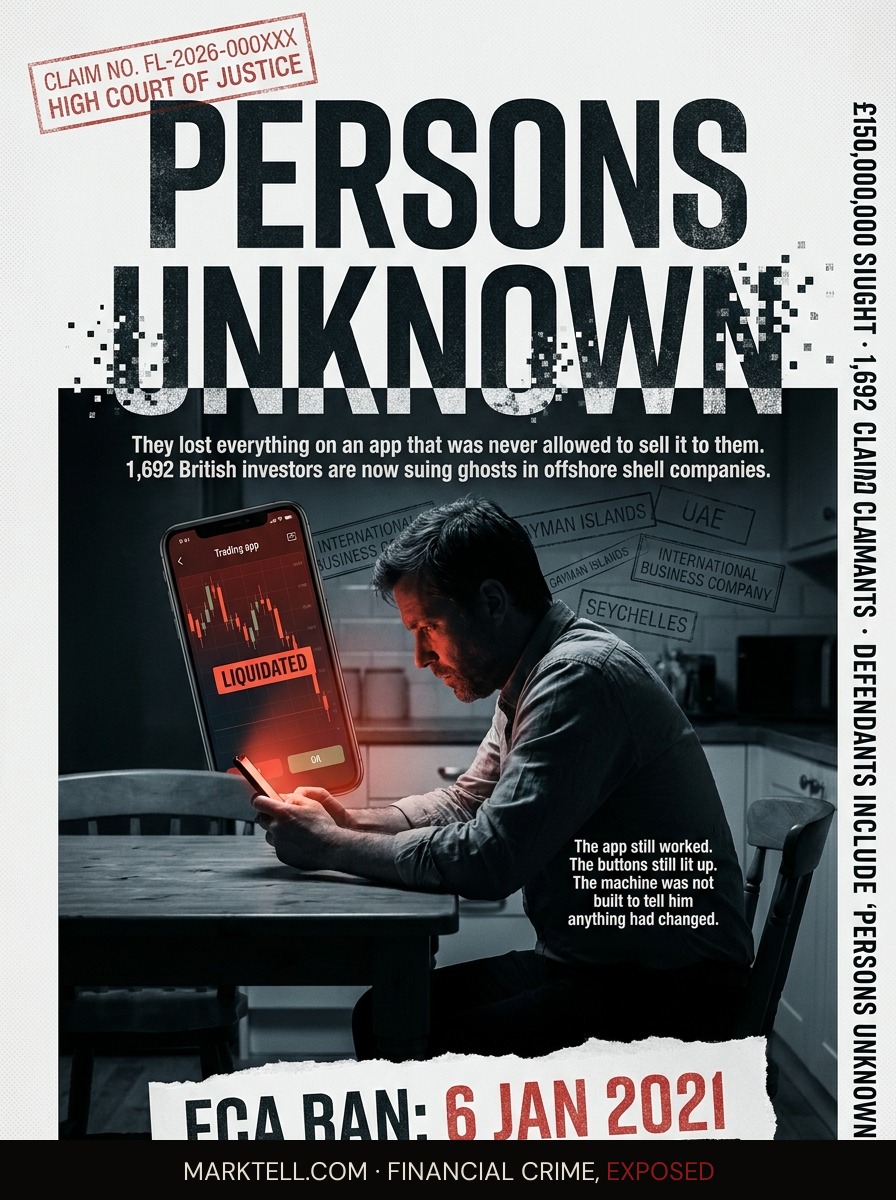
Tomas was 41 and a financial controller and he understood spreadsheets the way a mechanic understands an engine. He had a wife, a mortgage in a commuter town outside London, and the kind of confidence that comes from being the person at every dinner party who could explain compound interest without making anyone feel stupid.
A colleague showed him the app at lunch. Leveraged tokens. Something called BTCUP. You did not have to know futures. You just picked a direction and a multiplier. The colleague had made £2,000 that week. He showed the number on his phone.
Tomas opened an account that night at his kitchen table. The screen glowed. The KYC took under ten minutes. He funded it with £5,000 from a savings account he had built for a loft conversion.
That was late 2020. The FCA banned the retail sale of crypto derivatives on January 6, 2021.
Tomas did not know that. Or if he saw the headline, he did not connect it to the app on his phone, because the app on his phone still worked. The buttons still lit up. The leverage sliders still moved. The prices still ticked. The machine did not tell him anything had changed. The machine was not built to tell him.
By the summer of 2021 he was into it for £40,000. By the end of the year, north of £100,000. He would later be one of nearly 1,700 UK investors named in a claim filed in London's High Court on June 30, 2026. The claim seeks at least £150 million (about $200M USD). The defendants are Binance Holdings Ltd, registered in the Cayman Islands, Nest Exchange, registered in the UAE, Changpeng Zhao personally, and "persons unknown."
Read that last part again. Persons unknown. The claimants know they lost money. They know they lost it on a platform. They do not fully know who they lost it to. That is the whole story compressed into two words in a court filing.
I.
Here is the machine.
A UK retail customer opens an app on a phone in a kitchen in Reading or Manchester or Cardiff. The app is branded Binance. The customer types in their card details. The customer buys a leveraged token, or a futures contract, or an option. The money leaves a British bank account.
The money does not arrive in Britain. It arrives at an entity in the Cayman Islands, or an entity in the United Arab Emirates, or somewhere on a corporate diagram that is legally clean and geographically nowhere. That entity was never authorized by the Financial Services and Markets Act 2000 to sell what it just sold. That is what the claim alleges.
The Financial Services and Markets Act 2000 is the UK law that says: if you want to sell financial products to British people, you need permission from the British regulator. The regulator is the Financial Conduct Authority. The FCA.
Binance Markets Limited, the UK arm, applied for permission. It did not get the permission it needed. In June 2021 the FCA issued a consumer warning stating that Binance Markets Limited was "not permitted to undertake any regulated activity" in the UK without written consent. In May 2023 Binance Markets Limited canceled its FCA permissions entirely.
So the UK entity was not authorized. The Cayman entity was not authorized. The UAE entity was not authorized. And the app kept working.
That is not a bug. That is what an offshore wrapper is.
II.
The renaming.
They call this "jurisdictional flexibility." They call it "a global platform." They call it "serving users where they are."
Give it its real name. It is selling regulated products to people in a country while standing in a country where the regulator cannot reach you. It is the design of a room where the customer walks in through a door in London and the till is in George Town and the manager is on a beach in Dubai.
The FCA ban on retail crypto derivatives took effect January 6, 2021. Leveraged tokens. Futures. Options on crypto. The FCA said: British retail customers cannot be sold these products. Full stop.
The claim alleges the sales continued. Not because the ban did not exist. Because the seller was not in Britain.
That is the machine. That is what 1,692 people are now telling a judge about.
III.
Tomas at his kitchen table, October 2021.
His wife was upstairs. The kids were asleep. He was down £62,000 and he was trying to trade his way out. This is a thing every mark does and every operator counts on. The mark who is losing does not close the app. The mark who is losing opens the app more.
He had a position in a leveraged ether token. Three times long. The price moved against him by four percent. His position lost twelve. The liquidation notification arrived as a small red banner at the top of the screen. He did not have time to close it before the next one arrived on a different position.
He would later describe this to his solicitor as "the machine feeding on itself." He did not know it, but he was describing what the claim would allege.
He did not sleep that night. He sat at the kitchen table until 4 a.m. reading Reddit threads about people who had done the same thing. There were hundreds of them. Thousands. The threads were full of the same story told by different people. A colleague showed me the app. I made money at first. I put in more. Then it went.
Nobody in the threads mentioned that they had been sold something that was not permitted to be sold to them. They blamed themselves. They blamed the market. They blamed leverage. Nobody blamed the room.
IV.
The room.
Binance was founded by Changpeng Zhao, known as CZ, in 2017. By 2021 it was the largest crypto exchange in the world by volume. Its corporate structure was, and remains, difficult to draw on a whiteboard. Entities in the Cayman Islands. Entities in the Seychelles. Entities in the UAE. A holding company here, an operating subsidiary there, a marketing entity in a third place.
In November 2023, Binance pleaded guilty in a US federal court to violations of the Bank Secrecy Act and US sanctions law. The company agreed to pay over $4.3 billion in penalties. CZ pleaded guilty to a criminal charge, resigned as CEO, and served a four-month prison sentence in 2024. He received a presidential pardon in October 2025. He remains the company's largest shareholder.
These are adjudicated facts. Not allegations. Guilty pleas in a US federal court.
The UK claim, filed June 30, 2026 by law firm KP Law on behalf of 1,692 claimants, is a separate matter. It is not adjudicated. It is a claim. Binance has said it will defend against the claims through the appropriate legal process and remains committed to operating in accordance with applicable law.
But look at the sequence. Look at the calendar.
Late 2019 through 2020: the alleged unauthorized sales begin.
January 6, 2021: FCA bans retail crypto derivatives.
June 2021: FCA issues consumer warning against Binance Markets Limited.
May 2023: Binance Markets Limited cancels its FCA permissions.
November 2023: Binance pleads guilty to US federal charges. $4.3B settlement.
2024: CZ serves four months.
October 2025: CZ pardoned.
June 30, 2026: 1,692 UK investors file suit.
The claim is not the beginning of the story. The claim is a receipt being handed to a court five years late.
V.
Hannah Sharp, a partner at KP Law, described the claimants as "ordinary people" who suffered "real financial harm." That is careful lawyer language. It is also true. The individual losses reportedly range into the tens of thousands of pounds. Tomas Sutas, a financial controller named in the claim, allegedly lost over £100,000 (about $130K USD).
Read that job title again. Financial controller. This is a person who does accounting for a living. Who reconciles ledgers. Who understands the difference between a regulated and an unregulated product on a professional level.
The mark is never stupid. The machine is designed to defeat professional caution by making the room feel legitimate. A slick app. A well-known brand. A colleague at lunch. A price that moves in your favor for the first few days. By the time the room starts feeling wrong, the money is already in the Cayman Islands.
VI.
The last week of June 2026 was a busy one for CZ's public statements.
On June 28 he commented on the weak crypto market, blaming AI funding and global tension. On June 29 he said Binance's application for a MiCA license in Greece, which would have allowed regulated EU operations, had been "fully compliant" and near approval before "political forces intervened." Binance withdrew the application and exited Europe on July 1, the day this piece is dated.
That is his framing. Political forces.
On June 30, in a courtroom in London, a claim was filed that says the political forces were regulators doing their jobs and the political problem was that the machine did not want to submit to them.
Both statements cannot be equally true. That is what the High Court is now being asked to sort out.
VII.
Tomas closed the app on his phone in early 2022. He did not delete it. He kept it there because deleting it felt like admitting something he was not ready to admit. He never logged in again.
He told his wife in the spring. She did not shout. She just sat down at the kitchen table where he had done most of the trading and she looked at the surface of it for a long time. The loft conversion did not happen. They refinanced the mortgage. He picked up a second freelance client to catch up.
He heard about the claim from a Reddit post. He filled out the KP Law intake form on a Sunday afternoon in a coffee shop, because he did not want to do it at the kitchen table. He was one of 1,692.
He does not expect to get his money back. He does not know if the judgment, if the claimants win one, will be enforceable against a Cayman Islands entity. He does not know if CZ, pardoned in America and living in the UAE, will feel any pressure from a British court order.
He is not filing to get whole. He is filing so the record shows he was there.
VIII.
Here is what the claim, if it succeeds, could do.
It could establish, in a Western court of record, that a crypto exchange operating through offshore entities is responsible for the products it sells into a regulated jurisdiction. That the wrapper does not protect the seller. That "our servers are in the Caymans" is not a defense when the customer is in Cardiff.
That is why the case matters beyond the 1,692. If the wrapper opens, every other offshore exchange with retail customers in the UK, the EU, Canada, Australia, becomes exposed. The room stops being nowhere. The room becomes somewhere. Somewhere with a regulator.
That is a big if. Binance has said it will defend. The corporate structure is designed to be hard to reach. The claimants have to prove not just that they lost money, but that the entities named are the correct entities, that the products were sold in breach of FSMA 2000, and that CZ personally is liable for what those entities did.
Any one of those is difficult. All three together is a real fight.
IX.
Tomas keeps the Binance app on his phone. Second screen, third page, in a folder called "old."
He opens it sometimes. It still works. The buttons still light up. The leverage sliders still move.
He does not buy anything. He just looks at it. He is not looking at the prices. He is looking at the room. He is trying to see who is in it with him.
That is the whole story. He was never trading with the market. He was trading with the room. And the room was never in his country.
- The Block | July 1, 2026 | "Nearly 1,700 UK investors sue Binance, founder CZ over alleged unauthorized derivatives sales" | https://www.theblock.co/post/406842/uk-investors-sue-binance-cz
- UK Financial Conduct Authority | June 26, 2021 | Consumer warning re: Binance Markets Limited
- UK Financial Conduct Authority | January 6, 2021 | Ban on sale of crypto derivatives to retail consumers
- US Department of Justice | November 21, 2023 | Binance guilty plea, $4.3B settlement
- US Department of Justice | 2024 | CZ sentencing to four months
- KP Law | June 30, 2026 | High Court claim filing, 1,692 claimants, £150M damages sought
- Financial Services and Markets Act 2000 | UK statute
- CZ public statements | June 28-29, 2026 | X/Twitter and press remarks re: Greek MiCA application
Editorial Notice
MarkTell is a true crime publication about financial fraud. Some scenes, dialogue, and sequential details are reconstructed from court filings, enforcement actions, news reports, and public records. Where the public record does not provide exact details, editorial reconstruction is used to convey the documented pattern of events. Names of private individuals may be changed to protect identity. All factual claims are sourced to public documents cited in the Evidence Trail above. MarkTell does not provide investment, legal, or financial advice. Nothing published here constitutes a recommendation to buy, sell, or avoid any investment. Allegations described in active cases have not been adjudicated and defendants are presumed innocent until proven guilty. Readers should conduct their own due diligence before making financial decisions.