The yield was real until it wasn't, and the denial was louder than the loss
Four years after Singapore lending platform Hodlnaut froze 17,513 customer accounts, prosecutors charged its former CEO with six counts of fraud over the Telegram posts that kept the money flowing in after the company had already lost it.
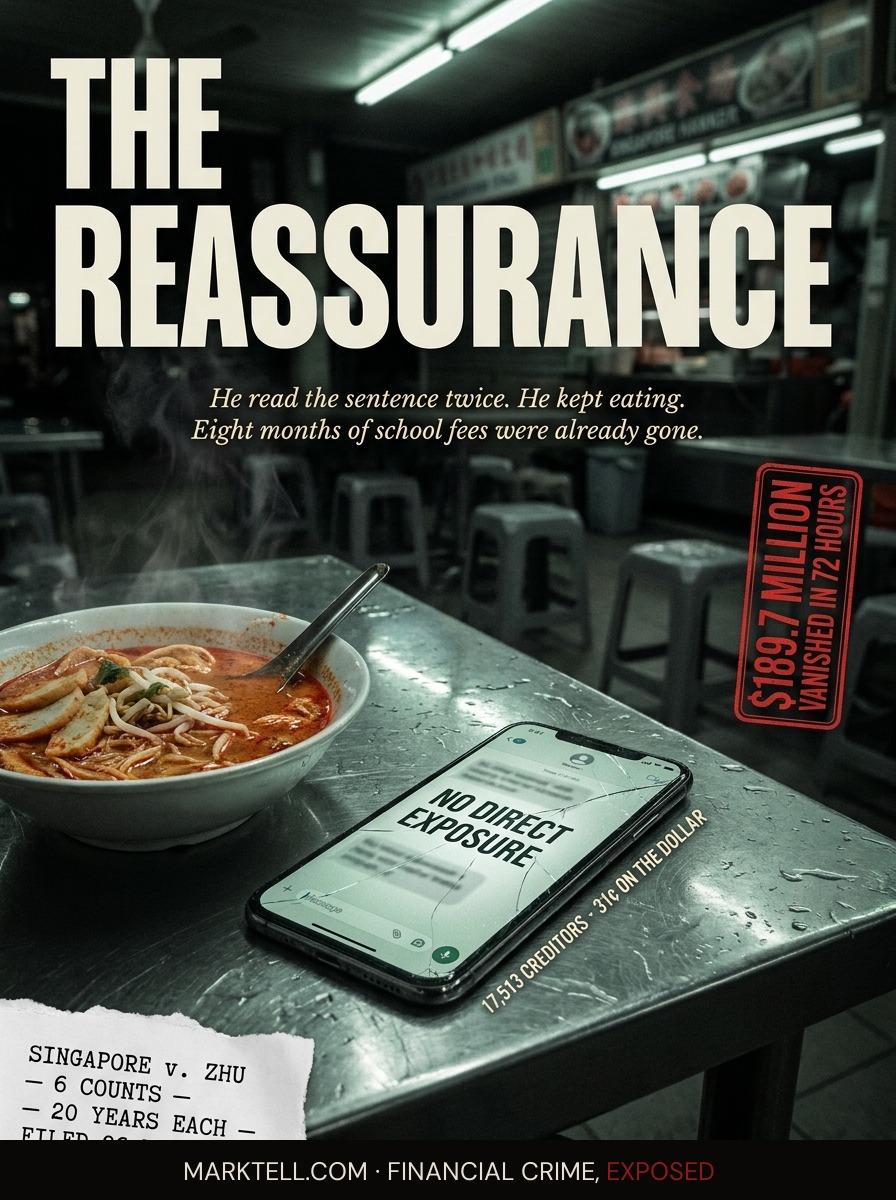
Wei Lin was eating laksa when he read the post that kept his money where it was.
He was forty-two. He worked in logistics, scheduling container ships out of Tuas. His daughter was going into Secondary Two and the fees were already in the family group chat as a running anxiety. He had moved a chunk of the school fund into Hodlnaut eight months earlier because a colleague had shown him the dashboard at lunch one day. Seven and a quarter percent on USDC. USDC is a digital dollar. One token, one dollar, that is the deal. The yield was the part that made his colleague lean across the table.
Wei Lin had not put everything in. He was not a fool. He had put enough that the monthly interest line item felt like a second small salary, and he had told his wife about it in the past tense, after the deposit, when it was already earning.
So in early June 2022, when the news feeds were full of a crashed stablecoin called TerraUSD and a man named Do Kwon and a forty billion dollar hole in the crypto market, Wei Lin opened the Hodlnaut Telegram channel at the hawker center with his spoon still in the bowl. He was looking for a sentence. He found one.
The company said it had no direct exposure to UST. It said the platform had not suffered losses from the crash. He read it twice. He kept eating.
That sentence is now the spine of a criminal case.
On Tuesday, May 26, 2026, Singapore prosecutors charged Zhu Juntao, the thirty-six-year-old former chief executive and co-founder of Hodlnaut, with six counts of fraud by false representation. Each count, if convicted, carries up to twenty years in prison. The charges center on statements posted to Hodlnaut's official channels in June 2022. The state alleges those statements were false. The state alleges Zhu knew they were false. Zhu, through his position so far, disputes the charges.
This piece is not about the trial. The trial has not happened. This is about the machine those statements were attached to, and what the machine did to people like Wei Lin while the statements kept it running.
I.
Hodlnaut launched in 2019 as a lending platform. You sent it your crypto. It sent you yield. The pitch was clean and the website looked clean and the Singapore address was real. By May 2022, it was managing roughly $750 million in customer assets across more than thirty thousand users.
Here is where the money actually went, according to the judicial managers and subsequent filings. Hodlnaut took customer deposits, including stablecoins like USDC and USDT, and converted a large portion of them into TerraUSD. TerraUSD, or UST, was a stablecoin that held its dollar peg through an algorithm and a sister token called Luna, not through reserves. The reason to hold UST was a protocol called Anchor, which paid roughly twenty percent annual yield on UST deposits. Twenty percent. On something that was supposed to be a dollar.
If you have ever worked in this industry, you knew what that was. It was not a yield. It was a subsidy, paid out of a foundation reserve, designed to grow adoption. The math did not close. Anybody who looked at the spreadsheet for ten minutes could see the spreadsheet did not close.
Hodlnaut put $317 million of customer-linked funds into UST. When UST de-pegged in May 2022 and collapsed to pennies inside seventy-two hours, Hodlnaut lost $189.7 million. That figure is from the judicial managers' filings.
That is the loss that, the prosecution alleges, the June 2022 Telegram post was written to hide.
II.
Picture the room that post came out of. We do not have the room. The judicial managers have spent four years building a record of where the money was, not what the office smelled like. But we have the public posts, and we have the timeline.
In June, the company told the public it was untouched.
In July, between the fourteenth and fifteenth, customers pulled $150 million out anyway. That is a run. People did not believe the post. Or they believed it and got nervous anyway. Either way, money walked.
On August 8, 2022, Hodlnaut suspended withdrawals, swaps, and deposits. It cited "recent market conditions." It withdrew its application for a Major Payment Institution license from the Monetary Authority of Singapore, the country's central bank and main financial regulator. It laid off roughly forty staff, eighty percent of the company.
On August 16, it filed for judicial management, which is Singapore's version of court-supervised restructuring. The judicial managers, two partners at EY, started counting.
Here is what they found, in numbers Wei Lin would later read in a creditors' notice on a Saturday morning in his living room. Liabilities of 391 million Singapore dollars, about $281M USD. Assets of 122 million Singapore dollars, about $88M USD. A capital shortfall of $193 million. An asset-to-debt ratio of 0.31. Thirty-one cents on the dollar, before legal fees.
17,513 creditors.
Read that number slowly. Each one of them is a Wei Lin.
III.
Wei Lin tried to withdraw on August 8 at 11:47 PM Singapore time. The button did not work. He thought it was the app. He killed it, restarted his phone, tried again. He went to the website. The notice was already up. Withdrawals suspended.
He did not tell his wife that night. He sat in the kitchen with the lights off and tried to count what he had in there. He counted twice. He got a different number both times because his hands kept opening and closing the calculator.
In November 2022, the Singapore Police Force, through its Commercial Affairs Department, opened a criminal investigation into Hodlnaut and its directors. In January 2023, creditors rejected a restructuring proposal and voted for liquidation, meaning they wanted the company sold for parts rather than rebuilt under the same management. On November 10, 2023, the High Court of Singapore ordered Hodlnaut wound up. The EY partners stopped being judicial managers and became liquidators. They are still doing that work today.
The charges filed Tuesday name Zhu specifically. They also reference a man named Goh Chang Teck, whom prosecutors allege Zhu instigated to post some of the misleading Telegram statements. The co-founder and CTO, Simon Lee, is not named in the charge sheet released so far.
The June 2022 statements are the crime scene the prosecutors are working. Not the UST trade itself. Not the Anchor strategy. Not the decision, made somewhere in 2021, to chase the highest yield on the menu with other people's money. Those decisions were catastrophic. They may have been reckless. But Singapore is not, at least in this filing, prosecuting the trade.
Singapore is prosecuting the sentence that came after the trade, the sentence that told users the trade had never happened.
IV.
That distinction matters, and it matters most for the next platform.
The lending platform model that Hodlnaut, Celsius, Voyager, Vauld, and BlockFi all ran in 2021 and 2022 is not a model anyone got right. The yield came from somewhere. The somewhere was usually a leveraged position, an undercollateralized loan, or a subsidized protocol like Anchor. When the somewhere broke, the yield stopped. When the yield stopped, the deposits left. When the deposits left, the platform was insolvent. That is not a fraud. That is a maturity mismatch, the same structural problem that has killed banks for four hundred years.
The fraud, where there is one, is in the gap. It is the window between when management knew the trade had failed and when management told the customers.
In Hodlnaut's case, the prosecution alleges that window opened in May 2022 and that the company filled it with reassurance instead of disclosure. The reassurance kept some deposits in. New deposits may have come in. Old customers who were trying to leave may have stayed. Each one of those decisions was a person at a hawker center reading a sentence on their phone.
That is the machine. Not the yield product. The reassurance layer bolted to the yield product. The communications team, the founder's Telegram account, the carefully worded blog post on a Friday afternoon. The pitch that the audit is fine, the exposure is zero, the platform is strong. The pitch is louder than the loss because the pitch is what keeps the loss from being recognized.
If you are reading this and you have money in a yield platform right now, the ugly question is not whether the yield is too good. You already know the answer to that question. The ugly question is what the platform's statements looked like the last time something in its sector broke. Did they go quiet? Did they post the reassurance? Did they say no exposure?
Save the screenshots. The prosecution four years from now will want them.
V.
Wei Lin got a notice in late 2023 with a number on it. The notice told him what percentage of his deposit he might eventually recover. The number was lower than he had been telling his wife.
He had told her thirty cents on the dollar, doing the rough math himself. The notice said it could be less, depending on asset recovery from FTX, where another $13 million of Hodlnaut funds had been trapped when that exchange collapsed in November 2022. The Hodlnaut money was inside another collapsed machine. There were creditors inside the creditors.
His daughter went to a different secondary school than the one they had planned. The fees were lower. She did not ask why. He told her it was closer to home. That part may be the part he thinks about most.
On Tuesday in a Singapore courtroom, six charges were read aloud. Zhu Juntao stood and indicated he was not guilty.
The trial, when it happens, will turn on what he knew and when he knew it. The prosecution will introduce the June 2022 Telegram post. The defense will say it was a reasonable statement based on the information available at the time. A judge will decide.
Wei Lin will not be in that courtroom. He does not know Zhu. He never met him. He read one sentence Zhu's company posted, and he believed it for sixty-three days.
The sentence is what got charged. The machine that needed the sentence to keep running is still legal.
It is being rebuilt right now under other names.
- AsiaOne | May 26, 2026 | "Ex-CEO of Singapore-based crypto platform Hodlnaut charged with fraud"
- Hodlnaut Interim Judicial Managers' Reports | EY Corporate Advisors Pte. Ltd. | 2022-2023
- High Court of Singapore | November 10, 2023 | Liquidation order, Hodlnaut Trading Ltd.
- Monetary Authority of Singapore | August 2022 | Withdrawal of MAS license application
- Singapore Police Force, Commercial Affairs Department | November 2022 | Investigation announcement
- Hodlnaut official Telegram channel | June 2022 | Statements on UST exposure (referenced in charging documents)
- FTX bankruptcy filings | November 2022 | Schedule of customer accounts including Hodlnaut exposure
Editorial Notice
MarkTell is a true crime publication about financial fraud. Some scenes, dialogue, and sequential details are reconstructed from court filings, enforcement actions, news reports, and public records. Where the public record does not provide exact details, editorial reconstruction is used to convey the documented pattern of events. Names of private individuals may be changed to protect identity. All factual claims are sourced to public documents cited in the Evidence Trail above. MarkTell does not provide investment, legal, or financial advice. Nothing published here constitutes a recommendation to buy, sell, or avoid any investment. Allegations described in active cases have not been adjudicated and defendants are presumed innocent until proven guilty. Readers should conduct their own due diligence before making financial decisions.