The word "sharia" sat on the website like a seal. The seal was the lock.
Police in Jakarta have detained a former Financial Services Authority executive in the PT Dana Syariah collapse, a sharia-branded peer-to-peer lender that prosecutors allege ran fictitious projects to raise Rp 2.4 trillion ($147M USD) from more than eleven thousand lenders. The man who once helped write the rules sat on the company's masthead.
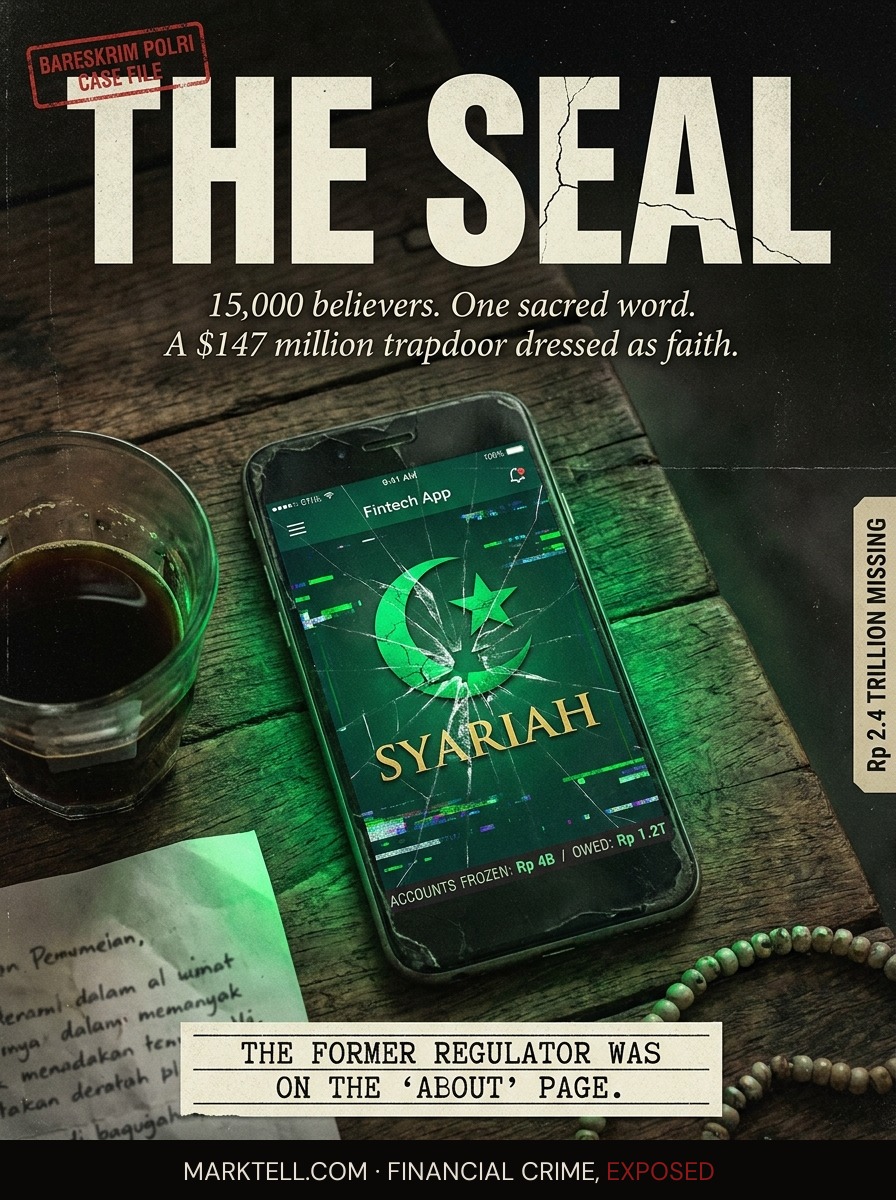
Indah is forty-four. She teaches eighth-grade mathematics at a public school in Bandung. The chair in her kitchen is plastic, the kind that flexes when she leans back, and on a Tuesday morning in June 2025 she is sitting in it with a cup of kopi tubruk going cold and her phone in her right hand.
She opens the app. Green icon. White crescent. The word at the top of the screen is the word that made her trust it: Syariah.
Her father had saved for forty-one years driving a delivery truck for a textile company. When he died in 2022, what he left her was Rp 340 million ($21K USD) in a savings account and a note in his handwriting telling her not to touch anything haram with it. She had taken that seriously. She had asked her cousin, who worked at a bank, what to do. Her cousin mentioned DSI. A sharia-compliant peer-to-peer lending platform. Real projects. Real borrowers. Returns up to eighteen percent a year. Licensed by OJK.
OJK is the Financial Services Authority. That is the agency in Indonesia that supervises banks, insurance companies, and fintech platforms. Being licensed by OJK is supposed to mean someone in a government office has looked at your books.
Indah looked at the website. There was a man on the About page. He had been a director at OJK. Now he was an advisor at DSI. She remembers thinking that this was the strongest possible signal. The regulator was inside the company. The company was being watched by people who used to do the watching.
She invested Rp 280 million ($17.5K USD) across what the app called "projects." A housing development in Bekasi. A small business in Surabaya. The dashboard showed photos. The dashboard showed schedules. The dashboard showed her money working.
On that Tuesday in June 2025, the schedule was still ticking. The dashboard was still green.
The dashboard was a screenshot of nothing.
I.
PT Dana Syariah Indonesia launched as a sharia-based peer-to-peer lender. Peer-to-peer lending is a model where ordinary people put money into a platform, and the platform routes that money to borrowers who need loans. The lender earns interest. The platform takes a fee. In Indonesia, OJK regulates these platforms.
"Sharia-based" means the product is structured to comply with Islamic law. No interest in the conventional sense. No investment in alcohol, gambling, or pork. The contracts use Arabic terms. The returns are framed as profit-sharing on real economic activity.
For a Muslim saver in Indonesia, the sharia label is not marketing. It is the difference between a permissible income and a sinful one. The label does work that no other label can do.
DSI used the label as its front door.
According to the OJK's own timeline, the platform operated from 2018 through 2025. Police investigators say it raised Rp 7.478 trillion ($446M USD) from lenders between 2021 and 2025 alone. The total alleged fraud envelope, according to Bareskrim Polri, the National Police Criminal Investigation Agency, is Rp 2.4 trillion ($147M USD). The number of lenders is reported between 11,151 and 15,000.
Read that slowly. Fifteen thousand people. Most of them Muslim. Most of them choosing DSI specifically because they did not want to choose something else.
II. THE GHOST PROJECTS
Here is what police allege happened on the back end of the app Indah was looking at.
DSI had real borrowers. A peer-to-peer lender needs them. The borrowers came in, submitted documentation, requested financing.
According to the investigation, DSI took the data from those real borrowers and used it to spin up additional projects that did not exist. The names were real. The photos were real. The contracts on the app were fiction.
PPATK, the Financial Transaction Reports and Analysis Center, identified the structure as a sharia-based Ponzi scheme. The money from new lenders paid the returns of old lenders. The "projects" were the wrapper.
Bareskrim Polri alleges that Rp 796 billion ($47M USD) was channeled to affiliated companies, and another Rp 218 billion ($13M USD) to individuals or other affiliated entities. The destinations were not housing developments in Bekasi or small businesses in Surabaya. The destinations were inside the same network as the people running the platform.
When PPATK froze 33 DSI-linked accounts beginning December 18, 2025, the combined balance was approximately Rp 4 billion ($240K USD).
Outstanding to lenders: approximately Rp 1.2 trillion ($72M USD).
Do the math. The accounts held about one third of one percent of what was owed.
III. THE MAN ON THE ABOUT PAGE
On June 19, 2026, Bareskrim Polri detained Fitri Hadi for an initial twenty days. He is the fifth suspect named in the case. According to police, he was a founder and advisor of DSI and a nominee shareholder without capital contribution. According to police, he actively recruited investors.
His resume before DSI is the part that matters.
From 2014 to 2017, he served as Director of Operational and Information System Facilities at OJK. From 2017 to 2018, he served as Director of the Digital Financial Innovation Group at OJK. Between 2018 and 2022, he was Director of Information Technology and Risk Management at the Indonesia Stock Exchange.
The man who allegedly helped build the inside of a fictitious-project Ponzi had spent the previous decade inside the institution responsible for catching fictitious-project Ponzis.
He is the fifth suspect. The others, per Bareskrim Polri:
Taufiq Aljufri, CEO and shareholder, detained February 10, 2026.
Ade Rizal Lesmana, Commissioner and shareholder, detained February 10, 2026.
Mery Yuniarni, former Director and shareholder, reported at large due to illness.
AS, founder and former Director from 2018 to 2024, named a suspect April 2, 2026.
Allegation is not adjudication. None of these cases has been tried. But the chronology of the company and the chronology of Fitri Hadi's regulatory career sit next to each other on the page, and the reader can see what the reader can see.
IV. THE DASHBOARD AND THE DOOR
Indah did not stop checking the app right away. She kept checking through July. Through August. The schedule kept ticking. Then a project she had funded showed a delayed payment. Then another. Then the support chat stopped answering.
In October 2025, OJK imposed Business Activity Restrictions on DSI. That meant the platform could not accept new funding or issue new financing. In the language of the regulator, it was a freeze. In the language of a Ponzi, it was the moment the new money stopped covering the old money.
In November 2025, OJK opened a formal audit after lender complaints piled up. By December, PPATK was freezing accounts. By February 2026, two of the most senior people at the company were in custody.
Indah heard about it from a WhatsApp group of DSI lenders that had formed in September. She read the news in Indonesian and then in English to make sure she was reading it right. She read about fictitious projects. She read about a former OJK director listed as a founder.
She went back to the About page on the website. The man was still there.
The label was still there too. Syariah. Soft gold banner. The word that had told her the money was clean.
V. WHAT THE LABEL WAS DOING
This is the part of the chapter that is uncomfortable to write because the people who were exploited here were exploited through their faith.
The sharia label in Indonesian fintech is a trust accelerator. It compresses the due diligence step. A saver who would normally ask about audited financials and risk disclosure asks instead whether the contract is compliant. If it is compliant, the rest of the questions get smaller. The label is doing the work the questions used to do.
DSI's alleged scheme did not invent this. It rode it. The promised returns of up to 18 percent per annum were framed as profit-sharing on real ventures. The fictitious projects were dressed in sharia contract language. The man from the regulator was on the About page.
The label was the lock on the door. The lock looked official because the locksmith used to work for the city.
A lawmaker, Marwan Jafar, has called for an internal audit of OJK to examine how the supervision failed. On June 24, 2026, OJK issued new rules requiring financial influencers to obtain licenses or certifications to recommend financial products. These are downstream responses. They are not retrieval of Rp 1.2 trillion.
VI. INDAH'S KITCHEN, JUNE 2026
She still has the plastic chair. She still teaches eighth-grade math.
The Rp 280 million is not coming back. The accounts have Rp 4 billion against Rp 1.2 trillion in claims. Even if every rupiah in those accounts went to lenders pro rata, Indah's share would be roughly enough to buy a tank of fuel.
She has not told her mother. Her mother thinks the inheritance is in a savings account at a bank she trusts. Indah has decided to let her think that for as long as she can, because the money her father saved across forty-one years of driving a textile truck was supposed to mean something, and the something it was supposed to mean cannot survive the sentence she would have to say out loud.
That part may be the saddest.
The dashboard on her phone has not updated since June 2025. The "project" she funded is still showing on schedule. The schedule is still green. The screenshot is still nothing.
The word at the top of the screen is still the word that made her trust it.
The lock is still on the door. The door does not open onto anything anymore.
The man from the About page is in custody. The machine he allegedly helped build raised more money in four years than the GDP of a small country. The accounts it left behind would not cover a month of the school's electricity bill.
Indah closes the app.
She does not delete it. Not yet. There is a part of her that is still waiting for the dashboard to tell her something true.
That is the part the machine was built to find.
- Indonesia Business Post | June 2026 | "Police detain former OJK executive in US$147 million PT Dana Syariah fraud case"
- Bareskrim Polri statements via Brig. Gen. Ade Safri Simanjuntak | February-June 2026 | reported in Indonesia Business Post
- OJK (Otoritas Jasa Keuangan) | October 15, 2025 | Business Activity Restrictions (PKU) imposed on PT Dana Syariah Indonesia
- PPATK (Financial Transaction Reports and Analysis Center) | December 18, 2025 | account freezing actions on 33 DSI-linked accounts
- OJK regulatory action | June 24, 2026 | new rules on financial influencer licensing
- Public statements by lawmaker Marwan Jafar | 2026 | call for OJK internal audit
- Fitri Hadi public career record | OJK (2014-2018), Indonesia Stock Exchange (2018-2022)
Editorial Notice
MarkTell is a true crime publication about financial fraud. Some scenes, dialogue, and sequential details are reconstructed from court filings, enforcement actions, news reports, and public records. Where the public record does not provide exact details, editorial reconstruction is used to convey the documented pattern of events. Names of private individuals may be changed to protect identity. All factual claims are sourced to public documents cited in the Evidence Trail above. MarkTell does not provide investment, legal, or financial advice. Nothing published here constitutes a recommendation to buy, sell, or avoid any investment. Allegations described in active cases have not been adjudicated and defendants are presumed innocent until proven guilty. Readers should conduct their own due diligence before making financial decisions.