The word he used was safe. The fund was a coffee shop, a mine, and a Ponzi.
Vincent Camarda built A.G. Morgan Financial Advisors in a Massapequa storefront and steered at least $138 million of his clients' retirement money into a Philadelphia Ponzi, a western mining bet, and his son's coffee startup. On April 3, 2026, he pleaded guilty.
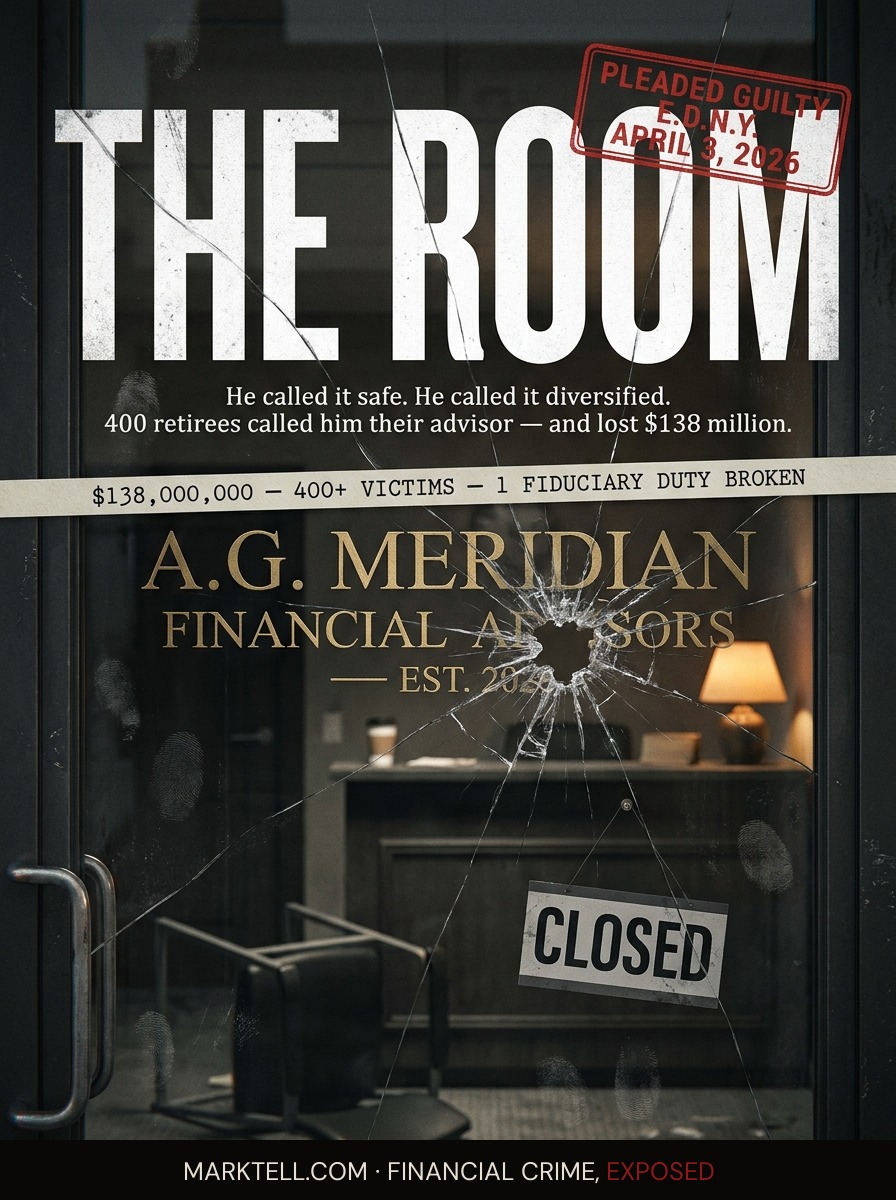
The office sat on a stretch of Sunrise Highway in Massapequa, the kind of address a retired bus driver could find without GPS. Glass door. Firm name in serif lettering. A reception area with a coffee machine and a bowl of wrapped mints. A.G. Morgan Financial Advisors. The name sounded like a bank that had been there a hundred years. It had not. Vincent Camarda founded it. He was the CEO. He was, for many of the clients who walked through that door, the only adviser they ever met.
Picture the client. Call her Margaret. She is a composite, but she is not invented. The federal record describes more than 400 of her, many of them elderly, most of them on Long Island, most of them with retirement money they had spent forty years saving in small amounts. She sits across the desk from Camarda. He is in his late fifties at the time, dressed well, comfortable. He uses three words. Safe. Low-risk. Diversified. She signs.
That is the first scene. Hold it.
I.
I sold over the phone for years. Metals, magazines, small-cap shares in a company that did not really make the thing it said it made. I know what the words safe and diversified do to a person who is afraid of losing what they have. The words are not a description. They are a sedative. They are designed so the client stops asking questions and starts signing pages. Camarda was not selling on a phone in a back room. He was selling across a desk in a town where his name was on the glass. That is a different kind of room. The trust is heavier. The signature is faster.
According to the U.S. Attorney's Office for the Eastern District of New York, between January 2017 and December 2024, Camarda steered at least $138 million of client money into private investment funds he created and controlled. The funds had names that sounded like funds. AGM Capital. Windsor Capital. Omni Diversified. The last one had the word built into it.
Read the names slowly. They are doing work. They sound like the kind of vehicle a fiduciary would use to spread risk. They were the opposite.
II.
Here is where the money actually went.
Some of it went to Philadelphia, to a company called Par Funding, which the SEC charged in 2020 as an unregistered securities offering tied to a Ponzi scheme. Camarda and A.G. Morgan had already been charged by the SEC in 2022 in connection with that $500 million offering. According to the SEC, A.G. Morgan was itself in debt to Par Funding and did not disclose this to its clients.
Some of it went west, to a high-risk mining venture called Millennium Holdings. Camarda received commissions on those placements, according to the SEC's 2026 civil complaint. The clients were not told.
And some of it went to a coffee shop. Buzz'd Express Coffee. A startup. Owned by his son.
Read that again. Retirement savings. Owned by his son.
Approximately $1 million was taken directly, the criminal information alleges, and spent on luxury goods, plastic surgery, vacations, and jewelry. That part of the file is almost ordinary. It is the line every one of these stories has. The mark's twenty years of overtime becoming someone else's weekend.
III.
The thing the machine sells is not the investment. The machine sells the room.
The room in Massapequa had a desk and a chair and a man behind it who knew the names of his clients' grandchildren. The room had certificates on the wall and a firm name with the word Financial Advisors in it. The room had a chief compliance officer, James E. McArthur, who is now named in the SEC's parallel civil case filed April 3, 2026. McArthur, the SEC alleges, served as president and chief compliance officer while the scheme ran. FINRA has suspended him for failing to pay arbitration awards. He has not been criminally charged. Allegation is not adjudication.
But the room. The room is the product. The room is what makes a 71-year-old widow believe that the word diversified means what the dictionary says it means. The room is what makes her not call her son before she signs. The room is what costs her the house if she had been planning to leave one.
IV.
The machine became visible the way these machines always do. Slowly, then all at once.
In September 2023, according to the criminal information, Camarda began telling clients that he did not have the money to pay them back. He blamed a Texas business associate named Anthony Zingarelli. The Texas guy did it. The Texas guy lost it. That is the story he told.
In early 2024, the mining company defaulted. The coffee shop defaulted. The principal did not come back.
Investors lost approximately $123 million in unreturned principal, the criminal filing states. FINRA arbitration panels have already awarded more than $16 million in judgments to 22 of those clients. Camarda has not paid them. That is why FINRA suspended him.
On April 3, 2026, Vincent J. Camarda, 62, of Amityville, walked into federal court in the Eastern District of New York and pleaded guilty to one count of securities fraud and one count of investment adviser fraud. He agreed, as part of the plea, to pay at least $160 million in restitution and $6.6 million in forfeiture. He was released on a $1 million unsecured bond. Sentencing is scheduled for August 12, 2026. The maximum exposure is twenty years on the securities count and five on the adviser count.
The same day, the SEC filed civil charges against Camarda, against A.G. Morgan Financial Advisors LLC, and against McArthur, alleging the $138 million scheme.
V.
Now go back to Margaret at the desk.
She is not stupid. She walked into a registered investment adviser's office on a commercial street in a town she has lived in for forty years. She asked the questions a person is supposed to ask. She got the answers a fiduciary is supposed to give. The man across from her had a legal duty, under federal law, to put her interests ahead of his own. That is what a fiduciary is. That is the whole job.
He did not. According to his own guilty plea, he did not.
That part may be the saddest. Not the coffee shop. Not the plastic surgery. The fact that the system she trusted was the system that took her, and that the words it used to take her were the words she had been told all her life to listen for.
Safe. Low-risk. Diversified.
Three words on a Long Island morning. $138 million on the other end of them.
The storefront is closed now. The plea is on the record. The sentencing is on the calendar. The machine is visible.
The next one will have a different name on the glass.
- U.S. Attorney's Office, Eastern District of New York | April 3, 2026 | Press release and criminal information re: Vincent J. Camarda guilty plea
- U.S. Securities and Exchange Commission | April 3, 2026 | Civil complaint against Vincent J. Camarda, A.G. Morgan Financial Advisors LLC, and James E. McArthur
- U.S. Securities and Exchange Commission | 2022 | Prior charges against Camarda and A.G. Morgan related to Par Funding offering
- FINRA | arbitration awards and suspensions of Camarda and McArthur
- Newsday | May 2026 | "Massapequa financial adviser Vincent Camarda pleads guilty to fraud"
Editorial Notice
MarkTell is a true crime publication about financial fraud. Some scenes, dialogue, and sequential details are reconstructed from court filings, enforcement actions, news reports, and public records. Where the public record does not provide exact details, editorial reconstruction is used to convey the documented pattern of events. Names of private individuals may be changed to protect identity. All factual claims are sourced to public documents cited in the Evidence Trail above. MarkTell does not provide investment, legal, or financial advice. Nothing published here constitutes a recommendation to buy, sell, or avoid any investment. Allegations described in active cases have not been adjudicated and defendants are presumed innocent until proven guilty. Readers should conduct their own due diligence before making financial decisions.