The woman he loved was never on the other end of the line
A New Jersey man pleaded guilty to running a romance fraud that emptied $416,155 from a single Ohio victim under the guise of a dying woman and a fake doctor begging for hospital money. The machine ran on a name, a photograph, and the word "urgent."
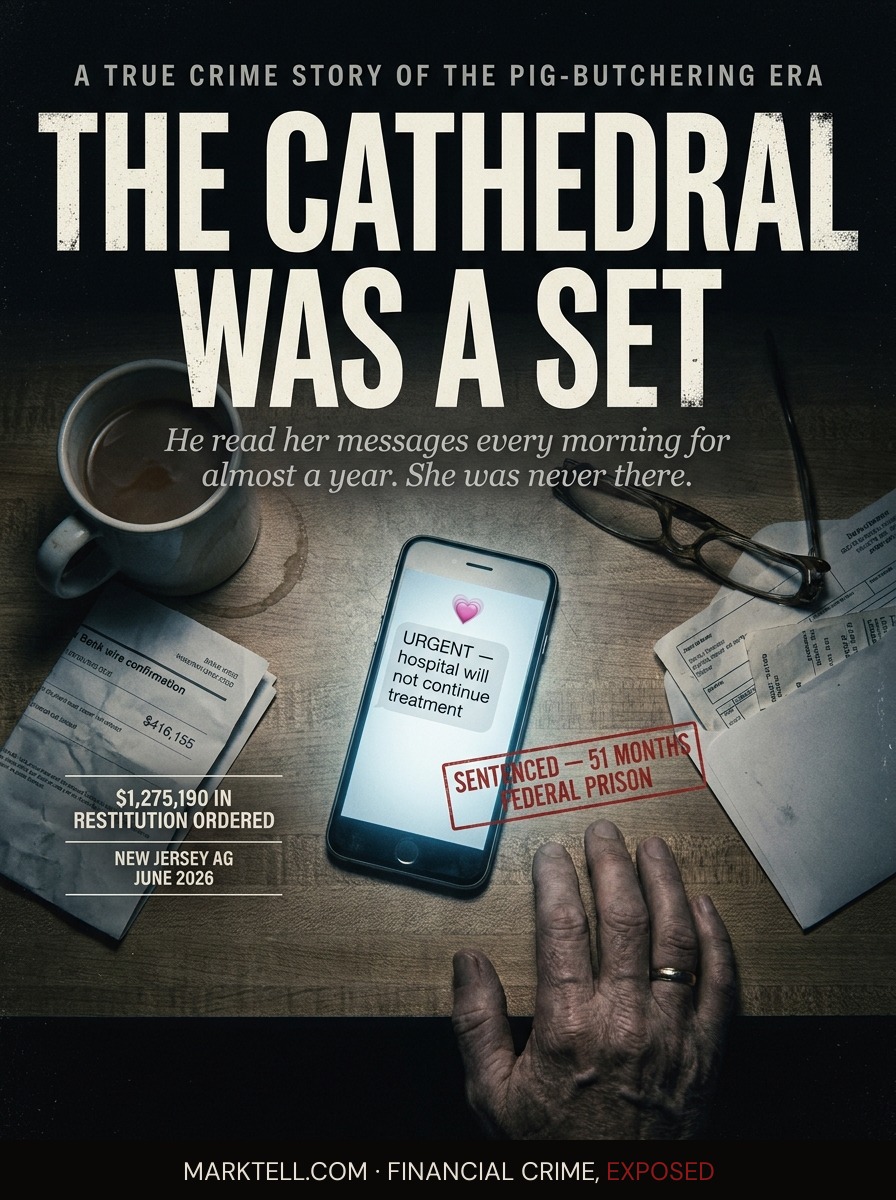
Raymond was already up at five. He was sixty-seven and he was always up at five. The house outside Dayton had gone quiet three years before, when his wife went into the hospital on a Tuesday and did not come home, and now the silence had its own schedule. Coffee. The radio low. The phone face-up on the counter next to the toaster.
The phone was where she lived.
He had not met her. He understood, in the part of his mind that still kept its receipts, that he had not met her. But he had read her messages every morning for almost a year. He knew the names of her brothers. He knew she liked tea, not coffee. He knew she worked overseas on a contract she could not talk about, which was why the video calls never quite happened, which was why the meeting in Cleveland kept getting moved.
He also knew, that morning, that she was dying.
The message had come in overnight. It was not from her. It was from a man who signed his name Dr. Ben Levy. The doctor used short sentences. He used the word urgent. He said the hospital would not continue treatment without payment and that Raymond was the only contact she had listed. He attached what looked like a bill.
Raymond read it twice. He read it a third time. Then he opened his banking app.
This is the part that is hard to write without flinching. Because the man at the counter was not stupid. He had run a line at a parts plant for thirty-one years. He balanced his checkbook by hand. He knew, the way anyone who has ever been sold anything knows, that the world is full of people asking for money under false names.
But he was not being asked by a stranger. He was being asked by her. And the doctor was just the messenger.
He sent the first wire that morning.
I.
The machine that ran Raymond did not need a website. It did not need a token. It did not need a conference room or a pitch deck or a celebrity endorsement. It needed two characters and a phone.
According to the New Jersey Attorney General's office, the man behind both characters was Kenny Osas Okuonghae, 38, of New Jersey. He pleaded guilty. He was sentenced in June 2026 to more than 51 months in federal prison. The court ordered him to pay $1,275,190 in restitution.
Read that number again. $1,275,190.
The Ohio man identified in court papers as Victim 1, the man whose chair Raymond is sitting in, lost $416,155 of it. The rest was other people. Other kitchens. Other phones face-up on other counters at five in the morning.
The script Okuonghae ran has a name now. The FBI and FTC call the family of frauds pig butchering, a translation from the original Mandarin term used by the criminal networks that industrialized it. The phrase is ugly because the work is ugly. You fatten the victim with affection, with attention, with the slow construction of a person who exists only on a screen. Then you slaughter the account.
The classical version of the scheme ends with a fake crypto trading platform. Okuonghae used the older variant. The dying woman. The hospital. The doctor on the side begging for funds to keep her alive.
The FTC reported in 2023 that twenty-four percent of romance scam victims were told a story about a medical emergency. It is the oldest hook because it works. The mark is not being asked to invest. The mark is being asked to save a life.
II.
Raymond sent the second wire eight days after the first. The doctor had written again. The treatment was working but the hospital needed more. There were new specialists. There was a procedure. The doctor's English was a little off in places and Raymond had noticed that, the way you notice a stone in your shoe, and he had filed it under the explanation she had already given him months earlier about her being on a job in a place where the doctors learned English second.
The wires came out of his savings first. Then his checking. Then a line of credit he opened at the credit union, telling the woman at the desk it was for a kitchen remodel because he could not bear to say out loud what it was actually for.
The total, when the federal prosecutors put it on paper, was $416,155.
Picture that money leaving in pieces. Not one wire. Many. Each one with its own confirmation slip. Each slip folded and put in a junk-drawer envelope because Raymond did not want to look at them but could not bring himself to throw them away.
This is the part of the machine the press release never quite captures. The fraud is not the wire. The fraud is the year before the wire. The fraud is the architecture of trust built one message at a time until the request for money does not feel like a request. It feels like a privilege. He was the only person she had listed.
The doctor was a prop. The hospital was a prop. The woman was the cathedral.
III.
The thing that finally cracked it is the thing that almost always cracks it. Somebody else looked at the screen.
In the public record we do not know exactly how Victim 1 came to law enforcement. The court papers do not narrate that morning. What we know is that at some point the doctor stopped writing, or the wires stopped clearing, or a son visiting for a weekend picked up his father's phone and read three messages and went very still.
Nobody outside that kitchen has seen what that moment looked like. Not really. But we know what those moments look like in general because there are tens of thousands of them. The FBI's Internet Crime Complaint Center logged $672 million in confidence and romance fraud losses in 2024 across 17,910 complaints. The FTC counted $1.14 billion in 2023. In February 2026, the UK bank TSB reported romance fraud losses up 37 percent year over year.
This is not a rare crime. This is a category.
The moment of recognition has a shape. The mark looks at the screen and sees, for the first time, that the person on the other end has no past outside the screen. No phone number that anyone else has called. No friend who has met her. No employer who can confirm her contract. The cathedral is a set. The set has a back side. And the back side is plywood.
For Raymond, the back side was plywood the day a federal agent called him and used the phrase the suspect.
The suspect.
Not she. Not he. The suspect. One person.
IV.
What the New Jersey AG's office laid out in the plea is the part that should be taped to every refrigerator in America.
Okuonghae was not a woman. Okuonghae was not Dr. Ben Levy. Okuonghae operated both characters. The woman wrote the love. The doctor wrote the bill. They were the same hand on the same keyboard in the same room in New Jersey. The conversation Raymond thought he was having between two people was a monologue. He was the only other voice in it.
This is the move worth naming. The two-character script is not new and it is not crude. It is the oldest closing technique in any boiler room. You put a second voice on the line because a second voice creates the illusion of a witness. The pitcher and the closer. The salesman and the manager. The girlfriend and her doctor.
In the metals rooms in the eighties we called it the turnover. You handed the phone to a second guy who was sitting two desks down and the customer felt better because now there were two of us telling him the same thing. We were the same machine. The customer thought he had verification. He had choreography.
Okuonghae's choreography ran in text instead of voice. The woman handled the trust. The doctor handled the close. Raymond never thought to ask why he had never spoken to either of them on a live call because by the time the doctor arrived, asking that question would have felt like an insult to her.
V.
Raymond sat at the kitchen table after the agent's call and did not move for a long time.
He had not lost a fund. He had not lost a stock. He had lost a person who had never existed, and the loss of a person who never existed is a particular kind of loss because there is nobody to bury and nothing to forgive. The woman did not betray him. The woman was the betrayal. There is no version of this where he gets to be angry at her, because she was the hand that wrote the doctor.
The chair across the table is empty in the way it has been empty for three years. The phone is face-up on the counter. The bank app shows the balance it shows.
$416,155 is recoverable on paper. Restitution was ordered. Restitution is a number a court writes down. The actual money has been moved through accounts, converted, withdrawn, dispersed across a network the public filings only partially describe. The restitution order in this case totals $1,275,190 against one defendant sentenced to a little over four years. Do the math on what the hourly recovery rate looks like from a federal prison.
That part may be the saddest. Not that he sent the money. That the money is gone in a way the legal system can name but not undo.
VI.
If you are reading this because someone you love has a person on their phone you have never met, here is what to look for. Not the exciting questions. Not the television questions. The ugly questions.
Has anyone else ever spoken to her on a live video call. Not a photograph. Not a recorded clip. A live call where her face moves when your father's face moves.
Has anyone outside the phone confirmed she exists. An employer. A friend. A passport. A flight record. A hospital that will take a call from outside.
Has the first request for money arrived yet. If not, it is coming. If it has, it will not be the last. The medical emergency is the most common variant because it is the most immediate, but the structure underneath is the same: a crisis only you can solve, on a timeline that does not allow for verification.
Has a second character entered the conversation. A doctor. A lawyer. A customs official. A bank officer. The second character is the closer. The second character is always the closer. The second character is the same hand.
This is the part the machine cannot survive. The machine needs the mark to never ask the people in his own house. The machine dies the moment a son picks up the phone.
VII.
Raymond's phone is still on the counter. The messages stopped the day the federal agent called. He has not deleted them. He has not blocked the number. He scrolls them sometimes, the way a widower scrolls a voicemail he should have erased years ago.
He told the agent he understood. He told his son he understood. He told the woman at the credit union he understood when he went in to close the line of credit.
He did not understand. He is sixty-seven and he had built, in the silence of a house that had gone quiet on a Tuesday three years before, a person who wrote to him every morning. A federal court has now told him that the person was a 38-year-old man in New Jersey running a script.
The script worked because Raymond was not stupid. The script worked because Raymond was a person, and the machine was built to feed on persons.
There is no woman in the hospital.
There never was a hospital.
The doctor and the woman were the same hand, and the hand has been sentenced, and somewhere tomorrow morning a different hand will start writing to a different kitchen at five in the morning, and the phone will be face-up on the counter, and the coffee will be on, and the silence will be in its chair.
That is the machine. It has been arrested. It has not been stopped.
- People.com | June 2026 | "Man Sent $416,000 to Woman He Met Online to Help Cover Her Medical Costs. She Doesn't Exist"
- New Jersey Attorney General's Office | June 2026 | Plea and sentencing of Kenny Osas Okuonghae, 38, New Jersey, 51+ months federal prison, $1,275,190 restitution
- Federal Trade Commission | 2023 | Romance scam consumer loss report, $1.14 billion across 64,003 reports; medical-emergency pretext cited in 24% of reports (2022 data)
- FBI Internet Crime Complaint Center (IC3) | 2024 Annual Report | $672 million in confidence/romance fraud losses, 17,910 complaints
- TSB Bank UK | February 2026 | Romance fraud analysis, 37% loss increase year over year, 15% case increase
- Moody's | 2024 | Identification of 1,193 new global entities with potential romance scam ties
Editorial Notice
MarkTell is a true crime publication about financial fraud. Some scenes, dialogue, and sequential details are reconstructed from court filings, enforcement actions, news reports, and public records. Where the public record does not provide exact details, editorial reconstruction is used to convey the documented pattern of events. Names of private individuals may be changed to protect identity. All factual claims are sourced to public documents cited in the Evidence Trail above. MarkTell does not provide investment, legal, or financial advice. Nothing published here constitutes a recommendation to buy, sell, or avoid any investment. Allegations described in active cases have not been adjudicated and defendants are presumed innocent until proven guilty. Readers should conduct their own due diligence before making financial decisions.