The woman at the door had a clipboard. The cash was already in the envelope.
A Manatee County retiree took a photograph of the woman who came to collect her envelope. That photograph unwound a courier network that had been moving cash across Florida for over a year.
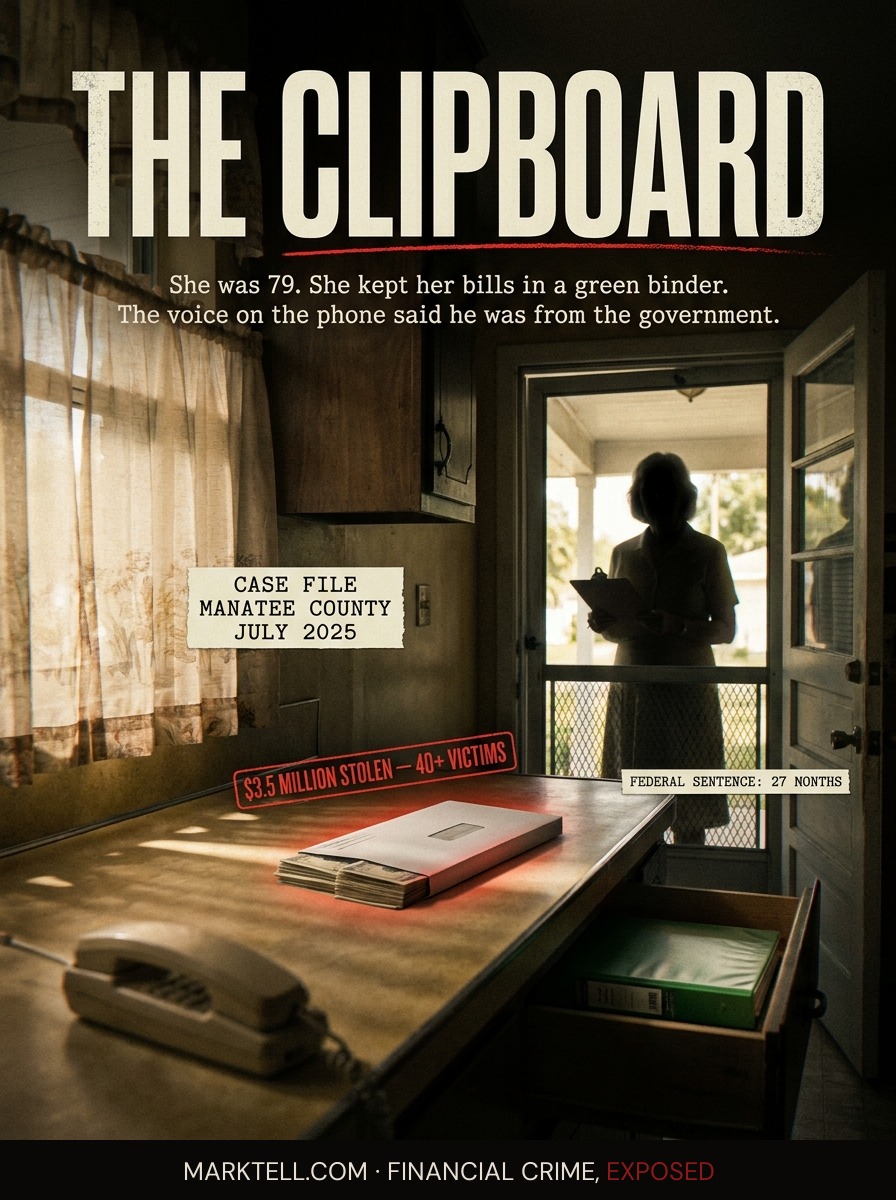
Eleanor was seventy-nine and she kept her utility bills in a green vinyl binder in the drawer next to the kitchen phone. She had worked as a bookkeeper for thirty-one years and she still balanced her checkbook by hand on the first of every month. The kitchen was clean. The phone was a beige cordless from a hardware store on Manatee Avenue. The drawer stuck a little because the house had settled.
The call came on a Tuesday afternoon.
The man on the other end said he was with the Federal Trade Commission. He knew her name. He knew the last four digits of her checking account. He knew which bank. He said her identity had been compromised and that a federal account had been opened in her name to protect her assets while the investigation was running. He used the word "protect" the way a good salesman uses the word "safe." He used it three times in the first minute.
He told her not to talk to anyone at the bank. He told her the bank had been infiltrated. He told her a courier would come to her door, a federal employee, and that the courier would bring her cash to a secure facility where it would sit until the case closed.
Eleanor wrote it all down on the back of the electric bill. She was a bookkeeper. She wrote things down.
The envelope sat on the counter for two hours before the knock came.
II.
The Manatee County Sheriff's Office opened the file in July 2025 because a different Manatee resident, on a different street, did the one thing the script does not account for. He looked out the window. He saw a woman get out of a car he did not recognize. He took a photograph of the woman and a photograph of the car and the license plate. Then he called the sheriff.
The woman in the photograph was Xin Liu, forty, a Chinese national. According to the United States Attorney for the Northern District of Florida, Liu traveled across Florida in July 2025 attempting to collect more than $95,000 in cash from elderly victims. She was the hand at the door. She was not the voice on the phone.
On June 23, 2026, a federal judge sentenced Liu to twenty-seven months in federal prison.
The MCSO investigation that grew out of the photograph eventually documented more than forty elderly victims across the state of Florida and total losses north of $3.5 million. One seventy-nine-year-old Manatee County woman, according to the Sheriff's Office, lost more than $200,000 to a cryptocurrency variant of the same script. Same voice on the phone. Different envelope.
III.
Picture the room on the other end of the call.
We have not seen it. Nobody outside the operation has seen it. Not really. But the shape of it is in the record. A phone room. Scripts. A list of names with addresses and bank fragments attached. A way to spoof the caller ID so the number on Eleanor's handset reads like a government office. A second list, the courier list, of people who can be in Bradenton by Wednesday and in Sarasota by Thursday.
The phone room is the factory. The courier is the truck.
The factory makes fear. The truck picks up the cash.
This is the part the FBI Jacksonville Special Agent in Charge, Jason Carley, called a betrayal of trust. He said it at the announcement. He is right, but he is also being polite. The trust is the product. The trust is what the factory is built to manufacture and the courier is built to harvest. When the voice on the phone says Federal Trade Commission, the trust is already in the envelope before the courier arrives.
IV.
Back in the kitchen.
The knock came at the time the man on the phone said it would come. Eleanor opened the door. The woman on the porch was polite. She was holding a clipboard. She asked Eleanor to confirm her name. Eleanor confirmed her name. The woman took the envelope. The woman did not count it on the porch. That was a kindness. Counting cash on a porch would have looked wrong. The woman put the envelope in a bag and walked back to her car and drove away.
Eleanor went back inside and sat in the chair by the kitchen phone and waited for the next call from the man at the FTC, who had told her he would call back within the hour to confirm the funds were safe.
He did not call back within the hour.
He did not call back that day.
She called the number she had written on the back of the electric bill. It rang and nobody answered. She called it again. She called the actual Federal Trade Commission, the one in Washington, and the woman who answered explained that the FTC does not call people. The FTC does not send couriers. The FTC does not take cash.
The binder of utility bills was still in the drawer. The drawer still stuck.
V.
The pattern is older than the phones. Treasury Department impersonations were running in the 1960s. IRS impersonations ran the eighties and nineties. The Federal Trade Commission version is newer because the FTC's name carries a softer authority. It sounds protective. The Treasury sounds like men in suits. The IRS sounds like a bill. The FTC sounds like the agency that is on your side.
That is why they picked it.
The U.S. Attorney's office, announcing Liu's sentencing, flagged the rise of elder fraud schemes operated in part by foreign nationals working as couriers. The Department of Justice has been saying it for two years. The FBI's Internet Crime Complaint Center reported that Americans aged sixty and older lost $4.9 billion to fraud in 2024. That is the floor. The ceiling, by some estimates, is closer to $28 billion a year.
Read that slowly. Four point nine billion is what the victims reported. Most do not report. They are embarrassed. They are afraid their children will take the checkbook. They sit at the kitchen table and they do not say anything and the number stays out of the file.
VI.
Eleanor's number is not in the public file because Eleanor is a composite. But the binder is real. The drawer is real. The script is real. The forty-plus victims in the MCSO file are real and the $3.5 million is real and the photograph the neighbor took of Xin Liu's car is real and that is what cracked the case.
A man with a window. A woman with a camera. A cop who took the call seriously.
That is the part the operators cannot script around. The script assumes the neighbor is not looking. The script assumes the victim is alone. The script assumes the courier gets back in the car and the car gets back on I-75 and the cash gets handed up the chain and nobody ever connects the voice on the phone to the woman at the door.
Most of the time, the script is right.
VII.
Liu got twenty-seven months. She was the hand. She was not the voice. The voice is still on a phone somewhere, working from a script that has been edited slightly since the arrest, and the list of names is still being cross-referenced with bank fragments, and another courier is being dispatched to another address in another county this afternoon.
The factory is still running.
The truck just got a new driver.
Eleanor sat in the chair by the kitchen phone for a long time that evening. She did not call her son. She did not call the bank. She put the green vinyl binder back in the drawer and she closed the drawer and the drawer stuck a little, the way it always did.
The man on the phone had used the word protect three times in the first minute.
He had meant it the way the courier meant the clipboard.
- WFLA News Channel 8 | June 25, 2026 | MCSO investigation uncovers $3.5M statewide elder fraud ring
- U.S. Attorney's Office, Northern District of Florida | June 23, 2026 | Sentencing announcement for Xin Liu
- Manatee County Sheriff's Office | June 25, 2026 | Press announcement on statewide elder fraud ring investigation
- FBI Internet Crime Complaint Center (IC3) | 2024 Elder Fraud Report | $4.9B in losses reported by Americans 60+
- FBI Jacksonville | June 23, 2026 | Statement of Special Agent in Charge Jason Carley
- Florida Department of Elder Affairs | June 2026 | Statement of Secretary Michelle Branham
Editorial Notice
MarkTell is a true crime publication about financial fraud. Some scenes, dialogue, and sequential details are reconstructed from court filings, enforcement actions, news reports, and public records. Where the public record does not provide exact details, editorial reconstruction is used to convey the documented pattern of events. Names of private individuals may be changed to protect identity. All factual claims are sourced to public documents cited in the Evidence Trail above. MarkTell does not provide investment, legal, or financial advice. Nothing published here constitutes a recommendation to buy, sell, or avoid any investment. Allegations described in active cases have not been adjudicated and defendants are presumed innocent until proven guilty. Readers should conduct their own due diligence before making financial decisions.