The wire went out on a Tuesday. The house went with it.
A federal jury in South Carolina convicted Demani and Tanya Bosket this week in a transnational email-compromise ring that drained more than $25 million from people in the middle of the largest transactions of their lives. The pitch was not a pitch. It was a forwarded thread.
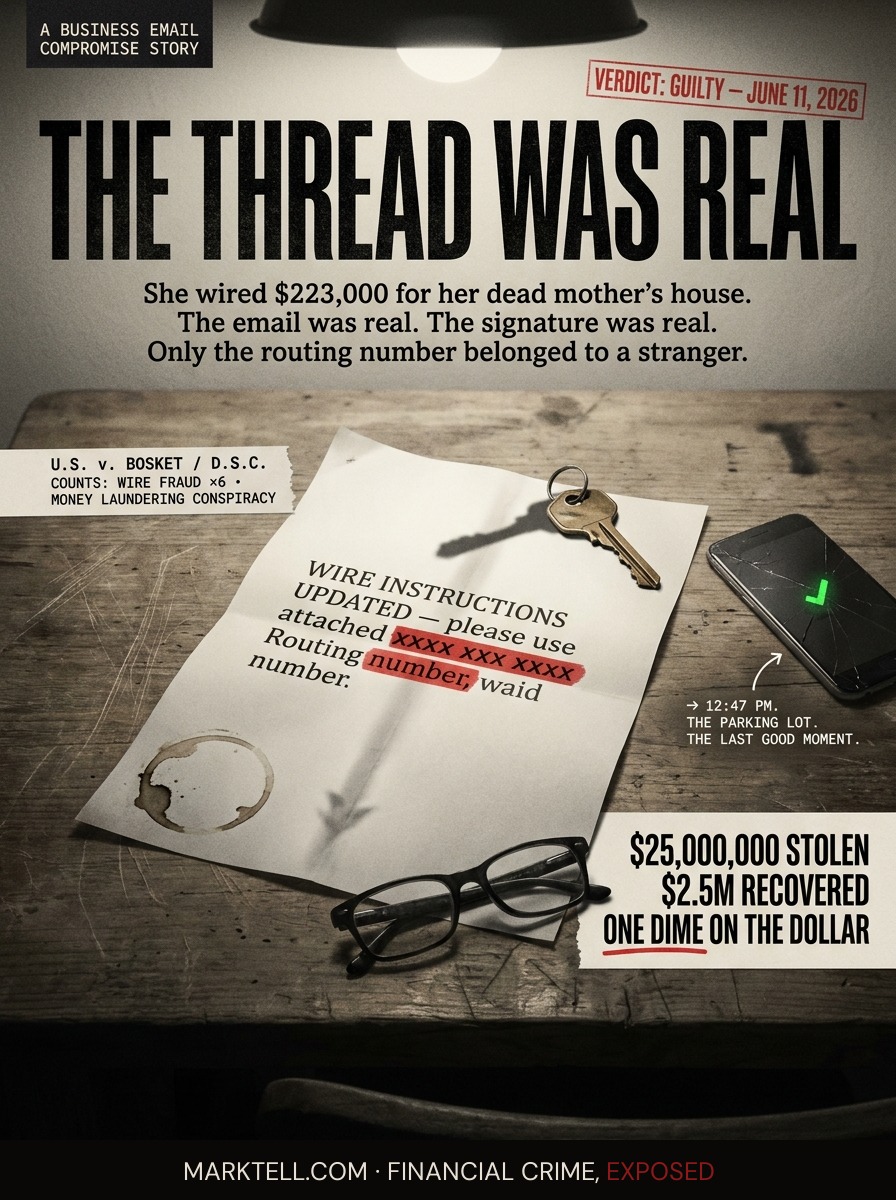
Marcia was sixty-two and a week into being an orphan when the email came in.
It came in on a Tuesday morning, the way real emails come in, slotted between a coupon from CVS and a reminder about a dental cleaning. The subject line had the file number on it. The file number was correct. The attorney's name in the signature was correct. The thread underneath, when she scrolled, was the thread she had been on for six weeks. Her replies were in there. The paralegal's replies were in there. The inspector's PDF was in there.
The email said the wiring instructions had been updated. It said please use the attached. It said sorry for the late change and confirmed the closing was still on for Thursday.
Marcia printed it. She always printed the important ones. She put the printout next to the closing statement on the kitchen table, the same kitchen table where her mother had sat through chemo, the same kitchen table where the will had been read out loud by a cousin who cried more than Marcia did.
She drove to her credit union at lunch. She handed the printout to the woman behind the desk. She wired $223,000.
The little green checkmark came up on her phone on the way back to the car.
That is the part you have to picture. Not the courtroom. Not the indictment. The green checkmark in the parking lot of a credit union in suburban Charlotte, and a woman who thought she had just bought back her childhood.
I. The thread
This is what the Department of Justice says happened, in cases like Marcia's, more than two hundred and twenty-three thousand times over.
Between 2020 and 2024, a transnational ring stole more than $25 million from businesses and individuals across the United States. They did it by getting inside email accounts. Not customer accounts. Business accounts. Closing attorneys. Title companies. Vendors. Lenders. People who move other people's money for a living.
Once they were inside, they read. They did not steal anything at first. They watched. They learned the rhythm of a real estate closing or an inheritance transfer or a vendor payment. They learned the names. They learned the signature blocks. They learned which days the wires usually went out.
Then, at the moment when the money was about to move, they sent one email. Same thread. Same signature. New routing number.
That is the machine. There is nothing else to it.
The federal name for the machine is Business Email Compromise. BEC. It does not require a hack of your bank. It does not require malware on your computer. It requires patience, and an inbox that somebody, somewhere, did not protect well enough.
II. The mules with company names
A foreign operator with a stolen routing number is a man holding a gun he cannot fire. The money has to land somewhere in the United States. It has to land in an account at a real bank, with a real name on it, that a real human can walk into a real branch and drain.
That is where the Boskets come in.
According to the U.S. Attorney for the District of South Carolina, Demani Jawara Bosket, 51, of Saluda, was the U.S. side of the operation. He recruited people. One of the people he recruited was his niece, Tanya Lashawn Bosket, 53, of Charlotte.
Tanya's job, the record says, was to register sham businesses and open bank accounts in their names. Not real businesses. Names on a page. A registered agent, an EIN, a checking account, a debit card. Enough paperwork to make a wire look like it had landed somewhere normal.
When Marcia's $223,000 left her credit union, it did not land at a closing attorney. It landed at an LLC nobody had heard of two months earlier, at a bank branch nobody at her closing had ever set foot in.
Demani Bosket, the government says, directed what happened next. Runners pulled cash. Runners bought cashier's checks. The money moved out of the receiving account and into other accounts the same day, sometimes within hours, layered through enough names that by the time anyone at Marcia's credit union picked up the phone, there was nothing on the other end of the wire but a closed account and a shrug.
The Secret Service has recovered about $2.5 million of the more than $25 million the ring took. Read that ratio slowly. One dollar in ten.
III. The seventh day
The jury in Columbia heard seven days of it. The wires. The shell LLCs. The cashier's checks. The bank surveillance footage. The co-conspirators who had already pleaded out and were now sitting in the witness chair explaining how they got recruited.
On June 11, 2026, the jury came back.
Demani Bosket: guilty on conspiracy to commit wire fraud, conspiracy to commit money laundering, and six counts of wire fraud. Up to thirty years.
Tanya Bosket: guilty on conspiracy to commit wire fraud, conspiracy to commit money laundering, and four counts of wire fraud. Up to twenty years.
U.S. Attorney Bryan Stirling called it "a sophisticated transnational fraud ring that stole more than $25 million from victims across the country." Donald Eakins of IRS Criminal Investigation said the Boskets "siphoned more than $25 million from victims across the country, exploiting trust, technology, and the financial system for personal gain."
Both of those statements are true. Neither of them is the story.
The story is that the people in the U.S. courtroom are the bottom of the food chain. The people who read Marcia's email thread for six weeks were not in that courtroom. They were not charged. They are probably not in the United States. They are probably still reading somebody else's email thread right now.
IV. What Marcia held
Marcia found out on Thursday. The closing attorney called her at 10:14 in the morning to ask why the wire had not arrived. He used a polite, slightly puzzled voice. The voice people use when they think there has been a clerical mistake.
Marcia said she had sent it on Tuesday. She said she had used the new instructions.
There was a silence on the other end of the call that she would think about, later, as the moment her chest understood before her head did. The attorney asked her, slowly, what new instructions.
She held the printout in her hand. The file number was correct. The signature was correct. The thread underneath was the thread.
That part may be the saddest. The document she was holding looked exactly like what it was pretending to be, because it had been built on top of what it was pretending to be. She had not been tricked by a stranger. She had been tricked by her own correspondence.
The house her mother had left her went back on the market. Marcia did not buy it. Somebody else did.
V. The ugly question
If you are reading this because you are about to wire money, here is the ugly question. Not the exciting one. Not the one in the bank's training video.
The ugly question is this. If your closing attorney emails you new wire instructions, the email itself proves nothing. The thread proves nothing. The signature proves nothing. The PDF letterhead proves nothing. The reply-to address proves nothing.
The only thing that proves anything is a phone call to a number you already had, before any of this started, dialed by you, to a person whose voice you have heard before.
That is it. That is the whole defense. One phone call to a number you wrote down before the wire instructions ever existed.
The Boskets are convicted. The machine is not. The people who sat inside the inbox are still sitting inside somebody's inbox. The shell LLC will be opened again next week under a different name in a different state by somebody Demani Bosket has never met.
Marcia got a letter in the mail last month with a case number on it. The Secret Service has recovered about a dime on the dollar. Her share, if it comes, will not buy back the house.
She still has the printout. She keeps it in the top drawer of the kitchen desk, the way her mother used to keep the important papers. She is not sure why she keeps it. She does not look at it.
She just knows that the thread was real. That is what she cannot get past.
The thread was real. The wire was real. The checkmark was green.
Only the routing number had a stranger's hand on it.
- U.S. Department of Justice, District of South Carolina | June 11, 2026 | Press release announcing convictions of Demani Jawara Bosket and Tanya Lashawn Bosket
- U.S. Attorney Bryan Stirling, statement on verdict | June 11, 2026
- Donald "Trey" Eakins, Special Agent in Charge, IRS Criminal Investigation Charlotte Field Office | statement on verdict | June 11, 2026
- WLTX / WYFF News 4 reporting | June 11-12, 2026
- U.S. Secret Service, investigative agency on the recovery of approximately $2.5M
- FBI IC3 background materials on Business Email Compromise (general definitional context)
Editorial Notice
MarkTell is a true crime publication about financial fraud. Some scenes, dialogue, and sequential details are reconstructed from court filings, enforcement actions, news reports, and public records. Where the public record does not provide exact details, editorial reconstruction is used to convey the documented pattern of events. Names of private individuals may be changed to protect identity. All factual claims are sourced to public documents cited in the Evidence Trail above. MarkTell does not provide investment, legal, or financial advice. Nothing published here constitutes a recommendation to buy, sell, or avoid any investment. Allegations described in active cases have not been adjudicated and defendants are presumed innocent until proven guilty. Readers should conduct their own due diligence before making financial decisions.