The Windermere house was the receipt. The investors were the down payment.
Federal prosecutors are moving to seize seven homes and eleven vehicles allegedly bought with money from more than 1,000 investors who believed Christopher Delgado was running a crypto liquidity pool. Court filings say almost none of the $328 million ever reached a pool.
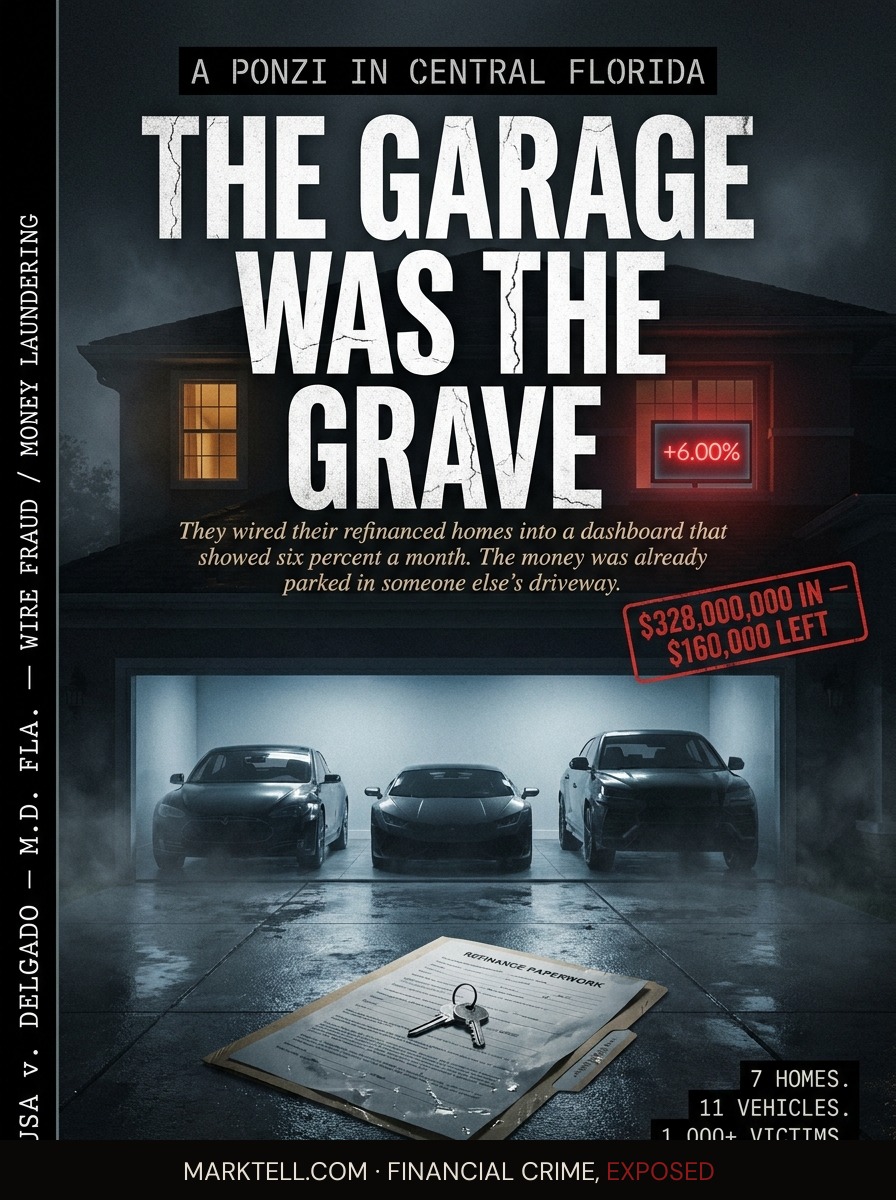
Marisol kept the refinance paperwork in a manila folder on the kitchen table for three weeks before she signed it. She is fifty-eight. She has been a pediatric nurse in Kissimmee for nineteen years. The folder sat under a fruit bowl, and every time she moved the bowl to wipe the table she looked at the folder and then put the bowl back.
Her cousin had shown her his Goliath Ventures statements at a christening. Six percent. A month. He pulled it up on his phone between the cake and the photos. She watched him scroll. The numbers were there. The login worked. The withdrawal he had taken in October cleared into his checking account in two days.
She signed the refinance in November. She wired ninety-four thousand dollars to an account whose routing number she copied twice to make sure she had it right. The confirmation email came back inside an hour. The first monthly credit appeared on the dashboard in December.
Six percent. Credited. She took a screenshot and sent it to her sister.
That was the pool. That is what they called it. A cryptocurrency liquidity pool, which is a phrase that means, in plain English, a pot of digital money that sits behind a trading screen and earns fees when other people trade against it. Liquidity pools are real. Some of them pay yields. None of them pay six percent a month, every month, for three years, to a thousand retail investors in Central Florida. The math does not work. It has never worked. It was not working here.
Here is what federal prosecutors say was actually happening.
From January 2023 through January 2026, Christopher Alexander Delgado, thirty-four, the CEO of a company first called Gen-Z Venture Firm and later renamed Goliath Ventures, took in at least $328 million from more than 1,000 investors. According to the criminal complaint filed in the Middle District of Florida, only about $1 million to $1.5 million of that money ever reached anything resembling a liquidity pool. The rest went somewhere else.
It went to the garage.
That is the metaphor that fits this case better than any other. Forget the pool. The pool was a sentence in a pitch deck. The garage is where the money lived.
On May 22, 2026, the United States filed a civil forfeiture complaint seeking to seize seven real properties and eleven vehicles that prosecutors say were bought with the proceeds of the alleged wire fraud. Civil forfeiture is a procedure that lets the government take assets it believes are traceable to a crime without waiting for a criminal conviction. It moves on a separate track. It moves faster. It moves because the houses cost money to keep and the cars depreciate every week they sit in a driveway.
Read the complaint slowly.
A house in Windermere. $8.5 million.
A house in Winter Park. $3.2 million.
A house in Sanford. $1.65 million.
A house in Kissimmee. $1.15 million.
Approximately $17 million in alleged victim funds across five homes and office space, by the government's count. Another $2.5 million across eleven vehicles. A 2024 Rolls-Royce Ghost. A 2024 Lamborghini Huracán. A 2024 Bentley Bentayga. A 2025 Escalade V. A 2023 Rolls-Royce Cullinan. A 2023 Ferrari 296 GTS, which prosecutors describe as a foreign asset. Rolexes. Audemars Piguet. Jacob & Co. The list of watches reads like a counter at a Bal Harbour boutique. The list of jewelry continues onto another page.
This is what was in the garage. This is where Marisol's ninety-four thousand dollars went. Not all of it. A slice of it. Mixed with slices from a thousand other people, and converted into a chassis, or a closing, or a payout to an earlier investor who had asked to withdraw and whose withdrawal kept the screen working for everyone else who logged in that week.
That is the mechanism. It has a name. Charles Ponzi gave it the name. New investor money pays old investor returns until the inflow slows, and then it collapses. The crypto wrapping is new. The structure is a hundred years old.
Delgado built the inflow the way these schemes always build it. Personal referrals. A christening. A cousin. Professional marketing. Luxury events. Charitable sponsorships in towns where a charitable sponsorship is how you become a name people trust. The Apopka mayor was subpoenaed for financial records on May 21, 2026 as part of the Goliath bankruptcy. The investigation is reading the receipts in both directions.
Marisol did not know any of this when she signed the refinance. She knew her cousin's withdrawal cleared. She knew the dashboard worked. She knew six percent compounded looks like a path out of pediatric night shifts before her knees gave out.
The dashboard is the part worth pausing on. Picture it. A login. A balance. A monthly credit line that says "Return - 6.00%." A button that says "Withdraw" and works, until it doesn't. The dashboard is the room the mark sits in. The room looks correct. Everything in the room is labeled the way a financial product is labeled. The room is a stage set.
Delgado was arrested in February 2026. He is charged with wire fraud and money laundering. He is out on a $1 million bond, wearing an ankle monitor. In an interview published May 14, 2026, he told a reporter he failed his investors. "They put their trust in me. And I failed them." He said he knows he is going to prison. He said the early money went into a crypto fund in Dubai that is frozen. He said by the time the Department of Justice intervened, the operating account had about $160,000 left in it.
Hold that next to the garage.
$160,000 in the bank. $8.5 million in Windermere. $328 million in by the government's lowest count, with reports running as high as $400 million and $500 million depending on how the loss is measured. Delgado said he continued taking investor money because he "didn't have any choice." A Ponzi operator never has a choice. That is what the structure does to the person inside it. The inflow has to keep moving or the dashboard breaks.
In March 2026, a federal judge in Orlando froze Delgado's assets, prohibiting him from selling or transferring anything. The May 22 forfeiture complaint is the next step. The houses go on a list. The cars go on a list. The watches go on a list. The lists will become an auction. The auction will become a recovery pool. The recovery pool will be divided among more than a thousand people who once watched a dashboard credit them six percent a month.
Marisol will be on that list. Her share of the recovery, if there is one, will arrive in an envelope, probably years from now, probably for cents on the dollar. That is what these recoveries look like. The math of the recovery is as merciless as the math of the original pitch, just running the other direction.
On May 19, 2026, victim attorneys filed a class action against JPMorgan, Bank of America, and Coinbase, alleging the institutions that moved the money should have seen the red flags. The lawsuit also names Alston & Bird, a law firm that allegedly prepared documents to help Goliath Ventures avoid securities registration. Securities registration is the federal process that forces an issuer to disclose, in writing, what it is doing with investor money. Avoiding it is sometimes legitimate. Sometimes it is the body disposal plan. That is what the class action will try to prove.
These cases are unresolved. Allegation is not adjudication. Delgado has not been convicted. The banks and the law firm have not been adjudicated liable. The civil forfeiture is contested. The bankruptcy is in motion. The criminal trial has not started.
What is resolved is the garage.
The garage is on the public record. The deeds are on the public record. The VINs are on the public record. The federal complaint lists them by address and by serial number. They exist. They were purchased. The government alleges they were purchased with money that came from people like Marisol, who refinanced her house in November, who wired ninety-four thousand dollars to a routing number she copied twice, who watched a dashboard credit her six percent a month, who is now working extra shifts on the pediatric floor because she cannot retire on what is left.
Her sister will not talk to her about it. The cousin moved.
The pitch was the pool. The truth was the garage. And the garage was always going to fit in the complaint exactly the way it does now. Address, square footage, purchase price, lien status. A house in Windermere with eight and a half million dollars of other people's labor poured into the foundation.
Marisol still has the screenshot on her phone. Six percent. Credited. December 2023.
She has not deleted it. She is not sure why.
- United States Attorney's Office, Middle District of Florida | May 22, 2026 | Civil forfeiture complaint, 7 real properties and 11 vehicles
- Orlando Sentinel | May 22, 2026 | "Feds seek fancy homes owned by Christopher Delgado, alleged Ponzi schemer"
- United States Attorney's Office, Middle District of Florida | February 2026 | Criminal complaint against Christopher Alexander Delgado, wire fraud and money laundering
- U.S. District Court, Middle District of Florida | March 2026 | Order freezing Delgado's assets
- Class action complaint | May 19, 2026 | Victims v. JPMorgan, Bank of America, Coinbase, Alston & Bird
- Published interview with Christopher Delgado | May 14, 2026 | Delgado admissions regarding investor losses and Dubai-frozen crypto claim
- Goliath Ventures bankruptcy filings | ongoing | Subpoena to Apopka Mayor Nick Nesta, May 21, 2026
- IRS Criminal Investigation and Homeland Security Investigations | 2026 | Investigative findings cited in DOJ announcement
Editorial Notice
MarkTell is a true crime publication about financial fraud. Some scenes, dialogue, and sequential details are reconstructed from court filings, enforcement actions, news reports, and public records. Where the public record does not provide exact details, editorial reconstruction is used to convey the documented pattern of events. Names of private individuals may be changed to protect identity. All factual claims are sourced to public documents cited in the Evidence Trail above. MarkTell does not provide investment, legal, or financial advice. Nothing published here constitutes a recommendation to buy, sell, or avoid any investment. Allegations described in active cases have not been adjudicated and defendants are presumed innocent until proven guilty. Readers should conduct their own due diligence before making financial decisions.