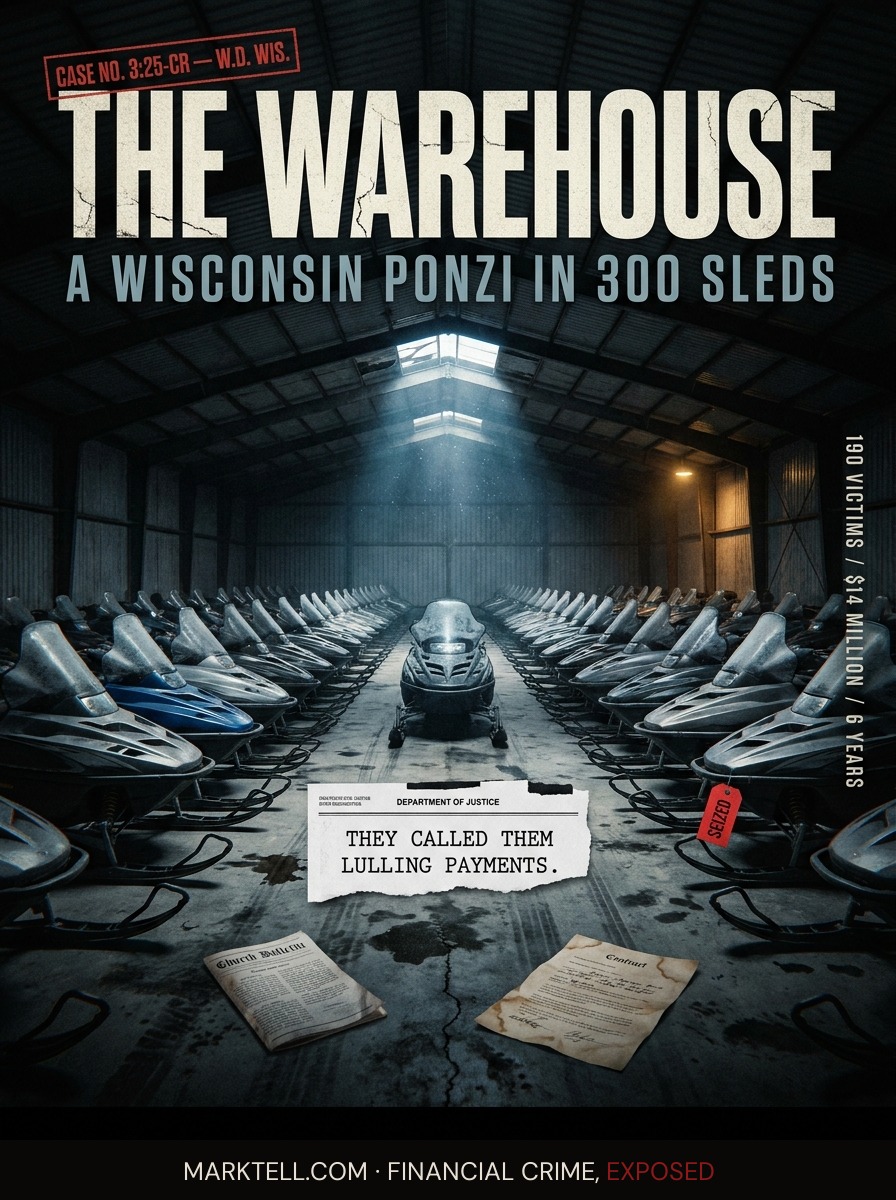
The warehouse in Wausau held 300 snowmobiles. None of them belonged to the investors.
Stanley Pophal told nearly 190 investors he was a licensed fiduciary blessed with good fortune. On June 13, he pleaded guilty to running a six-year Ponzi scheme out of a Wausau warehouse stacked with snowmobiles.
Karen kept the envelope from Northwestern Mutual in the same drawer where her husband had kept the gas bills. For two years after he died, she did not touch it. The check inside was the largest single number she had ever owned. She moved it to the credit union and let it sit at less than one percent because she did not trust herself to do anything else.
She was sixty-eight. She had worked nights at the regional hospital for thirty-one years and had never once been the person at the table who knew about money.
The friend from church was the one who said the name. Stanley. A nice man, the friend said. Local. He had helped her with her IRA and she had seen real returns. Not bank returns. Real ones.
That is the door this story walks through. Not a cold call. Not a website. A friend, in a church basement, with coffee that had been sitting on the burner too long.
I.
Stanley Pophal was sixty-four years old and lived in Wausau, Wisconsin. He ran a company called Bright with Silver Incorporated. He told investors he was a licensed investor and a fiduciary. A fiduciary is a person who is legally required to put your interests ahead of his own. The word has weight. It is supposed to mean something.
Pophal was not registered with the Securities and Exchange Commission, which oversees people who sell investments. He was not registered with the Financial Industry Regulatory Authority, which oversees brokers. He was registered with no one. According to the federal case filed in the Western District of Wisconsin, he was not what he said he was.
He told people he had been blessed. He used the word "divine." He said his good fortune was a gift, and the investments he offered were a way to share it. He promised annual returns of at least twenty percent. He said the money would go into cryptocurrency, into artificial intelligence ventures, into precious metals, into real estate.
Read those four categories again. They are the four categories of pitch that have run through American small-town fraud for the last six years. Anything new. Anything shiny. Anything the investor cannot easily check.
Karen sat at her kitchen table and signed a single-page document. The pen was the one she kept by the phone. The coffee was cold by the time she finished reading. She wired the money on a Tuesday. She remembers the day because she had to go to the credit union in person, and the teller, who knew her, asked twice if she was sure.
II.
The scheme ran from 2019 through March of 2025. That is six years. Six years is not a short con. Six years is a career.
According to the Department of Justice, Pophal defrauded nearly 190 investors out of more than $14 million. The earlier charging documents put the number above $15 million and the count at one hundred and twenty. The federal case grew as more victims came forward.
The mechanism is the oldest one in the book. A Ponzi scheme is a structure where there is no real investment. There is only a flow. New money comes in. Some of it goes out to earlier investors so they believe their returns are real. The rest goes to the person running it. There is no twenty percent. There is no crypto venture. There is no precious metals account. There is only the pipe.
The payments to earlier investors have a name in the federal lexicon. The DOJ calls them "lulling payments." The word is exact. They are not returns. They are sedatives. They keep the investor calm. They keep the investor recommending you to her friend from church.
This is what makes the Ponzi worse than the simple theft. The simple theft takes the money and runs. The Ponzi takes the money, sends a portion of it back wearing a uniform that says "return on investment," and waits for the victim to bring her sister.
Karen received two payments. Both arrived on time. The amounts matched the quarterly statement, which arrived in a thin envelope with a silver-leaf logo at the top. She showed the statement to her son at Thanksgiving. He told her it looked professional.
III.
The money did not go into AI. It did not go into precious metals. According to federal prosecutors, the vast majority of it went into a lifestyle Stanley Pophal could not have afforded otherwise. Travel. Mortgage payments. Private plane rentals. Motorcycles. And snowmobiles. More than three hundred of them.
Picture that.
A man in central Wisconsin bought three hundred snowmobiles with money taken from retirees and small investors who thought they were funding the future of technology. New snowmobiles run from about four thousand dollars to more than twenty-two thousand dollars apiece. He stored them in a rented warehouse.
When agents from IRS Criminal Investigation and the FBI moved in, they seized more than six hundred items in total. Hundreds of snowmobiles. Other vehicles. The inventory list reads like a dealership liquidation.
FBI Special Agent in Charge Alan Karr said Pophal had spent victims' money on his personal life and his hobbies. IRS-CI Special Agent in Charge Adam Jobes said Pophal had used new victims' money to keep the scheme alive while funding a lifestyle he could not afford.
That is the federal language for what the warehouse was. A warehouse is a place where you store things you intend to use later. Pophal was not going to use three hundred snowmobiles. He was storing the money in a shape that could not be wired back.
That is the renaming. The warehouse was not a warehouse. It was the balance sheet.
IV.
The structure became visible in early 2025. The lulling payments slowed. Then they stopped. The investors who called Bright with Silver got the kinds of answers people get at the end of these schemes. Delays. Reassurances. Stories about a temporary issue with a custodian. Then silence.
By March, federal investigators were inside. By the summer, the warehouse was being inventoried. On June 13, 2026, Stanley Pophal pleaded guilty in federal court to wire fraud and money laundering. He is scheduled to be sentenced on September 2. As part of the plea, he agreed to forfeit the snowmobiles and the other vehicles, which will be publicly auctioned. He will be ordered to pay restitution.
Restitution is the word the system uses for the gap it cannot close. The snowmobiles will be sold. The money will be returned in pieces. Nearly one hundred and ninety investors will receive a fraction of what they put in. That fraction will arrive years from now. Some of the investors will not be alive to receive it.
Karen got a letter from the U.S. Attorney's Office. It told her she was a victim in a federal case. It told her she would receive updates. The letter was the first official confirmation she had that the money was gone. Her son drove up from Madison and sat at the same kitchen table where she had signed the document. He read the letter twice. He did not say anything for a long time.
That part may be the saddest. Not the loss. The way the loss arrived. In an envelope. From the government. After everyone else already knew.
V.
There is a temptation, with cases like this, to make the story about the snowmobiles. Three hundred snowmobiles is a number that travels. It is the kind of detail that gets printed in the headline because it is absurd, and absurdity is shareable.
But the snowmobiles are not the story. The snowmobiles are what happens when the machine has nowhere left to put the money. They are the last shape the cash took before the cash stopped being cash.
The story is the church basement. The friend who said his name. The single-page document. The two payments that arrived on time. The Thanksgiving conversation where the son said the statement looked professional. The teller who asked twice. The drawer where the envelope from Northwestern Mutual used to sit.
The story is that the machine was not exotic. There was no blockchain. There was no offshore structure. There was a man in Wausau who said he was blessed, who promised twenty percent, who was registered with nobody, and who was believed by nearly one hundred and ninety people for six years.
If you are reading this because someone you know is talking about a local man who has a gift for investing, who promises returns that no bank can match, who works through friends and church and word of mouth, who is not registered with the SEC or FINRA, who shows you a quarterly statement on his own letterhead and asks you to sign a single page, you are reading about the same machine.
It is running right now under another name.
The warehouse is somewhere else.
- U.S. Department of Justice, Western District of Wisconsin | June 13, 2026 | Plea announcement, United States v. Stanley Pophal
- Barron's | June 2026 | "Financial Advisor Pleads Guilty in Ponzi Scheme That Funded the Purchase of 300 Snowmobiles"
- FBI public statement | June 2026 | SAC Alan Karr remarks
- IRS Criminal Investigation public statement | June 2026 | SAC Adam Jobes remarks
- SEC investor education materials | Definitions of fiduciary, registered investment adviser, broker-dealer
- FINRA BrokerCheck | Verification of registration status
Editorial Notice
MarkTell is a true crime publication about financial fraud. Some scenes, dialogue, and sequential details are reconstructed from court filings, enforcement actions, news reports, and public records. Where the public record does not provide exact details, editorial reconstruction is used to convey the documented pattern of events. Names of private individuals may be changed to protect identity. All factual claims are sourced to public documents cited in the Evidence Trail above. MarkTell does not provide investment, legal, or financial advice. Nothing published here constitutes a recommendation to buy, sell, or avoid any investment. Allegations described in active cases have not been adjudicated and defendants are presumed innocent until proven guilty. Readers should conduct their own due diligence before making financial decisions.