The voice on the phone was her grandson. The car at the curb was a stranger.
A Cleveland man pleaded guilty in a transnational scheme that turned ride-share drivers into unwitting cash couriers and grandchildren's voices into the lock that opened a generation's savings accounts. The machine ran from October through January. The drivers never knew what they were carrying.
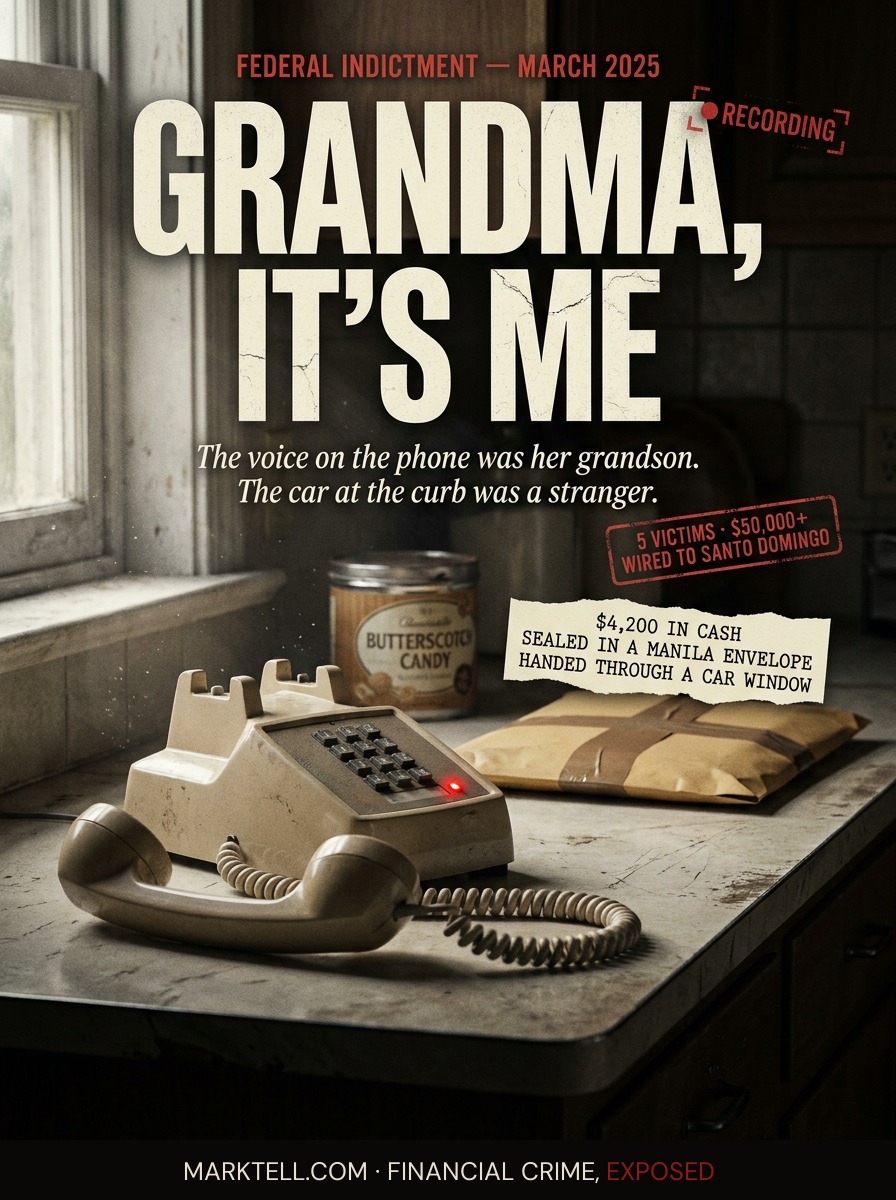
Marlene picked up on the second ring because that is what you do when the landline rings on a Saturday morning. She is seventy-eight. She keeps the landline because her grandchildren memorized the number when they were small and she does not want to be the kind of grandmother who is hard to reach.
The voice on the other end said Grandma.
It sounded like Kyle. Not exactly. A little muffled. He was crying. He said he had been in an accident. He said there was a woman in the other car. He said please do not tell Mom.
Then a second voice came on. A man. Calm. Professional. He said he was Kyle's attorney. He said the bail amount was forty-two hundred dollars in cash. He said a courier would come to her house within the hour. He said do not discuss this with anyone, because a gag order had been issued by the judge.
Marlene wrote down the address he gave her for the meeting point. A Sheetz parking lot in Hermitage. She took her checkbook out of the drawer, then put it back, because he had said cash. She drove to the bank. She told the teller she was helping with a family emergency. The teller did not ask twice. The teller is not trained to ask twice.
She put the money in a manila envelope and taped it shut, because the man on the phone had told her to.
The Lyft driver who pulled up to the Sheetz was named something Marlene would not remember. He was polite. He took the envelope through the window. He did not ask what was in it. The app on his dashboard told him to drive to a parking lot in Parma, Ohio. He drove. He delivered. He got paid for the ride.
He did not know he was a courier. He thought he was a driver. This is the design.
I.
The grandparent scam is not new. The FBI has been warning about it for fifteen years. What is new is the machinery around it. The script has been industrialized. The cash has been logistically solved. The voice on the phone is sometimes synthetic now, trained on the few seconds of audio a grandchild posted to Instagram three years ago. The lawyer on the second line is a role played by someone who has played it a thousand times.
According to the federal indictment unsealed in March 2025, Luis Alfonso Bisono Rodriguez, 34, of Cleveland, was the man waiting in the parking lots in Northern Ohio. He is originally from the Dominican Republic. He was arrested in the Cleveland area in March 2025. He has now pleaded guilty.
The DOJ charged him with five counts of Receipt of Stolen Money that Crossed a State Border. The scheme, as alleged, ran from October 2024 through January 2025. At least five elderly victims in Western Pennsylvania. Total losses exceeding $50,000. Acting United States Attorney Troy Rivetti announced the indictment. Assistant United States Attorney Brendan T. Conway is prosecuting the case.
That is the public record. That is what is adjudicated. The rest of the network, the people who made the calls, the people who wrote the script, the people who set up the wire accounts in the Dominican Republic, remains an open question.
II.
Here is what the machine looks like when you take it apart.
A call center, somewhere offshore. A list of names and phone numbers, often purchased from data brokers, often cross-referenced with social media. A script. A panicked grandchild. A reassuring lawyer. A judge who has issued a gag order, because the gag order is what keeps the victim from calling her daughter.
A pickup address. A ride-share driver, summoned through a normal app on a normal phone, sent to a normal parking lot in a normal town. The driver receives a package. The driver does not ask what is in the package. The driver delivers the package to a second normal parking lot in a different state.
A man, on camera, meeting the driver. According to investigators, surveillance footage captured Rodriguez at these meeting points. The package is opened. The cash is counted. Some of it is deposited into a bank account. Most of it is wired to the Dominican Republic.
The victim, back in Pennsylvania, is sitting by the phone, waiting for Kyle to call and say he is okay. He does not call, because he was never in jail. He was at the gym. He was at work. He was asleep.
This is not turbulence. This is a pattern.
The genius of the design is that no one in the chain sees the whole chain. The driver sees a delivery. The recipient sees a package. The wire sees a transaction. The victim sees a grandson. The script writes itself across five state lines and one international border, and at the end of it there is a number in an account in a country where the FBI cannot knock on the door without help.
III.
Marlene's grandson called her on Sunday, the day after. Just to check in. He asked how her week was. She did not know what to say.
She did not call the police that day. She called the next morning, because by then she had read a news story about a scam that sounded almost exactly like the one that had happened to her, and she had cried for an hour, and then she had picked up the phone.
The detective was kind. He told her she was not the first call he had taken that week. He told her the money was almost certainly already gone. He told her the FBI was investigating a pattern of cases like hers across Western Pennsylvania.
He did not tell her the money was probably in Santo Domingo by then, because he did not want to say it out loud.
The FBI's Internet Crime Complaint Center reported $4.885 billion in losses from elder fraud in 2024, across 147,127 complaints. That is a 43 percent increase from 2023. A June 2025 analysis indicated that 72 percent of those cases were facilitated by the availability of victims' personal data online. The grandson's name. The grandson's school. The grandson's voice, three seconds of it, from a TikTok he posted in 2022.
That is the fuel. The script is the engine. The ride-share driver is the conveyor belt. The wire to the Dominican Republic is the exhaust.
IV.
What happens to Marlene after the call is the part the indictment does not address.
She stopped answering the landline. She kept it plugged in, because she did not want her grandchildren to think she had moved on without telling them, but she let it ring. She started screening every call. She started feeling stupid in a way she had not felt since she was a young nurse and a doctor had yelled at her for handing him the wrong instrument.
She had been a school nurse for thirty-one years. She had spotted concussions teachers missed. She had caught a case of meningitis on a hunch. She was not a person who got fooled.
That is the part that may be the saddest. The machine was not built to fool stupid people. It was built to fool careful people who love their grandchildren. The careful is the lock. The love is the key.
She has not told Kyle what happened. She is afraid that if she tells him, he will feel responsible. She is afraid that every time he posts a video, he will think of her.
He posts videos. He is twenty-two. He does not know yet.
V.
Rodriguez's plea closes one door. It does not close the room.
The call center is still operating. The script is still being read. Somewhere this morning, a phone is ringing in a kitchen in Ohio or Illinois or Florida, and a voice that sounds almost exactly like a grandson is asking for help. A Lyft driver is being summoned to a parking lot. A package is being handed through a window. A wire is clearing.
The federal case against Rodriguez establishes one man's role in one stretch of the machine, from October 2024 through January 2025, across five charged victims and over $50,000 in losses. It does not name the people who called Marlene. It does not name the people who wrote what they said. It does not return the money.
Picture it. A man on a surveillance camera in a Parma parking lot, walking calmly to a car driven by a stranger who does not know what he is delivering. Behind him, a chain of phones in a building no American jury will ever see. Behind him, an account in a country where the cash will land before the victim has finished writing down the lawyer's fake name.
Marlene still keeps the butterscotch tin on the counter. Kyle visits in August. She has decided she will not tell him. She has decided that the cost of him knowing is higher than the cost of her carrying it.
That is the cost the indictment does not measure. That is the cost the plea does not address.
The voice on the phone was her grandson. The car at the curb was a stranger. The money was gone before she hung up.
- Sharon Herald | June 2026 | "Cleveland resident pleads guilty in 'grandparent scam' scheme with victims here"
- U.S. Department of Justice, Western District of Pennsylvania | March 26, 2025 | Indictment announcement of Luis Alfonso Bisono Rodriguez
- FBI Internet Crime Complaint Center (IC3) | 2024 Annual Report | Elder fraud statistics ($4.885B in losses, 147,127 complaints, 43% YoY increase)
- FBI public advisories | June 2025 | Elder fraud trend analysis and personal-data facilitation finding (72%)
Editorial Notice
MarkTell is a true crime publication about financial fraud. Some scenes, dialogue, and sequential details are reconstructed from court filings, enforcement actions, news reports, and public records. Where the public record does not provide exact details, editorial reconstruction is used to convey the documented pattern of events. Names of private individuals may be changed to protect identity. All factual claims are sourced to public documents cited in the Evidence Trail above. MarkTell does not provide investment, legal, or financial advice. Nothing published here constitutes a recommendation to buy, sell, or avoid any investment. Allegations described in active cases have not been adjudicated and defendants are presumed innocent until proven guilty. Readers should conduct their own due diligence before making financial decisions.