The voice on the phone sounded like her grandson. It was a man in a Montreal call center.
Stefano Zanetti ran the U.S. side of a Montreal-built grandparent scam, coordinating couriers who collected cash from elderly victims in cities the network rotated through to stay ahead of police. A federal judge in Pittsburgh just gave him more than fifteen years.
The woman was seventy-eight and she had already cried twice when she opened the screen door. The young man on the porch wore a windbreaker and carried a clipboard. He had been told to look like a clerk, not a thief. He took the envelope. He said thank you, ma'am. He walked back to a sedan with out-of-state plates and got in the passenger seat. The driver did not look at the house.
That is the last frame the federal record gives us of one of these mornings. Pittsburgh suburb. Late summer. Cash in a kitchen envelope.
The voice that had sent her to the bank that morning belonged to no one she knew. It had said "Grandma" and it had been crying. It had said there had been a car accident, a girl in the other car, a charge, a judge, bail. Then a second voice, calmer, a man who said he was a lawyer, who said the gag order was real and she could not call her son, who said a runner from the court would come by before noon to collect the bond in cash because that was how the county did it on emergencies.
None of that was true. The accident was not real. The lawyer was not a lawyer. The county does not send runners.
The runner was real. The cash was real. The pipeline that swallowed it ran out of Montreal.
I.
The man at the top of the U.S. end of that pipeline is named Stefano Zanetti. He is forty-four. He is Canadian. Last week, in a federal courtroom in the Western District of Pennsylvania, he was sentenced to more than fifteen years in prison after pleading guilty to conspiracy to commit wire fraud and conspiracy to commit money laundering. He was arrested in Panama and extradited. The U.S. Attorney's office in Pittsburgh, led by Troy Rivetti, said in its statement that Zanetti and his co-conspirators "inflicted severe financial and emotional injury upon numerous elderly victims and their families." That is the legal language for what happened on that porch.
Zanetti did not call the woman. He never spoke to her. He did not put on the windbreaker or carry the clipboard. His job was logistics. He coordinated the crews who did. He moved couriers from city to city, week to week, on a route that the federal indictment describes as a deliberate rotation across the United States so that no single police department would see the pattern long enough to act on it.
That is the machine. Not a man with a phone. A route.
II.
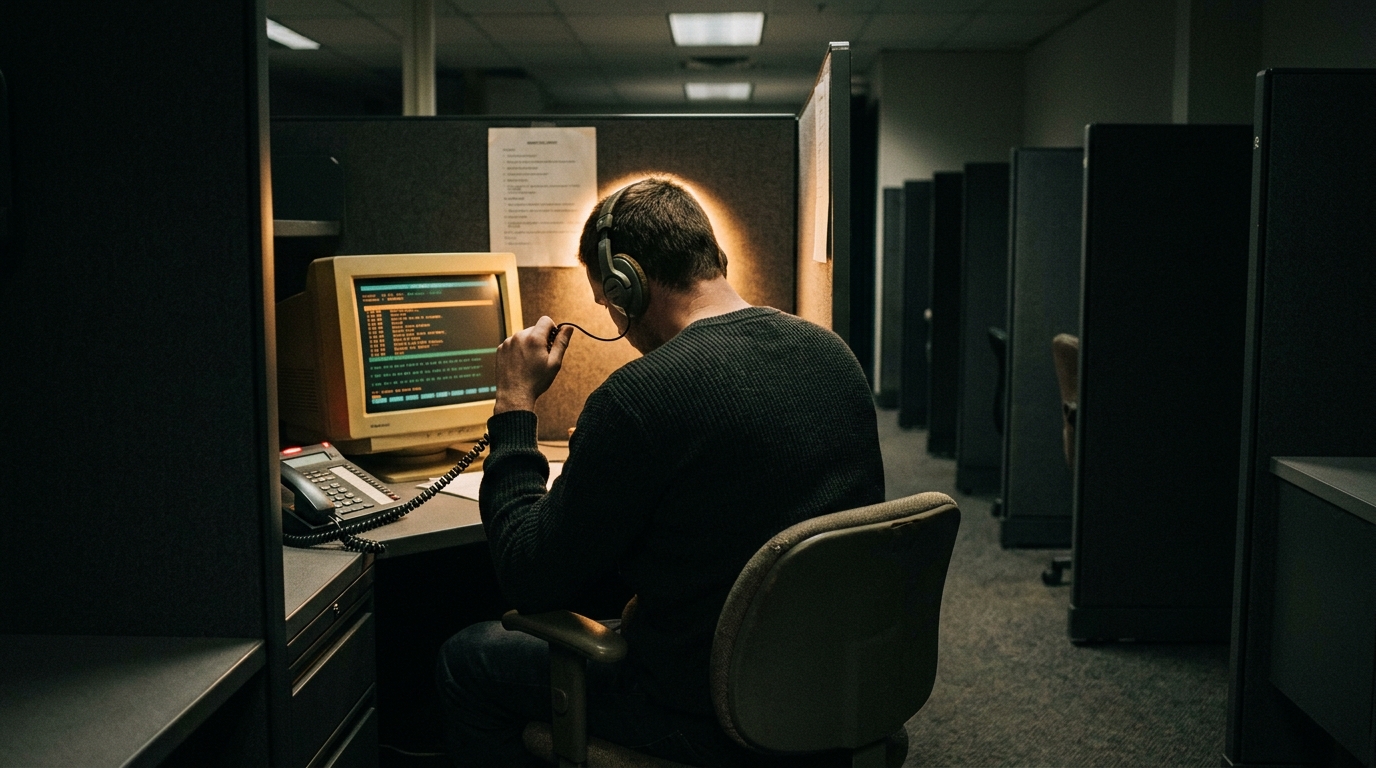
I want you to picture the call center, because the call center is where the script lives. Court filings and Canadian press reporting on related Montreal-based grandparent scam operations describe rooms with rows of desks, headsets, prepaid lines, and a whiteboard. On the whiteboard: cities. The cities for the week. Pittsburgh. Cleveland. Buffalo. The Twin Cities. The crew on the U.S. side is already in motion before the first call goes out, driving rented sedans toward the zip codes the room has chosen.
The script has two voices. The first voice cries. The first voice is the grandchild. He has been in an accident, or he has been arrested, or he is being held, and he is not allowed to call his parents. The second voice is the authority. Lawyer. Bondsman. Officer. The second voice tells the grandparent what to do. Go to the bank. Withdraw a specific amount. Do not tell the teller. Do not call your son. A courier will come.
If you have read about grandparent scams before, you have read this. The FCC put out a notice last month warning that the scripts are getting better, that the criminals are now using AI to clone the voice of an actual grandchild from a few seconds of social media audio. The script is the same script. The voice is just more accurate now.
The room is good at one thing. The room is good at finding the moment a person stops thinking and starts moving.
That moment is the entire business.
III.
The pipeline is older than the technology. The pipeline is older than the call center. What is new is the route.
Here is how the route works, according to the indictment in the Western District of Pennsylvania and to the FBI's advisories on this category of fraud. The Montreal end places the calls. The U.S. end places the bodies. A handful of crews live on the road. They fly into a city. They rent cars. They sit in hotel parking lots and wait for an address to come through. They drive to the address. They take the envelope. They drive to a drop. The cash leaves the country.
Zanetti's job, federal prosecutors say, was to keep the bodies moving. Two of his crews got caught. One in September 2021, in Pittsburgh, mid-pickup. The other in February 2022, in Pittsburgh again. Pittsburgh is where the indictment landed because Pittsburgh is where the federal agents were waiting.
The FBI estimates that elder financial abuse costs American seniors more than seven billion dollars a year. That is the FBI's number, published in April. The grandparent variant is a slice of that. Related cases prosecuted in the same window have involved losses of more than three million dollars across hundreds of victims in one operation, and a separate twenty-one million dollar scheme that hit seniors in forty-six states. Read those numbers slowly. Forty-six states. That is not a few bad actors. That is a route system.
The cash a victim hands to a courier on a porch in suburban Pittsburgh does not stay in Pittsburgh. It is collected, consolidated, and moved north, often through wire transfers structured to stay under reporting thresholds, sometimes through informal value transfer networks that leave less of a paper trail. By the time the woman who handed over the envelope realizes what happened and calls her son, the money is already in another country.
IV.
There are people in this story whose names belong in the record and who have not yet had their day in court. The indictment names Gareth West, alleged by U.S. prosecutors to be a leader of the network, who reportedly presented himself in Canada as a successful real estate developer. Twenty-five other individuals are alleged to have been involved. Many are awaiting extradition. Several have been arrested in places like Nicaragua, where a Montreal man wanted in connection with this kind of operation was picked up in March.
I am going to be careful here. Those are charges. Those are allegations. Allegation is not adjudication. The only person sentenced last week was Zanetti, and he pleaded guilty. The rest of the room is still in motion.
But the structure prosecutors have laid out is itself the story. A call center in one country. A courier network in another. A coordinator who never touches the victim, never picks up the phone, never sees the porch. A leader who, the U.S. Attorney's office says, looked from the outside like a developer.
That is the renaming. The sales floor of a grandparent scam is not a sales floor. It is a routing layer. The couriers are not employees. They are disposable. The coordinator is the one who matters, because the coordinator knows the route. Take the coordinator and the route stops moving for a few weeks. The route does not die. Routes do not die. They get a new coordinator.
V.
The hardest part of writing about this category is the part where you have to sit with the woman on the porch.
She was not stupid. She was not gullible. I have spent forty years watching pitches work on people, and I have watched the smartest people I know say yes to things they would never have said yes to on a different day. The script the room runs is built to find the day. It finds you when you are tired, when you are alone in the kitchen, when the phone rings and the voice on the other end is crying and saying your name, the name only a grandchild would use.
She did not hand cash to a stranger because she could not think. She handed cash to a stranger because she could think, and what she was thinking was: my grandson is in trouble and I am the one he called.
That is not a cognitive failure. That is love operating in a room that was built to weaponize it.
After the agents come, after the son arrives at the house, after the bank statement is printed out and the number on it is the number she withdrew that morning, the part that lasts is not the money. The money is gone and the money is, in many cases, recoverable in part, especially when a federal sentencing produces a restitution order, which this one will. The part that lasts is the moment in the kitchen when she said yes. She will replay that moment for the rest of her life. She will hear the voice. She will hear herself answering it.
That part may be the worst of it.
VI.
A judge in Newfoundland recently sentenced a courier in a related Canadian case to house arrest after he admitted to conning more than a dozen seniors out of $139,000 CAD (about $100K USD). Legal observers in Canada called the sentence light. The American end is going the other way. Fifteen years for the man who moved the bodies. Twenty more defendants in the queue.
The reason the U.S. sentence is heavy is not because Zanetti was the worst person in the network. He almost certainly was not. The reason the sentence is heavy is because the federal system has decided that elder fraud is a category where the route, not the runner, is the target. You take the coordinator and you make the route expensive to rebuild.
It will be rebuilt. There is another room somewhere in Montreal or somewhere else where the whiteboard is being updated this morning. There is another sedan with out-of-state plates idling on another curb. There is another envelope being prepared in another kitchen by another woman who heard a voice she loved say her name.
Zanetti pleaded guilty on a weekday. The route was already running on the weekend.
She thought she was helping her grandson. She was feeding the machine.
- CBC News | May 2026 | "Canadian man sentenced to 15 years in prison in U.S. for role in multi-million dollar grandparent scam"
- U.S. Attorney's Office, Western District of Pennsylvania | May 2026 | sentencing announcement and statement of U.S. Attorney Troy Rivetti
- U.S. Department of Justice | indictment of Stefano Zanetti and co-conspirators, conspiracy to commit wire fraud and conspiracy to commit money laundering
- FBI | April 2026 | Elder Fraud Report estimating $7B+ in annual losses
- FCC Consumer Advisory | April 2026 | Grandparent scams and AI voice cloning
- CBC News | April 2026 | Reporting on Charles Gillen sentencing in Newfoundland and Labrador
- CBC / Canadian press reporting | March 2026 | Arrest of Montreal man in Nicaragua in connection with grandparent scam network
- Related federal grandparent scam case reporting | 2024-2026 | $3M and $21M multi-state operations referenced for scale context
Editorial Notice
MarkTell is a true crime publication about financial fraud. Some scenes, dialogue, and sequential details are reconstructed from court filings, enforcement actions, news reports, and public records. Where the public record does not provide exact details, editorial reconstruction is used to convey the documented pattern of events. Names of private individuals may be changed to protect identity. All factual claims are sourced to public documents cited in the Evidence Trail above. MarkTell does not provide investment, legal, or financial advice. Nothing published here constitutes a recommendation to buy, sell, or avoid any investment. Allegations described in active cases have not been adjudicated and defendants are presumed innocent until proven guilty. Readers should conduct their own due diligence before making financial decisions.