The visitor fee was ten dollars. That was the business.
A jury convicted the manager of the Salt City Inn on charges of exploiting prostitution and money laundering. The case turned on a simple front-desk transaction the state called a tariff on harm.
Marisol was twenty-seven the week she stopped paying rent.
She did not stop because she had the money. She stopped because the man behind the counter at 1025 N. 900 West told her she did not have to. He said it the way a landlord says the heat is included. Casual. Already decided. The room was hers if she wanted it. The arrangement was the arrangement.
She put her ID on the counter. He slid it into a drawer.
That is where this story begins. Not in a courtroom. Not in a press release from the Utah Attorney General. At a motel front desk on the north side of Salt Lake City, where a man behind a register ran a business with two revenue lines. One was rooms. The other was access to the women in the rooms.
The state called it a no-tell motel. That is the polite name.
The honest name is a tariff. The Salt City Inn charged a tariff on visitors who came to see the women who lived there. Ten dollars minimum, according to the charges filed in April 2020. Cash. At the desk. Collected by the owner, Rezvan Saisani, or by his manager, Sameer Syed. One afternoon, investigators alleged, Syed collected seventy dollars in two and a half hours. Do the math on that one. Seven visitors. One desk. One register. One afternoon.
That is not a side hustle. That is a business model.
I.
The motel sat at 1025 N. 900 West. Two stories. A parking lot that faced the street. The kind of building a person drives past a hundred times and never looks at. That is the design. That is the point.
Tips started coming in to Salt Lake police in the summer of 2019. Commercial sex. Drug trafficking. The kind of activity that does not happen at a motel by accident. Motels are not the venue. They are the infrastructure. Privacy. Anonymity. A door that locks from the inside. A front desk that does not ask.
The Utah Attorney General's S.E.C.U.R.E. Strike Force opened the file. They watched. They built a record. On February 6, 2020, they came through the doors with warrants.
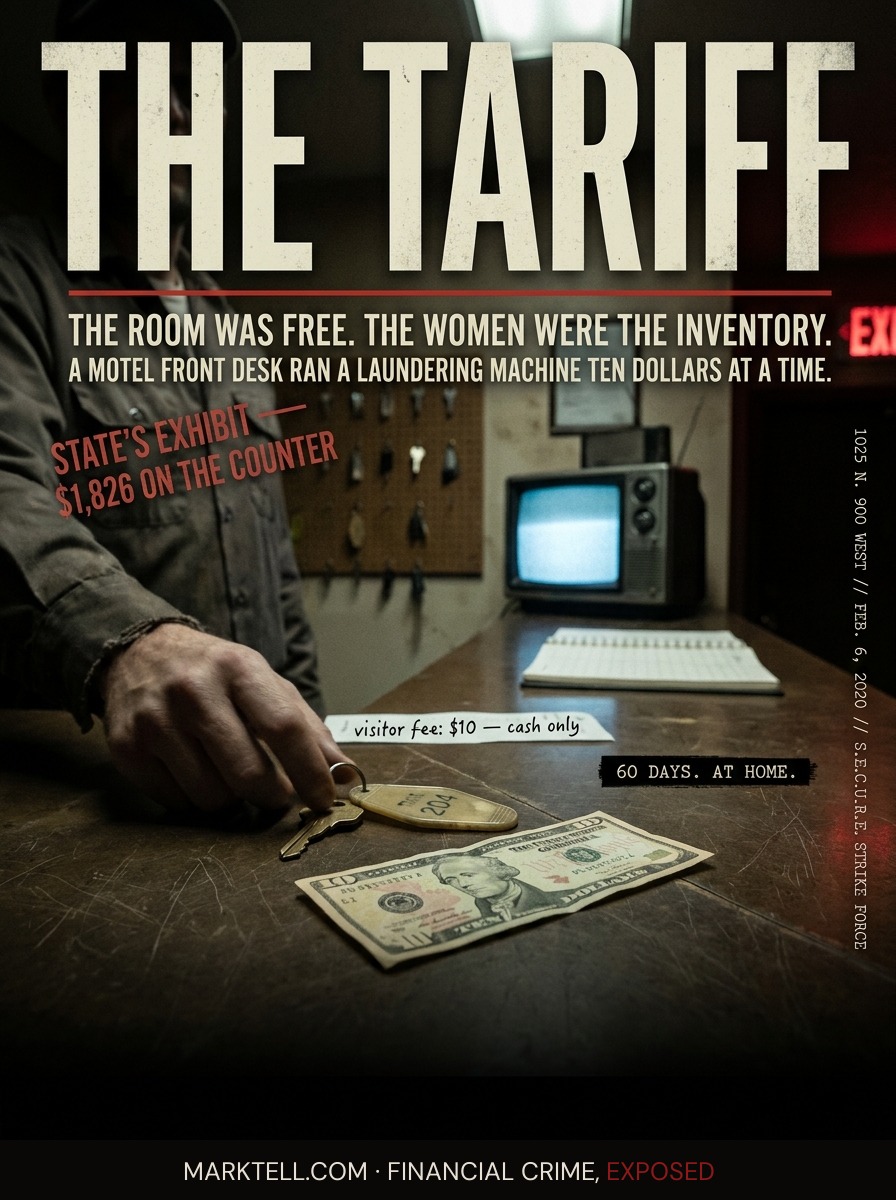
What they found on the counter that morning was $1,826 in U.S. currency. The state called it proceeds of exploiting and aiding prostitution. Eighteen hundred and twenty-six dollars. That is a slow Tuesday at a fast-food drive-through. That is what was sitting in the register of a motel that the state would later allege had been running this arrangement for months.
What they found in the building was worse. Multiple rooms were condemned after the search. Methamphetamine contamination. The walls themselves had to be sealed off. The inventory of the operation was not just the cash in the drawer. It was the building. It was the women who lived in the building. It was the chemistry burned into the drywall.
II.
Marisol did not know any of this when she handed over her ID.
She knew what she had been told. The room was free. The arrangement was the arrangement. She knew that men would come to the door and that the man at the front desk would already know they were coming because the man at the front desk had taken their ten dollars first.
This is what exploitation looks like at the operational level. It does not look like a kidnapping. It looks like a transaction. It looks like a free room offered to a woman who needed a free room. It looks like a register that opens and closes with a quiet click.
The charging documents, filed in April 2020, said Saisani and Syed offered free rent to commercial sex workers in exchange for sex acts. Read that again. The men running the building were not just collecting a tariff on visitors. They were collecting from the women themselves. The currency of that second transaction was not cash. It was the women's bodies.
That is the part of the ledger that does not show up in the $1,826.
III.
Rezvan Saisani went first.
He pled guilty on March 27, 2023, to money laundering, one count of exploiting prostitution, and maintaining a public nuisance. He was sentenced on June 20, 2023. A suspended prison term of one to fifteen years for the laundering count. Up to five years for the exploitation count, also suspended. One hundred and eighty days in jail for the public nuisance count, ninety of which were suspended. The remaining sixty days were converted to home confinement.
The owner of a motel that ran a tariff on the women living inside it served his sentence at home.
That part may be the saddest part of the public-record chronology. Not because the law failed in any technical sense. Because the math of accountability, when you write it out, looks like this. The cash on the counter was $1,826. The home confinement was 60 days. The women who lived in the rooms were not named in the sentencing documents.
Sameer Syed, the manager, did not take a plea. He went to trial. A jury returned a conviction this month for exploiting prostitution and money laundering, according to ABC4 Utah reporting from May 2026. Sentencing details have not yet appeared in the public record as of this writing.
A jury, in other words, looked at the visitor fees and the cash and the testimony and called it what the state called it. Laundering is a specific word. It means that the money collected at the desk was being run through the books of a business that looked like a motel. That is the mechanism. That is the machine.
The room rate was the cover. The visitor fee was the business.
IV.
Picture the front desk.
A register. A guestbook. A row of keys on hooks. A small television playing something nobody is watching. The man behind the counter takes a ten-dollar bill from a visitor and writes nothing down. He hands over a room number. The visitor walks up the stairs. The man behind the counter goes back to whatever he was doing.
That is the entire machine. There is no boiler room. There is no pitch deck. There is no offshore wallet. There is a register, a stairwell, and a tariff.
This is what makes the case useful as a pattern. Most financial crime stories in this column involve a stage. A website. A roadshow. A guy in a suit talking about returns. The Salt City Inn case is the same machine with the costume removed. Money was collected. Money was concealed inside the receipts of a legitimate-looking business. The legitimate-looking business existed to launder the collection.
The hospitality industry has a name for this kind of property. They call it a problem motel. The federal statutes have a different name. They call it a venue that financially benefits from exploitation and knew or should have known. That second name carries civil and criminal liability for the operator. The Salt City Inn case is what it looks like when the state proves the second name in court.
The motel itself is gone now. The property was acquired in 2020 by a developer who renovates distressed properties into affordable housing. The plan announced at the time was new apartments on the site by November of that year. The building that ran the tariff was torn down or gutted. The ledger was closed.
The women who lived in the rooms went somewhere else. The record does not say where.
V.
Marisol is a composite. The women she stands in for are not.
There were women in those rooms. The charges say so. The Attorney General's office said so. The jury, by its verdict this month, said so. They were the inventory of the business. The free rent was the wage. The visitor fee was the markup. The eighteen hundred dollars on the counter on the morning of the warrant was a single day's float on an operation that had been running long enough for the walls to absorb the meth.
The owner served his time at home.
The manager will be sentenced soon.
The building is gone.
The ten dollars is still the ten dollars. Somewhere, at a desk that looks like the desk at 1025 N. 900 West, a man is sliding a key across a counter and not writing anything down. The machine does not need the Salt City Inn. The machine needs a register, a stairwell, and a woman who has been told the rent is free.
That is the part nobody tore down.
- ABC4 Utah | May 2026 | "Jury convicts Salt City Inn manager of exploiting prostitution, money laundering"
- Utah Attorney General's Office | April 2020 | Charging documents, State of Utah v. Saisani and Syed
- Utah Third District Court | March 27, 2023 | Saisani guilty plea
- Utah Third District Court | June 20, 2023 | Saisani sentencing
- Utah AG S.E.C.U.R.E. Strike Force | February 6, 2020 | Search warrant execution, Salt City Inn, 1025 N. 900 West, Salt Lake City
- Statement of Attorney General Sean D. Reyes | 2020 | Public remarks on no-tell motels and human trafficking
Editorial Notice
MarkTell is a true crime publication about financial fraud. Some scenes, dialogue, and sequential details are reconstructed from court filings, enforcement actions, news reports, and public records. Where the public record does not provide exact details, editorial reconstruction is used to convey the documented pattern of events. Names of private individuals may be changed to protect identity. All factual claims are sourced to public documents cited in the Evidence Trail above. MarkTell does not provide investment, legal, or financial advice. Nothing published here constitutes a recommendation to buy, sell, or avoid any investment. Allegations described in active cases have not been adjudicated and defendants are presumed innocent until proven guilty. Readers should conduct their own due diligence before making financial decisions.