The vault manager knew the reporting line. He deposited three thousand at a time.
Joshua Shore spent years learning how banks catch thieves. Federal prosecutors say he used that knowledge to steal $440,000 from the two banks that trained him, one ATM deposit at a time.
Marisol pulled into the lot at 7:52 on a Tuesday and saw the spot again.
The one closest to the side door. The one with the small reserved sign her manager had joked about, saying he had earned it by being the first one in for two years running. She had believed him. He usually was the first one in.
That morning it was the third day the spot had been empty, and the auditors were still inside.
She was thirty-four. She had been a personal banker at the Renton branch of First Financial Northwest for a little over a year. She had two kids at her mother's house that morning because her shift started early and she liked being the one who unlocked the drawer, checked the strap counts, and had the coffee going before the branch opened. She was the kind of employee a bank wants and rarely deserves.
She had answered the auditors' questions twice already. She would answer them again that day and the day after.
Did she ever access the vault alone. No.
Did she notice any irregularities in the cash orders. No.
Did she ever see the market manager in the vault outside of a two-person control. She paused on that one.
She had. Of course she had. He was the market manager. He was the vault. That was the joke, when the joke was still funny.
I.
The federal indictment came down on July 10, 2026. Thirty counts. Joshua Shore, forty-one, of Woodinville, Washington. Bank theft. Money laundering. The U.S. Attorney's Office for the Western District of Washington laid it out in specific dates and specific dollars, the way these documents do, so that the story reads like a ledger before it reads like a crime.
Approximately $40,000 on December 6, 2021.
An additional $100,000 on January 28, 2022.
Approximately $300,000 on or near October 10, 2025.
Four hundred and forty thousand dollars. Two banks. Roughly four years between the first alleged theft and the last.
The first two took place while Shore worked as operations manager of a cash vault for Wells Fargo in Tukwila, from July 2019 through April 2022. The third came after he had moved on to First Financial Northwest as a market manager in Renton, September 2023 through December 2025.
Read that timeline slowly.
He allegedly stole from Wells Fargo. He then got hired at another bank. He then allegedly stole from that one too.
II.
The machine here is small and old and it has a name most people never learn.
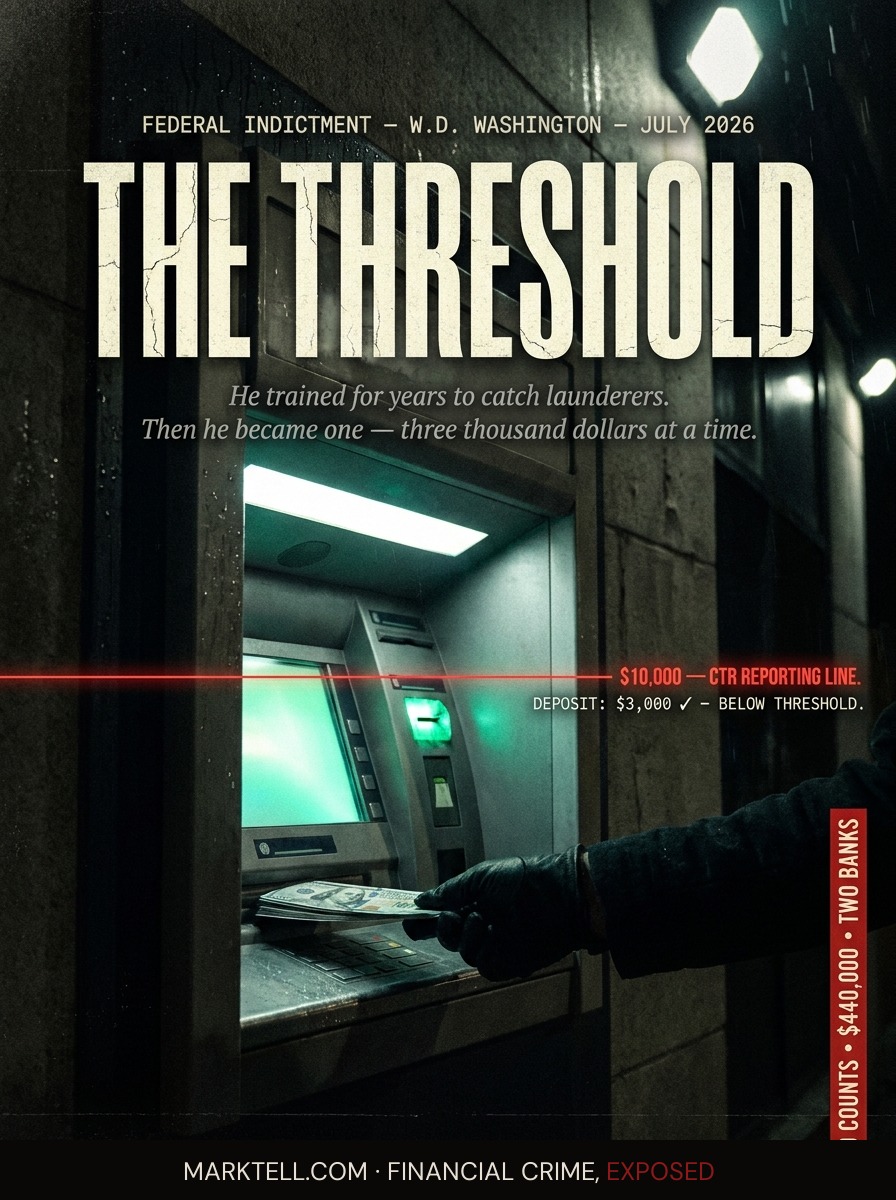
The Threshold.
If you deposit more than $10,000 in cash into a U.S. bank account in a single transaction, the bank has to file a Currency Transaction Report with the federal government. That is the law. The CTR exists so that large cash movements leave a paper trail. A bank employee who has been trained on anti-money laundering rules knows this cold. It is on the test. It is in the annual refresher. It is the first line of defense against people who want cash to disappear into the banking system without being noticed.
Shore, according to the indictment, allegedly knew it the way a mechanic knows the torque on a bolt.
He allegedly made $3,000 cash deposits into BECU ATMs.
He allegedly made deposits up to $10,000 at a time into JP Morgan Chase ATMs.
Not $10,001. Not $11,000. Just under the line. Every time.
First Assistant U.S. Attorney Neil Floyd, announcing the case, said Shore "allegedly victimized two financial institutions, stealing huge piles of cash and casting suspicion on all the employees who worked there." He added that the "attempted cover-up, repeated deposits of thousands of dollars to other bank's ATMs, provided a trail for law enforcement."
That is the part to sit with. The cover-up is what convicted him in the papers, if the government's case holds. The theft was allegedly clean enough that Wells Fargo did not notice for a while. The laundering left the map.
III.
Picture the vault.
Not a movie vault. Not the round door with the spinning wheel. A modern bank cash vault is a room. Fluorescent light. Metal shelving. Straps of bills organized by denomination. A log book, or more often a computer, tracking every strap that goes in and every strap that comes out. Two-person integrity. Two sets of credentials. Two signatures. Two sets of eyes.
Except when the person watching the vault is the person the two-person rule is designed to catch.
An operations manager of a cash vault does not just work in the room. He runs the room. He sets the schedule. He approves the reconciliations. He is the one who signs off when the numbers match. If the numbers do not match, he is the one who investigates the discrepancy.
That is not a design flaw. That is a design decision. Every bank has to trust someone at the top of the cash chain, because if you do not trust anyone, the money does not move. The bet the industry makes is that the person at the top of the chain has too much to lose.
Shore, if the indictment is true, took the bet the other way.
IV.
Marisol answered the same questions on Wednesday.
The auditors were polite. They were also very tired, and she could tell they had been having the same conversation with everyone at the branch for three days.
She was asked whether she had noticed any change in Shore's demeanor in the weeks before he stopped coming in. She thought about it honestly. She said no. He had been the same. He had asked about her kids. He had told her the branch numbers looked good for the quarter. He had complimented her on the way she handled a difficult customer on the phone.
She did not know yet, that day, what the indictment would allege. She only knew that her name was in a spreadsheet somewhere and that a stranger was going to look at it and decide whether she was clean.
That is what Floyd meant when he said Shore had cast suspicion on all the employees who worked there. Every teller in that branch, every operations person in that Tukwila vault, is now the subject of a background check they did not ask for. Some of them will be fine. Some of them will find that the check has slowed down a mortgage, or a job change, or the way their new employer looks at them across the desk.
That part may be the saddest.
V.
The pattern is not unusual. It is common enough that the industry has a phrase for it.
Insider fraud. Occupational fraud. The trusted employee. The one who knows where the cameras point.
In 2024, banking and financial services accounted for nineteen percent of all occupational fraud cases, more than any other sector, with median losses over $1.5 million per case and a median discovery time of eight months. That is the industry number. Eight months of the money already gone before anyone in the building knows to look.
The Wells Fargo alleged thefts, according to the timeline in the indictment, went undetected long enough that Shore was able to leave that bank, take a year off from banking, and get hired somewhere else. First Financial Northwest hired him as a market manager. That title carries authority over multiple branches. It carries vault access. It carries the same trust that Wells Fargo had extended and, if the government is right, been repaid with a hole.
Nobody outside the hiring room knows what the background check turned up. Perhaps it turned up nothing, because the alleged Wells Fargo losses were not yet attributed to him. Perhaps the internal investigation there was still ongoing, or had gone cold, or had never quite been opened. We do not know.
What we know is that in October 2025, according to the indictment, approximately $300,000 walked out of a second vault.
VI.
Here is the small, ugly detail worth staring at.
Shore's training was the weapon.
Every bank employee with vault access sits through the same modules. Bank Secrecy Act. Know Your Customer. Anti-Money Laundering. Suspicious Activity Reports. Currency Transaction Reports. The Threshold, at ten thousand, in cash, per transaction. These are not secret. They are required by federal law and reinforced every year until they become muscle memory.
The training is meant to teach the employee how to spot a launderer walking through the door.
It also, if you are looking at it from the other side of the desk, teaches you exactly what not to do.
Do not deposit more than ten thousand in cash.
Do not deposit at the same branch twice in a suspicious pattern.
Do not use your own bank.
Do not do it at a counter where a teller has to sign the slip.
Use an ATM. Use a competitor's ATM. Break the money down. Space it out.
That is not an accusation. That is the government's alleged reconstruction. Prosecutors say Shore did each of these things, and that the doing of them, more than the taking, is what the FBI followed.
VII.
Marisol still works at the branch.
The auditors finished. The questions stopped. Her name came off whatever internal list it had been on. Her mortgage went through. Her kids never knew any of it happened.
She does not talk about it much. When she does, it is not about the money, because the money was never hers and the bank will absorb the loss the way banks absorb losses, quietly, into a line item. What she talks about is the week she had to prove she had done nothing wrong to keep a job she had done nothing wrong in.
The parking spot filled again eventually. Somebody new got it. She does not remember the joke about who had earned it.
VIII.
Bank theft carries up to thirty years. The money laundering counts carry up to ten or twenty each, depending on the count. Thirty federal felonies in a single indictment is a very large weight, and it will get argued down, or negotiated, or tried, and the sentence at the end of it will be one number the newspapers will report and then forget.
The number that matters is smaller and older.
Ten thousand dollars.
That is the line the whole alleged operation was built around. Stay under it and the government does not get an automatic notice. Stay under it enough times and you have moved a fortune. Stay under it while you are the person whose job is to catch people who stay under it, and you have written the manual on your own eventual arrest.
He allegedly knew the line. He allegedly walked right along it.
He left a footprint every time.
- U.S. Attorney's Office, Western District of Washington | July 10, 2026 | Indictment announcement, United States v. Joshua Shore
- MyNorthwest.com | July 2026 | "Woodinville man charged with stealing, laundering $440K from banks he worked for"
- Federal Bureau of Investigation | July 2026 | Investigative role in United States v. Shore
- Association of Certified Fraud Examiners | 2024 | Report to the Nations, occupational fraud statistics
- Bank Secrecy Act, 31 U.S.C. § 5313 | Currency Transaction Report reporting threshold
Editorial Notice
MarkTell is a true crime publication about financial fraud. Some scenes, dialogue, and sequential details are reconstructed from court filings, enforcement actions, news reports, and public records. Where the public record does not provide exact details, editorial reconstruction is used to convey the documented pattern of events. Names of private individuals may be changed to protect identity. All factual claims are sourced to public documents cited in the Evidence Trail above. MarkTell does not provide investment, legal, or financial advice. Nothing published here constitutes a recommendation to buy, sell, or avoid any investment. Allegations described in active cases have not been adjudicated and defendants are presumed innocent until proven guilty. Readers should conduct their own due diligence before making financial decisions.