The tree-planting fintech that planted its own customers
Joseph Sanberg sold the world a bank that planted trees. The trees were real. The customers paying for them, prosecutors say, were him. On June 1, a federal judge sentenced him to 14 years.
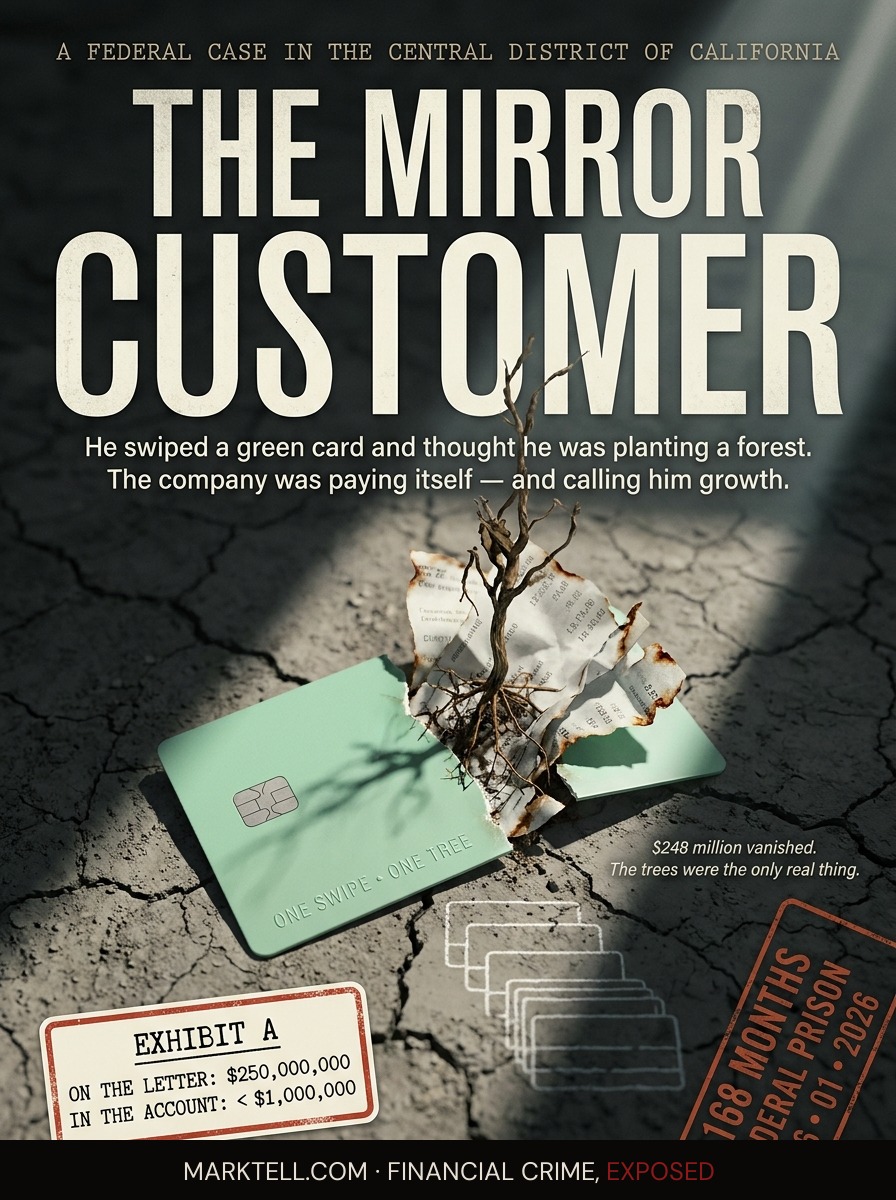
Marcus kept the card in the front slot of his wallet because he liked the color. Soft green, no bank logo on the back, just a small line of text about the trees. He was 58, taught earth science at a public high school in Pasadena, and he had been looking for years for a checking account that did not feel like a small daily compromise. Aspiration showed up in a podcast ad in 2020. Fossil-fuel-free deposits. A tree planted every time he swiped. A "pay what is fair" fee, which he set at three dollars a month because he wanted the company to exist.
He moved his direct deposit over on a Sunday afternoon. His wife asked if he had checked who owned it. He said it was started by a guy who worked on anti-poverty stuff and a guy who used to be a Clinton speechwriter. She said okay. He swiped the green card at the grocery store and felt, for a second, like a sentence in his life had been corrected.
That was the product. This is the chapter about what was happening behind it.
I.
On June 1, 2026, a federal judge in the Central District of California sentenced Joseph Neal Sanberg, 46, co-founder and former board member of Aspiration Partners, to 168 months in federal prison. Fourteen years. The Department of Justice press release put the scale of the scheme at more than $248 million in losses to investors and lenders. He had pleaded guilty in October 2025 to two counts of wire fraud. A restitution hearing is set for July 20, 2026.
Sanberg's public biography was anti-poverty activist, California ballot-initiative funder, climate-conscious entrepreneur. He had photographs with politicians. He spoke at conferences about the moral failure of fossil-fuel banking. The company he co-founded with Andrei Cherny in 2013 marketed itself as sustainability-as-a-service, a place where your debit card was a small daily vote against pipelines.
Marcus did not know who Sanberg was. He just knew the card was green and the trees were real.
The trees were real. That part holds up. Aspiration did fund tree planting. What was not real, according to the Department of Justice and a parallel civil complaint from the SEC, was who was buying them.
II.
There are two frauds inside this case. They run on parallel tracks. They meet at the same destination.
The first one is the loan fraud. Between 2020 and 2021, the DOJ says, Sanberg and a fellow Aspiration board member named Ibrahim AlHusseini fraudulently obtained roughly $145 million in loans from two lenders, one of them affiliated with UBS. The collateral was Sanberg's Aspiration stock. To get the loans approved, prosecutors say, AlHusseini's bank and brokerage statements were falsified, inflating his assets by tens of millions of dollars to make him look like a credible borrower. AlHusseini pleaded guilty to wire fraud in March 2025 and is awaiting sentencing.
The second fraud is the one that touches Marcus.
From March 2021 to November 2022, according to the indictment, Sanberg orchestrated a scheme to artificially inflate Aspiration's revenue by tens of millions of dollars. The mechanism was the mirror.
It worked like this. Aspiration sold tree-planting services to corporate clients. Companies would sign letters of intent committing to pay Aspiration a certain amount for a certain number of trees. The letters became the basis for revenue Aspiration recorded on its books. The revenue made the company look like it was growing. The growth made investors want in.
The DOJ says Sanberg recruited the customers himself. Friends. Business associates. Small businesses. Religious organizations. They signed the letters. The letters generated invoices. And the money to pay those invoices, prosecutors say, came from entities Sanberg secretly controlled. He was the customer. He was the company. He was the revenue.
Money left one of his accounts, walked through a friend's company, arrived at Aspiration as a payment for tree-planting services, and posted to the financial statements as proof that strangers wanted what Aspiration was selling.
Read that slowly. The growth chart Aspiration showed investors was, in significant part, Joseph Sanberg paying Joseph Sanberg.
III.
In August 2021, Aspiration announced it would go public through a SPAC merger with InterPrivate III Financial Partners. The SPAC, a special-purpose acquisition company, is the shell-shaped door through which a private company walks onto the public markets without the slow regulatory pat-down of a traditional IPO. The proposed valuation was $2.3 billion.
The SEC complaint, filed alongside the criminal case, alleges that the inflated-revenue scheme helped Aspiration raise more than $300 million from investors. Some of those investors were famous. Steve Ballmer, owner of the Los Angeles Clippers, would later tell the sentencing judge in an April 2026 letter that he was defrauded out of $60 million. Leonardo DiCaprio, Robert Downey Jr., Orlando Bloom, and Drake were also reported investors.
To support the fundraising, prosecutors say, Sanberg presented fraudulent financial materials. One of them was a fabricated letter from Aspiration's own audit committee. The letter stated the company had $250 million in available cash.
The company had less than $1 million.
$250 million on the page. Less than $1 million in the account. That gap is the whole story.
IV.
Marcus did not see any of this. Marcus saw a debit card. He saw a monthly email telling him how many trees his swipes had funded. He saw, in the summer of 2024, an email about something called GreenFi.
The email explained that the consumer banking business was being spun off and would continue under a new brand with new ownership. The tone was upbeat. The trees would keep getting planted. He read it twice looking for the part that explained why. There was no part that explained why.
In March 2025, Aspiration Partners filed for Chapter 11 bankruptcy. By July it had been converted to Chapter 7 liquidation, which is the legal term for turning out the lights and selling the chairs. A bankruptcy motion filed in April 2026 accused Kfir Gavrieli, CEO of the shoe company Tieks, of helping orchestrate part of the fake-customer network. That allegation has not been adjudicated.
Marcus learned the company had collapsed from a news alert on his phone while he was waiting in the pickup line at his daughter's school. The headline said co-founder, $248 million, prison. He sat with the phone in his hand and tried to figure out whether his trees had been real or whether they were part of the inventory that justified the fake invoices.
The DOJ's release says the trees were planted. The fraud was not in the trees. The fraud was in the customers who were supposedly paying for them.
V.
Here is the part that matters for the next one.
ESG, which stands for environmental, social, and governance, is the umbrella label for investing and consumer products that promise some social good alongside the financial transaction. The label became a marketing surface in the 2010s. The marketing surface attracted capital. The capital attracted operators.
The Aspiration case is not an indictment of climate-conscious banking. The trees were planted. The fossil-fuel-free deposits were, by all available reporting, fossil-fuel-free. The product did what the product said it did at the consumer level.
The fraud lived one floor up, in the room where the company's growth story was being assembled for investors. That room is invisible to the person holding the debit card. It is also invisible to most of the people writing the checks, because the documents in that room are signed by accountants and audit committees and lawyers, and the documents in that room are presumed to mean what they say.
A fabricated letter from an audit committee, claiming $250 million in cash, is not a document the average investor can verify. They are reading the letter. They are not auditing the auditors.
This is the ugly part. Not the part about Sanberg. The part about the structure.
When a company's growth story is being built on revenue, and that revenue is being generated by letters of intent from customers nobody at the investor's table has ever met, the investor is trusting that somebody downstream verified those customers exist and pay their bills. In the Aspiration case, prosecutors say, that verification did not happen, or did not happen well enough, for almost two years.
Andrei Cherny, the other co-founder, resigned as CEO in 2022. He has since said publicly that Sanberg's actions were among the reasons he left and contributed to the company's collapse. He has positioned the employees, customers, and investors as the victims. The court will sort out what each of those statements is worth.
VI.
Marcus still has the card. He pulled it out of his wallet a week after the sentencing and put it in the kitchen drawer with the takeout menus and the dead batteries. He has a GreenFi card now. He uses it. The trees, he assumes, are still real.
He told his wife he felt stupid. She told him he was not stupid. She told him he had picked a product that did what it said it would do for the small piece of his life that touched it. The fraud was in a room he was never invited into.
That part may be the saddest. The customer got what the customer was promised. The investors got a number that did not exist. And the man who built the room walked into a federal courthouse on a Monday in June and was told he would not walk out again for fourteen years.
The trees got planted. The customers were the fiction.
- U.S. Department of Justice, Central District of California | June 1, 2026 | Press release on sentencing of Joseph Neal Sanberg
- U.S. Securities and Exchange Commission | 2025 | Civil complaint against Joseph Sanberg alleging revenue inflation scheme
- U.S. Department of Justice | October 2025 | Sanberg guilty plea, two counts of wire fraud
- U.S. Department of Justice | March 2025 | Ibrahim AlHusseini guilty plea
- Aspiration Partners Inc. | March 2025 | Chapter 11 bankruptcy filing, later converted to Chapter 7 in July 2025
- Sentencing court filings, Central District of California | April 2026 | Letter from Steve Ballmer to sentencing judge
- Bankruptcy court filing | April 20, 2026 | Motion accusing Kfir Gavrieli of Tieks regarding fake-customer network
- Regtechtimes | June 2026 | Reporting on Sanberg sentencing
- InterPrivate III Financial Partners | August 2021 | Announcement of proposed SPAC merger with Aspiration at $2.3B valuation
Editorial Notice
MarkTell is a true crime publication about financial fraud. Some scenes, dialogue, and sequential details are reconstructed from court filings, enforcement actions, news reports, and public records. Where the public record does not provide exact details, editorial reconstruction is used to convey the documented pattern of events. Names of private individuals may be changed to protect identity. All factual claims are sourced to public documents cited in the Evidence Trail above. MarkTell does not provide investment, legal, or financial advice. Nothing published here constitutes a recommendation to buy, sell, or avoid any investment. Allegations described in active cases have not been adjudicated and defendants are presumed innocent until proven guilty. Readers should conduct their own due diligence before making financial decisions.