The tip was pre-selected. That was the whole business.
The travel app promised cheap flights and told users to tip their booking assistant. The FTC says the tip was never really optional. It was the product.
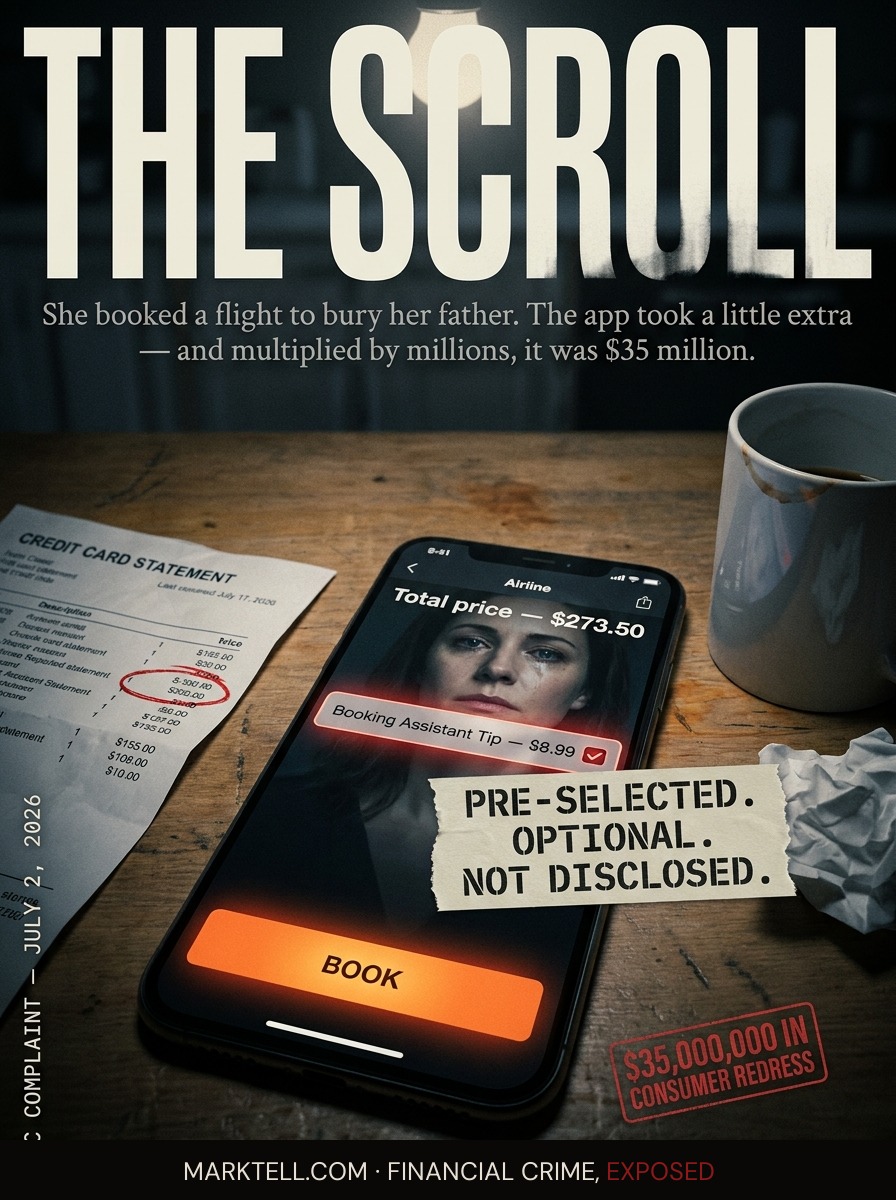
Rachel was thirty-four and she was booking a flight to bury her father.
Eleven at night. Ohio. She sat on the edge of the bed with the phone in one hand and her card in the other. The hospital where she worked had given her three days. She needed a Thursday flight to Tampa and she needed it done before she cried again.
She used the app because the app said it was cheaper. It usually was. The little bunny mascot. The confetti when the price dropped. She had booked with it twice before, both times without thinking hard about it, which was the point.
She typed the airports. She picked the flight. She tapped through to the payment screen. There was a total at the top. There was an orange button at the bottom. She tapped the button.
Two weeks later, sitting at her kitchen table with the funeral behind her and the statement in front of her, she found a line she could not place. It was small. Maybe fifteen dollars. Maybe more. She stared at it the way you stare at a bruise you do not remember getting.
She was not ruined. That is important. She was not wiped out. She was just, in a small way, at a bad moment, taken. And multiplied by millions of Rachels, that small taking is what the Federal Trade Commission this week called thirty-five million dollars.
I. THE SCROLL
On July 2, 2026, the FTC announced that Hopper Inc., the Canadian travel app, and its U.S. subsidiary had agreed to pay $35 million in consumer redress to settle allegations that the company hid fees behind the scroll.
That is the machine. The scroll.
You know it because you live inside it. You are on a checkout screen. There is a total near the top. There is a button near the bottom. Between them, in the space your thumb never visits, there is a line. Sometimes two.
According to the FTC complaint, that space is where Hopper put a "Tip" for its booking assistant and a "VIP Support" charge. Both were, the complaint alleges, pre-selected. Both were, the complaint alleges, presented as optional. Neither was, the complaint alleges, disclosed in a way most users would see before they tapped Book.
Read that slowly. Pre-selected. Optional. Not disclosed.
Those three words do not fit together. That is the point. The gap between them is where the money lives.
II. WHAT THE TIP JAR WAS
A tip, in ordinary English, is what you leave for a person who did something for you. It is a choice made after service. It is unchecked by default because that is what "voluntary" means.
The FTC alleges Hopper flipped that. The tip appeared before service, checked in advance, on a screen that made you scroll to find it. The complaint alleges the company knew what would happen if it did not do this. Internal testing, the FTC says, showed that if the fees were disclosed adequately and left unchecked, most consumers would decline them.
Picture the meeting where that data was reviewed. Someone brought the A/B test. Someone read the numbers. Someone made a decision about which version of the screen shipped.
We do not know who was in that room. Nobody outside Hopper has seen it. But the shipped screen tells you what the room decided.
The shipped screen is the whole story.
III. THE FORTY PERCENT
Hopper's business is not really flights. Flights are the front door.
The company sells what it calls fintech products. Price Freeze, which lets you lock in a fare for a fee. Cancel for Any Reason, which lets you back out for a fee. VIP Support, which promises faster help for a fee. Tips, which are a fee that a chatbot allegedly did not earn.
As of March 2026, per company disclosures, those products made up roughly 40 percent of Hopper's revenue.
That is not a side business. That is the business.
The flight is the reason you opened the app. The fees are the reason the app exists.
This is the part worth naming plainly. In a low-margin industry, when your core product barely makes money, you have two choices. You can find a way to sell the same thing more efficiently. Or you can find a way to sell something else on top of it while the customer is already inside the checkout flow, tired, on their phone, at eleven at night, with a card in their hand and a reason to be done.
The FTC's complaint describes the second choice.
IV. THE PROMISE THAT WAS NOT KEPT
The tips are one piece. The VIP Support charge is another.
The FTC alleges Hopper told users VIP Support meant "instant" help. Or "few minutes." Something fast. Something premium. Something worth the upcharge.
The complaint alleges many users who paid did not get that. They got the regular queue. They got the wait. They paid for a lane that did not exist for them.
This is the older, plainer form of the fraud the FTC is describing. Say a thing about the service. Charge for the thing. Do not deliver the thing. It has a name in the law. The FTC calls it deception.
Rachel did not buy VIP Support. Rachel did not need to. The tip was enough. The tip was the size of what she could absorb without noticing on the night she booked and small enough to shrug off on the morning she saw the statement.
That is the design. The take is calibrated to the shrug.
V. THE RULE THEY BROKE, AND THE ONE THEY BROKE FIRST
The FTC's complaint alleges two things.
First, violations of the FTC Act. That is the old law. The one that says you cannot deceive people to get their money. It has been on the books since 1914. It is the floor.
Second, for short-term lodging bookings made since May 12, 2025, violations of the FTC's Unfair and Deceptive Fees Rule. That is the new one. It is the rule the current FTC has been building enforcement around. It says a total price has to be a total price. It says junk fees have to be shown before the button, not after.
That rule exists because the scroll works. Because pre-selection works. Because the design pattern the FTC now calls a "dark pattern" is not a bug. It is a strategy that gets meetings and slides and A/B tests and shipped screens.
The rule is new. The behavior is old. That gap is why the FTC keeps having to write new rules.
Look at the pattern in the last sixty days alone. In May 2026, Shutterstock settled with the FTC for $35 million over subscription practices the agency called deceptive. In June, a federal court temporarily halted an operation called Genesis Tech that the FTC accused of running hidden-cost subscription schemes. In July, Hopper.
Three companies. Three consent-based takings. One machine, in three outfits.
VI. BACK TO THE KITCHEN TABLE
Rachel found the line item and she did not call anyone. She did not tweet. She did not file a complaint. She looked at the amount and she thought about her father and she paid the card in full and she closed the laptop.
That is what the machine is built for. Not the ones who fight. The ones who do not.
The $35 million redress fund the FTC secured is real money. Some of it may reach some of the Rachels. The order also bars Hopper from misrepresenting fees and requires clear and conspicuous disclosure of total price and final payment amount going forward.
Hopper, in the standard FTC template, has not admitted wrongdoing. The settlement resolves allegations. Allegation is not adjudication. Those are the words you use because those are the words the record supports.
But the screen is the record too.
If you have the app on your phone right now, open it. Start a booking. Do not book. Scroll all the way down before you tap the orange button. Look at what is checked. Look at what is not.
Whatever you see this week is not what Rachel saw. What Rachel saw was the version that shipped before the FTC came in the door.
The tip was pre-selected. That was the whole business.
- Federal Trade Commission | July 2, 2026 | Announcement of proposed settlement with Hopper Inc. and Hopper (USA) Inc.; FTC complaint alleging violations of the FTC Act and the Unfair and Deceptive Fees Rule
- FTC Bureau of Consumer Protection | Christopher Mufarrige statement on Hopper settlement, July 2, 2026
- TechCrunch | July 2, 2026 | "Travel app Hopper to pay $35M in FTC settlement over 'unfairly' charging hidden fees"
- Hopper company disclosures | March 2026 | Revenue mix reporting (fintech products ~40% of revenue)
- FTC Unfair and Deceptive Fees Rule | Effective May 12, 2025
- FTC | "Bringing Dark Patterns to Light" staff report | September 2022
- FTC | May 2026 | Shutterstock settlement announcement ($35M, subscription practices)
- FTC | June 17, 2026 | Genesis Tech temporary restraining order announcement
- Class action filing | August 2022 | Allegations regarding Hopper "Price Freeze" $100 cap disclosure
Editorial Notice
MarkTell is a true crime publication about financial fraud. Some scenes, dialogue, and sequential details are reconstructed from court filings, enforcement actions, news reports, and public records. Where the public record does not provide exact details, editorial reconstruction is used to convey the documented pattern of events. Names of private individuals may be changed to protect identity. All factual claims are sourced to public documents cited in the Evidence Trail above. MarkTell does not provide investment, legal, or financial advice. Nothing published here constitutes a recommendation to buy, sell, or avoid any investment. Allegations described in active cases have not been adjudicated and defendants are presumed innocent until proven guilty. Readers should conduct their own due diligence before making financial decisions.