The ticket was worth a euro. The clerk knew it was worth millions.
In 2012, a man in A Coruña handed his usual lottery slip across a counter and was told it was nearly worthless. The clerk and his brother, a state lottery official, tried to pocket the €4.7 million themselves. Fourteen years later, a court finally named what happened at that counter.
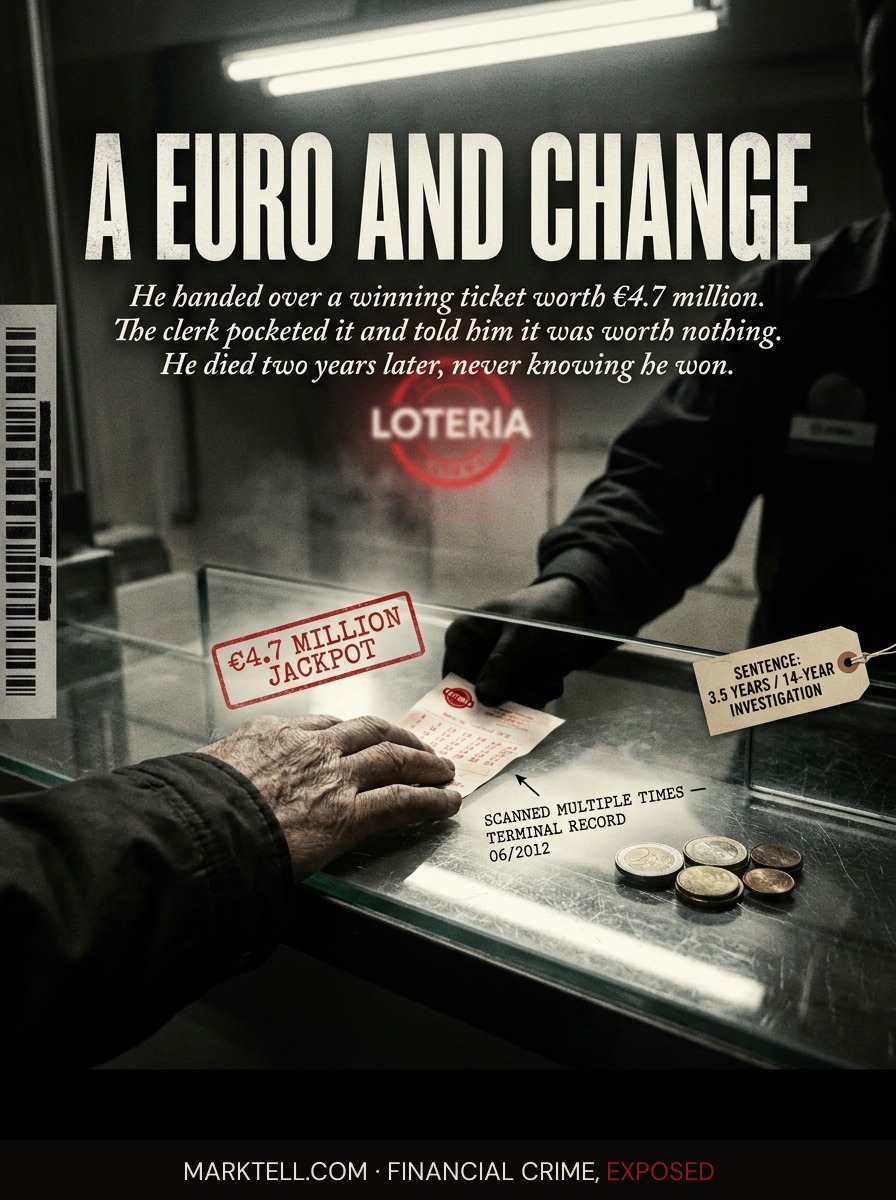
Manuel was sixty-eight and he played the same six numbers every week. He had played them when he still worked the docks, and he kept playing them after his knees gave out and he started taking the long way home just to have somewhere to walk. The numbers were a birthday, an anniversary, and three he could no longer explain to his daughter. He could not have told you why he trusted them. He trusted them the way a man trusts a chair he has sat in for thirty years.
On a Monday in June 2012, he carried his ticket into the lottery shop in A Coruña the way he always did. He handed it across the counter. He waited for the little printed slip that would tell him whether the chair held this week.
The clerk scanned the ticket. The clerk told him it was worth a euro and change.
Manuel took the coins. He walked out.
He died two years later without ever learning what the scanner had actually said.
I.
The clerk's name was Manuel Reija González. The shop was his. The customer in front of him had just handed over a La Primitiva ticket holding the full €4.7 million jackpot. In 2012 dollars, about $5.4M USD. The clerk told the customer the ticket was worth nothing.
Then he kept the ticket.
This is the part of the story I want you to sit with for a second. Not the fraud. The counter.
A lottery counter is a trust machine. The customer cannot read the terminal. The customer cannot see the screen. The customer hands a slip of paper across a sheet of glass and waits for another human being to tell him what the paper says. The whole system runs on the assumption that the person on the other side of the glass will read the screen out loud and tell the truth.
That is the machine. That is the only machine. Everything else, the colored balls, the televised draw, the press conferences when a town wins, all of it sits on top of a single transaction at a counter where one person tells another person what a number says.
Reija read the screen. Then he said a different number.
II.
According to the police investigation led by Chief Inspector José Manuel López, the terminal records showed the winning ticket had been scanned more than once on Reija's machine. Not the single accidental swipe of a clerk discovering a forgotten slip. Multiple scans. Initially mixed in with other tickets belonging to the same customer.
That is the receipt the machine kept on itself.
Reija's first story, the one he told publicly, was that he had found an unclaimed winning ticket in the shop and was trying to locate the rightful owner. The good Samaritan story. The story the local paper would have run with a photo of him smiling behind the counter.
It is a useful story to study. The good Samaritan cover is one of the oldest moves in retail fraud. You declare the theft as a discovery. You announce it loudly. You make yourself the hero of the thing you stole. By the time anyone investigates, you are already on record as the man trying to give it back.
The cover requires one more piece. Someone inside the system who can move the paperwork.
III.
Reija's brother, Miguel, was a provincial delegate for Loterías y Apuestas del Estado, Spain's state-owned national lottery. SELAE for short. That is the agency that runs the draw, holds the prize money, and verifies the winners.
Prosecutors allege Miguel used his position to, in their phrasing, "pave the way" for the prize to be cashed. To disguise the ticket's origin. To omit the verification steps that would have flagged the scan history.
Read that slowly. The man working the counter had a brother in the building where the counter reports to.
That is not a scheme. That is a closed loop.
The closed loop is what the customer cannot see from his side of the glass. He sees a clerk and a scanner. He does not see the brother in the provincial office who can decide which prize files get the careful look and which ones get waved through.
SELAE itself eventually became suspicious of Reija's account. The investigation opened. Terminal records were pulled. The legitimate winner was traced through the play history, the same six numbers played every week from the same shop. Police identified him as a man from A Coruña.
By the time they identified him, he had been dead for two years.
That part may be the saddest. He never knew he won. He died believing the chair had held one more week, the way it always had, and that his six numbers had once again come back as a euro and change.
His widow and his daughter are now the private accusers in the case.
IV.
The investigation took nearly fourteen years. The oral hearing finally happened in April 2026. The Prosecutor's Office asked for six years for Manuel Reija on fraud and embezzlement, and six years for Miguel Reija on money laundering.
On June 12, 2026, the Provincial Court of A Coruña sentenced Manuel Reija González to three and a half years in prison. Both brothers denied wrongdoing throughout.
Three and a half years for a counter and a scanner and a brother and a man who died not knowing.
Picture the widow in her kitchen reading the sentence. Fourteen years is a long time for a letter to arrive.
V.
There is a wider record around this counter that matters.
In July 2024, Spain's Court of Accounts urged SELAE to tighten its anti money laundering controls. The auditors had reviewed prize payment files between 2019 and 2022 and found 15,852 of them with incomplete documentation. Not 158. Not 1,585. Fifteen thousand eight hundred fifty two prize files where the paperwork did not match what the paperwork was supposed to do.
That number does not prove fraud. It proves something else. It proves the counter is not the only place where the trust machine has loose screws. The verification side has them too.
And other counters have done what Reija's counter did. In November 2024, a married couple in Valencia was sentenced to three years for convincing a customer to share a €15 million prize. In December 2025, a man got eighteen months for not sharing a €125,000 Christmas lottery win with a friend.
Different stories. Same room. A person standing at a counter holding a piece of paper, trusting the person on the other side to read it correctly.
VI.
I have stood on the other side of counters like this. Not lottery counters. Phone rooms. Metals desks. Timeshare tables. Rooms where the customer cannot see the screen and has to take your word for what it says.
The thing I want to tell you about those rooms is that nothing about them looks dangerous. The lighting is normal. The clerk is friendly. There is a little bowl of candy near the register. The fraud, when it happens, does not happen with a gun. It happens with a sentence. A euro and change. That is all it takes.
Manuel walked out of the shop with his coins. He went home. He probably stopped for bread on the way. He probably told his wife the numbers had not come in again. He kept playing them. He died in 2014.
The ticket sat in a system that was supposed to find him and did not, because the brother in the office made sure it did not.
The chair did hold that week. He just was not told he was sitting in it.
- Reuters | June 12, 2026 | "Spanish lottery vendor who cheated winner out of $5 million jackpot faces jail"
- Provincial Court of A Coruña | June 12, 2026 | Sentencing of Manuel Reija González
- Spanish Prosecutor's Office | April 2026 | Oral hearing, sentencing requests for Manuel Reija (fraud/embezzlement) and Miguel Reija (money laundering)
- Spanish Court of Accounts (Tribunal de Cuentas) | July 2024 | Audit report on SELAE prize payment files 2019-2022
- Loterías y Apuestas del Estado (SELAE) | 2012 onward | Investigation initiation and terminal records
- Spanish press reports | November 2024 | Valencia couple sentencing, €15 million lottery fraud
- Spanish press reports | December 2025 | €125,000 Christmas lottery sharing case
Editorial Notice
MarkTell is a true crime publication about financial fraud. Some scenes, dialogue, and sequential details are reconstructed from court filings, enforcement actions, news reports, and public records. Where the public record does not provide exact details, editorial reconstruction is used to convey the documented pattern of events. Names of private individuals may be changed to protect identity. All factual claims are sourced to public documents cited in the Evidence Trail above. MarkTell does not provide investment, legal, or financial advice. Nothing published here constitutes a recommendation to buy, sell, or avoid any investment. Allegations described in active cases have not been adjudicated and defendants are presumed innocent until proven guilty. Readers should conduct their own due diligence before making financial decisions.