The thief did not need a truck. He needed a UPS Store mailbox and a name nobody checked.
Aivaras Zigmantas was sentenced May 6 to five years in federal prison for stealing $10.1 million in interstate cargo without breaking a single lock. He used aliases, fake websites, and a load board that takes strangers at their word.
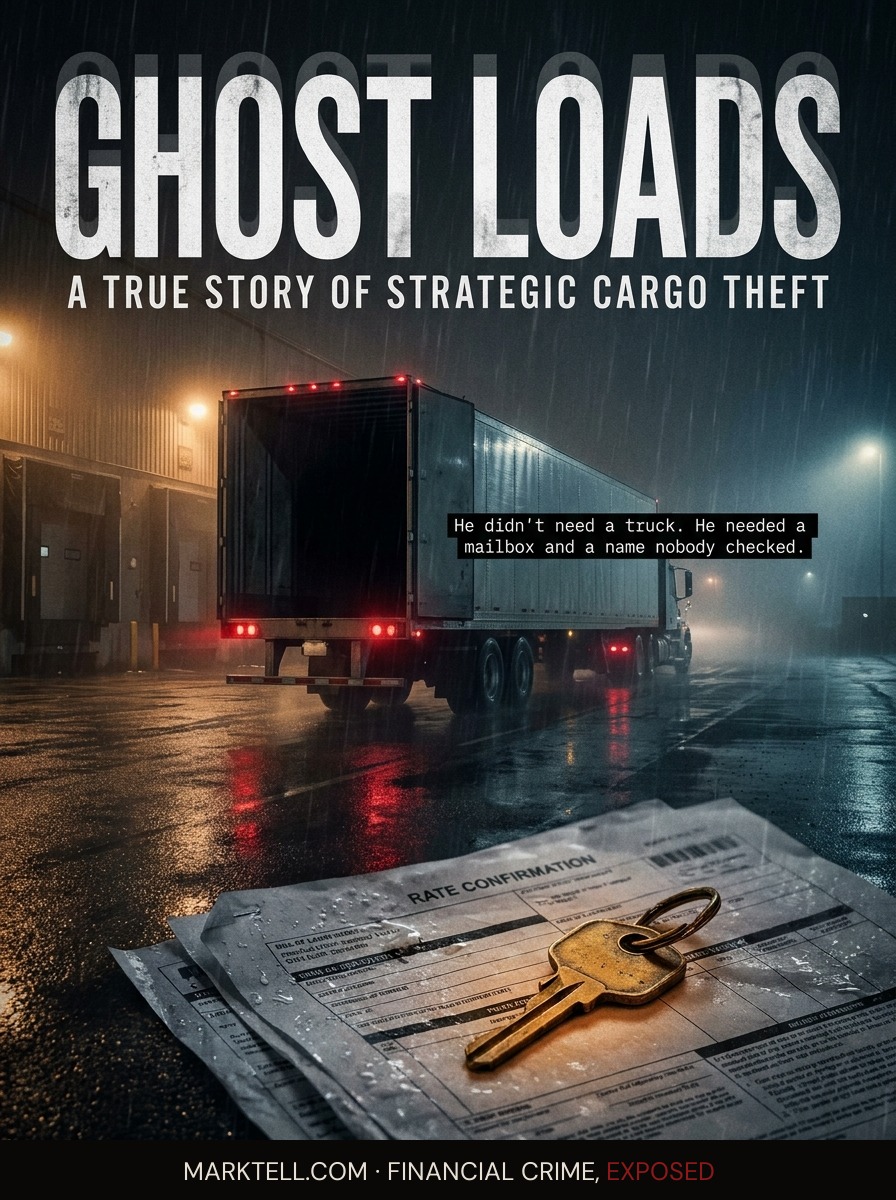
Somewhere outside Chicago, a dispatcher at a freight broker's office clicks accept on a load board at four in the morning. The carrier's MC number is real. The insurance certificate looks right. The email comes from a domain that matches the company name. The phone number rings to a man who knows the lingo. Pickup at the warehouse in three hours. Liquor, palletized, headed for a distribution center two states away.
The truck shows up on time. The driver is a real driver. He was hired off a different load board by a different name, given a rate confirmation, and told where to pick up and where to drop. He signs the bill of lading. He pulls away. He does not know that the broker who hired him does not exist and that the address on his rate confirmation is a UPS Store mailbox in a strip plaza in Elk Grove Village.
The cargo never reaches the consignee. By the time anyone notices, the trailer has been emptied into another trailer at a yard nobody can find, and the liquor is moving through a secondary market that does not ask hard questions about provenance.
That is one load. According to the U.S. Attorney's Office for the Northern District of Illinois, between 2020 and 2023, this pattern repeated until the totals reached $10.1 million in goods actually stolen and at least $14.6 million attempted.
The man at the center of it pleaded guilty to federal wire fraud in December 2025. On May 6, 2026, U.S. District Judge Elaine E. Bucklo sentenced Aivaras Zigmantas, 41, of Elk Grove Village, Illinois, to sixty months in federal prison.
Five years for ten million dollars in cargo he never had to physically steal.
I.
The thing to understand about the modern freight room is that it runs on trust the way a phone room runs on a script. There is a load board. There are MC numbers, which are the federal license numbers a motor carrier needs to operate. There are insurance certificates. There are emails and phone numbers and W-9s and rate confirmations. There is a clock, because freight does not wait, and the dispatcher who hesitates loses the load to the broker who does not.
What there is not, in most rooms, is a face.
The dispatcher does not see the carrier. The carrier does not see the shipper. The driver does not see the broker. Everyone is taking everyone else's paperwork at face value because the system was built for speed, and the people who built it for speed assumed that the friction of registering a real motor carrier was friction enough to keep most of the bad actors out.
That assumption is the door Zigmantas walked through.
II.
According to the Department of Justice, Zigmantas built carriers and brokers that did not exist. He registered businesses using fraudulent driver's licenses and foreign passports. He opened UPS Store mailboxes and used them as the official addresses of the fake companies. He created email accounts and websites that looked like the websites of real logistics firms. He used aliases, including the names Rolandas Butkus and Kathy Stone, to talk to shippers on the phone and over email.
He impersonated real carriers, which is its own particular cruelty. A small trucking company in some other state, three trucks and a dispatcher, would lose a contract and not know why. The shipper would think the small carrier had stolen the load. The small carrier would think the shipper was crazy. They were both being run.
He also impersonated real freight brokers, which is the other half of the trick. A broker stands between the shipper and the carrier. The broker says I have a load, who wants it. If the broker is fake, the load that gets booked is a load nobody is actually managing. The driver who shows up is hired by a person who does not exist, hauling for a company that does not exist, delivering to an address that exists only on paper.
The cargo Zigmantas targeted was not random. Liquor. Commercial-grade copper. High-value, fungible, easy to move on a secondary market.
III.
The industry has a name for this now. Strategic theft. It is theft by deception rather than theft by force. There is no glass broken, no fence cut, no warehouse pried open in the middle of the night. There is just a dispatcher at four in the morning clicking accept.
According to Verisk CargoNet, strategic theft increased 1,475 percent between 2022 and 2024. Cargo theft losses in 2025 reached an estimated $725 million, a 60 percent jump in a single year. The Truckstop 2024 Freight Fraud Report put losses at $455 million across 65,000 incidents, and that was before the worst year on record.
These numbers are abstract until you watch one truck pull away from one warehouse with one load on it.
IV.
I want to say something about the room.
I have never sat in a freight broker's office. I have sat in plenty of phone rooms. The freight room is not the same room. But the bones are the same. There is a script. There is a clock. There is a screen. There is a person on the other end of the line whose voice has to sound right, because in a phone room the voice is the only verification.
When I sold metals in Chicago, the customer never saw the platinum. He saw a confirmation slip in the mail. The slip looked correct. The voice on the phone had sounded correct. The wire had cleared. The platinum, if there was platinum, was in a vault somewhere he was never going to visit.
The freight system runs on the same theology. The shipper never sees the carrier. The carrier never sees the broker. Everyone trusts the paperwork because the paperwork looks correct.
Zigmantas understood that. He did not need a truck. He needed paperwork that looked correct and a voice that sounded correct and a mailbox the post office would deliver to.
V.
Here is the part that should bother every person in the supply chain.
The DOJ press release does not name the victim companies. It does not have to. There were many. The complaint describes shipments diverted, not a shipment. Multiple carriers impersonated. Multiple brokers fabricated. A scheme that ran for three years before the federal government put the pieces together.
Three years of clean pickups. Three years of paperwork that looked correct. Three years of shippers eating the loss, or insurers eating the loss, or small carriers eating the reputational cost of being impersonated by a man they had never met.
The investigation was run by Homeland Security Investigations and U.S. Customs and Border Protection, working through the Department of Justice's Trade Fraud Task Force. Assistant U.S. Attorney Kate McClelland prosecuted. Special Agent-in-Charge Matthew Scarpino ran HSI's piece.
It took federal investigators with subpoena power and inter-agency coordination to unwind a scheme that, on the front end, was nothing more than a man at a laptop with a UPS Store key.
VI.
Five years.
That is what the federal sentencing guidelines and Judge Bucklo arrived at on May 6 in Chicago. Five years for a fraud that the government valued at $10.1 million in actual loss and $14.6 million in intended loss.
Do the math on that yourself. Read it slowly.
The man stole, by the government's accounting, the equivalent of two million dollars per year of operation. He will serve, if he serves the full term, the equivalent of one year per two million.
That is not a statement about whether the sentence is fair. That is a statement about the economics the next person is doing in his head right now.
VII.
Zigmantas is not a unique villain. He is a node in a much larger machine. FreightWaves reported in March on a $9.4 million fake vendor invoice scheme run against Amazon and a $3.5 million ghost trailer scam involving 23 fake trucking companies billing for movements that never happened. The TIA Watchdog, a fraud reporting system run by the brokers' trade association, logged a 65 percent increase in fraud reports in a six-month window ending in February 2025.
The machine works like this.
Register a business. Open a mailbox. Build a website. Apply for an MC number, or impersonate one that already exists. Get on the load board. Take a load. Disappear.
Then do it again under a new name.
The fake LLC is the disposable wrapper. When one wrapper burns, you peel it off and put on the next one. The mailbox is at a UPS Store because UPS Stores will rent to anyone with paperwork that looks correct. The paperwork looks correct because nobody in the chain has the time, or the legal authority, or the financial incentive, to verify it past the surface.
VIII.
Picture the dispatcher again. Four in the morning. The screen glow. The carrier with the right MC number, the right insurance, the right email domain, the right voice on the phone. The clock running because the load has to move.
She clicks accept.
She is not stupid. She is the reader of this piece. She is the system working as designed.
The system was designed for a world in which most people on the load board were real. The system was not designed for a world in which a man in Elk Grove Village could spin up a carrier in an afternoon, run it for a week, take three loads, and vanish.
Zigmantas got five years. The mailbox is empty now. The load board is still running. Somewhere this morning a dispatcher clicked accept on a carrier whose MC number is real and whose paperwork is clean and whose voice on the phone sounded correct.
That is the machine. The man who went to prison this week was not the machine. He was a worker on the floor.
- U.S. Attorney's Office, Northern District of Illinois | May 6, 2026 | DOJ press release on sentencing of Aivaras Zigmantas
- CDLLife | May 2026 | Reporting on Zigmantas sentencing
- Verisk CargoNet | 2025 annual data | Cargo theft loss estimates
- Truckstop | 2024 Freight Fraud Report | Industry loss data
- TIA Watchdog | reporting period September 2024-February 2025 | Fraud report volume
- FreightWaves | March 2026 | Reporting on Amazon vendor invoice scheme and ghost trailer scam
Editorial Notice
MarkTell is a true crime publication about financial fraud. Some scenes, dialogue, and sequential details are reconstructed from court filings, enforcement actions, news reports, and public records. Where the public record does not provide exact details, editorial reconstruction is used to convey the documented pattern of events. Names of private individuals may be changed to protect identity. All factual claims are sourced to public documents cited in the Evidence Trail above. MarkTell does not provide investment, legal, or financial advice. Nothing published here constitutes a recommendation to buy, sell, or avoid any investment. Allegations described in active cases have not been adjudicated and defendants are presumed innocent until proven guilty. Readers should conduct their own due diligence before making financial decisions.