The tax man knew what was in everyone's drawer. That was the whole machine.
For three decades, Miles Burton Marshall sold his Hamilton neighbors an eight percent return backed by rental houses he could point to from the sidewalk. The houses were real. The math behind them was not.
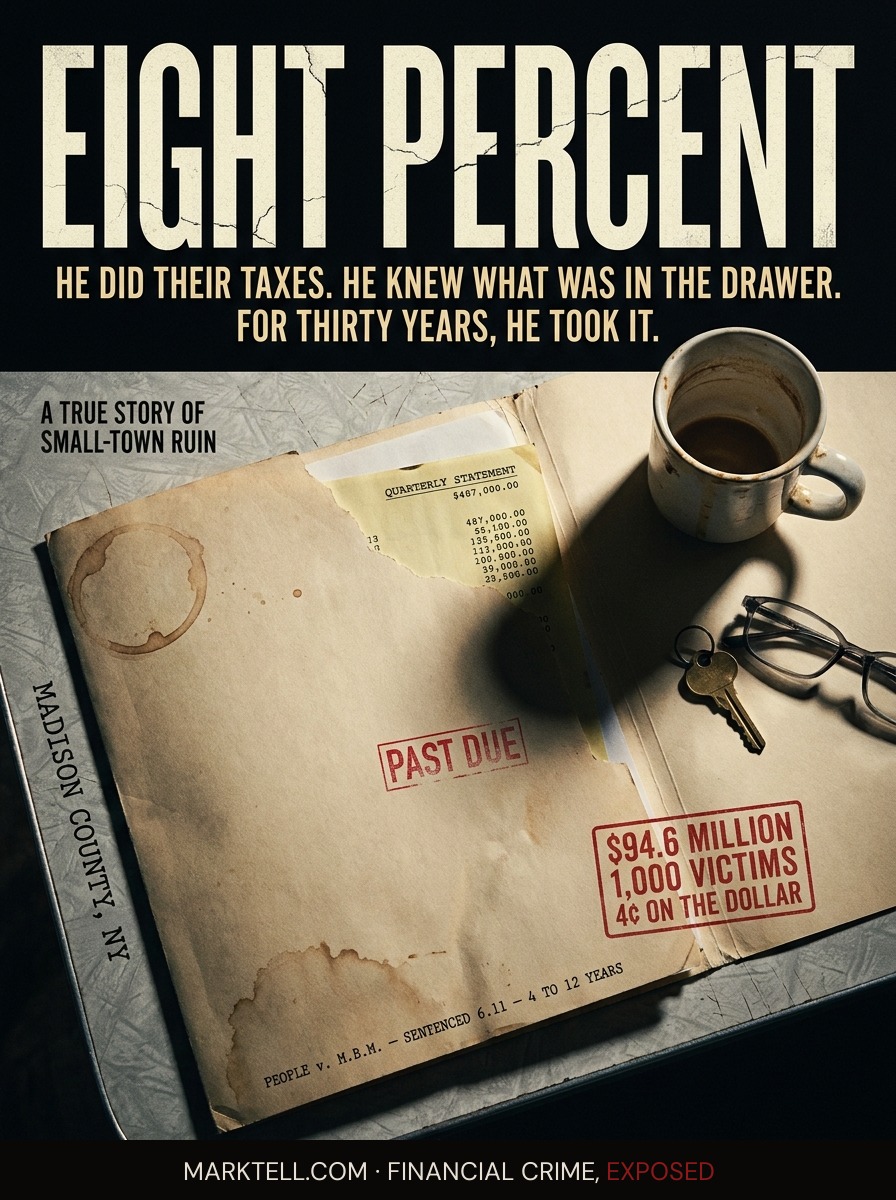
Eleanor kept the statements in a manila folder next to the recipe box. That is where the important things went. Birth certificates in the safe, the will at the lawyer's, and the quarterly notices from Burt Marshall in the kitchen, because the kitchen was where she sat down with her coffee and read.
She was seventy-one. She had managed dining services at Colgate for thirty-one years before she retired. She knew how to count plates and how to count money, and she had been getting an eight percent return from Burt for almost as long as she had been counting either.
Eight percent. Compounding. Backed, he always said, by the rental houses.
You could see the houses. That was the part that made it make sense. She could drive past them on Broad Street and on Lebanon and on the little side streets behind the campus. White clapboard, two stories, students on the porch in September, a fresh coat of paint every few summers. Burt owned more than a hundred of them across Madison County. He had pointed them out at the diner. The houses were real.
The money was real, too, for thirty years. The check came the same week every quarter. She paid her taxes with it. She bought her grandson's hockey skates with it. She let most of it ride, because Burt said compounding was the whole point, and Burt did her taxes, so Burt would know.
That is the first thing to understand about this machine. The man who did your taxes was the man who took your deposit. He sat at the same desk for both.
II.
Miles Burton Marshall went by Burt. He was seventy-four when he pleaded guilty on April 28 in Madison County court to second-degree grand larceny, securities fraud, and a first-degree scheme to defraud. The New York Attorney General's office had been building the case since the collapse in March 2023.
On June 11, Judge Rhonda Youngs sentenced him to between four and twelve years in state prison. She called him a con man. She said he had left a trail of devastation. As part of the plea, a bankruptcy court will enter a $94.6 million judgment against him. His own defense attorney, Jeffrey Parry, told the room what everyone in the room already knew. The number is symbolic. There is no money to pay it.
Victims have recovered, by current estimates, four cents on the dollar.
Read that slowly. Four cents on the dollar. Across nearly a thousand people. Across thirty years.
III.
Here is how the machine ran.
Burt was the tax man. He was also the insurance agent. In a town of a few thousand people, those two jobs put him inside the financial life of almost every household worth being inside of. He knew what was in the drawer. He knew what the mortgage was. He knew which widow had just inherited and which farmer had just sold the back forty.
He did not need a brochure. He did not need a pitch deck. He had something a Manhattan operator would pay millions for. He had standing.
What he offered was not complicated. Give me your money. I will pay you eight percent. I will buy rental property with it. The property is the security. You can drive past it.
The properties existed. That was true. Marshall accumulated more than a hundred rental units in Madison County over thirty years. The Attorney General's office puts the real estate's value at roughly $25 million.
The claimed obligations to investors at the end were $94.6 million.
Do the math. Put $25 million on one side of the line. Put $94.6 million on the other. The gap is the story.
By 2016, according to the case file, his liabilities exceeded his assets by more than $40 million. He kept taking deposits anyway. He had to. That is how the machine works. The eight percent he paid Eleanor in the spring of 2017 came from the deposit the dentist's widow handed him in the winter of 2017. The check Eleanor cashed was real. The source of the funds was the next neighbor's trust.
That is not a real estate business. That is a ledger that runs on community.
IV.
The eight percent is worth pausing on, because it is the lure inside the lure.
Eight percent compounding annually is not, on its face, a fantastical number. A Madoff promised twelve. Some of the oil-and-gas frauds I worked on at the SEC promised eighteen. Eight sounds reasonable. Eight sounds like the kind of return a thoughtful local man might earn by buying houses cheap and renting them to college students at a markup.
That is the design. The number was low enough to be believed. And compounded across thirty years, eight percent doubles a balance roughly every nine years. A neighbor who handed Burt $50,000 in 1993 and let it ride had, on paper, something close to $400,000 by 2023.
On paper.
The paper was the problem. The paper kept growing. The houses did not. There was no underlying business that could service eight percent on $94.6 million in claimed principal. There never had been. The compounding was the wound. The longer a believer believed, the bigger the hole became when the music stopped.
The believers who took their interest in cash, like Eleanor sometimes did, came out less destroyed. The believers who let it ride, who trusted Burt to hold and grow it, who watched their statements climb into six figures and seven, those are the ones whose grandchildren are not going to college on what they thought was waiting.
V.
The collapse, when it came in March 2023, did not come from a regulator. It did not come from a journalist. It came, the way these things almost always come, from a check that did not clear.
Then another.
Then a phone call to the office on Lebanon Street that went to voicemail.
Eleanor remembers the second missed week more than the first. The first week she assumed there was a mailing delay. The second week she drove past the office. The lights were on. The door was locked. There was a piece of paper taped to the inside of the glass and she could not read what it said from the sidewalk.
She went home. She sat at the kitchen table. She opened the manila folder next to the recipe box and she looked at the most recent statement, which said she had a balance of something she will not say out loud to her children.
She did the thing every mark does in that chair. She read the statement again. She tried to find the sentence in it that would make the missing check make sense.
There was no such sentence. There never is. The statement was the sentence.
VI.
The Attorney General's office, run by Letitia James, prosecuted the case. James said Marshall "scammed his clients out of their life savings." That is the prosecutor's language. It is accurate and it is also, in its way, gentle. Scammed is a soft verb for what happened.
Here is the harder version. Marshall did not steal from strangers. He stole from people whose tax returns he had prepared. He stole from people whose homeowner's policies he had written. He stole from people who had hired him to know exactly how much they could afford to lose, and then he used that knowledge to take it.
That part may be the worst part. Not the number. The intimacy of the number.
A stranger who takes your money in a cold call is committing a theft. A neighbor who takes your money after reviewing your 1040 is committing something the law does not have a separate word for.
VII.
At sentencing on June 11, Marshall expressed remorse. Several victims, according to reporting from the Colgate Maroon-News, said they did not believe him. Judge Youngs imposed four to twelve years. Marshall is seventy-four. The math on the back end of that sentence is its own kind of math.
The $94.6 million judgment will be entered in bankruptcy court. It will sit there as a number. Parry, the defense attorney, said plainly that his client has nothing left. The four cents on the dollar is what the bankruptcy estate could scrape together from the houses, the accounts, the everything.
Four cents.
For Eleanor that is enough to cover what she would have made in interest in the last quarter of the last year. It does not return the principal. It does not return the thirty years of compounding she thought she had earned. It does not return the part she cannot say out loud.
VIII.
There is a thing worth saying about the machine, because the machine will run again, under a different name, in a different town, with a different trusted figure at the desk.
The machine is not the eight percent. The machine is not even the rental houses. The machine is the standing. It is the person in your community who has access to the inside of your financial life and has been there long enough that you stopped asking yourself why. The mechanic who manages a fund on the side. The pastor with the real estate opportunity. The insurance agent who can get you into something his other clients are already in.
The fraud requires the standing. Without the standing, the pitch sounds like what it is.
Marshall had the standing for thirty years. He used it the entire time.
Eleanor's manila folder is still next to the recipe box. The statements in it are now what the lawyers call evidence. She does not open the folder anymore. She does not need to. She knows what is in it. She knows what is not.
The check did not come because the check had never really come from where she thought it came from. It had come from her neighbor. And her neighbor's had come from her. And both had come, in the end, from a man at a desk who did their taxes and knew exactly what to ask for.
- The Colgate Maroon-News | June 12, 2026 | "A Town Betrayed: Hamilton Businessman Admits to $94.6 Million Ponzi Scheme"
- New York State Office of the Attorney General | 2026 | Public statements from AG Letitia James regarding Marshall prosecution
- Madison County Court | April 28, 2026 | Guilty plea: second-degree grand larceny, securities fraud, first-degree scheme to defraud
- Madison County Court | June 11, 2026 | Sentencing by Judge Rhonda Youngs
- Bankruptcy proceedings | 2023-2026 | $94.6M judgment, asset/liability reconstruction
Editorial Notice
MarkTell is a true crime publication about financial fraud. Some scenes, dialogue, and sequential details are reconstructed from court filings, enforcement actions, news reports, and public records. Where the public record does not provide exact details, editorial reconstruction is used to convey the documented pattern of events. Names of private individuals may be changed to protect identity. All factual claims are sourced to public documents cited in the Evidence Trail above. MarkTell does not provide investment, legal, or financial advice. Nothing published here constitutes a recommendation to buy, sell, or avoid any investment. Allegations described in active cases have not been adjudicated and defendants are presumed innocent until proven guilty. Readers should conduct their own due diligence before making financial decisions.