The straw student was the product. The classroom was the cover.
For nearly a decade, Brandon Robinson fed names into the federal student aid pipeline and the pipeline paid him back. The classrooms were real. The students were not.
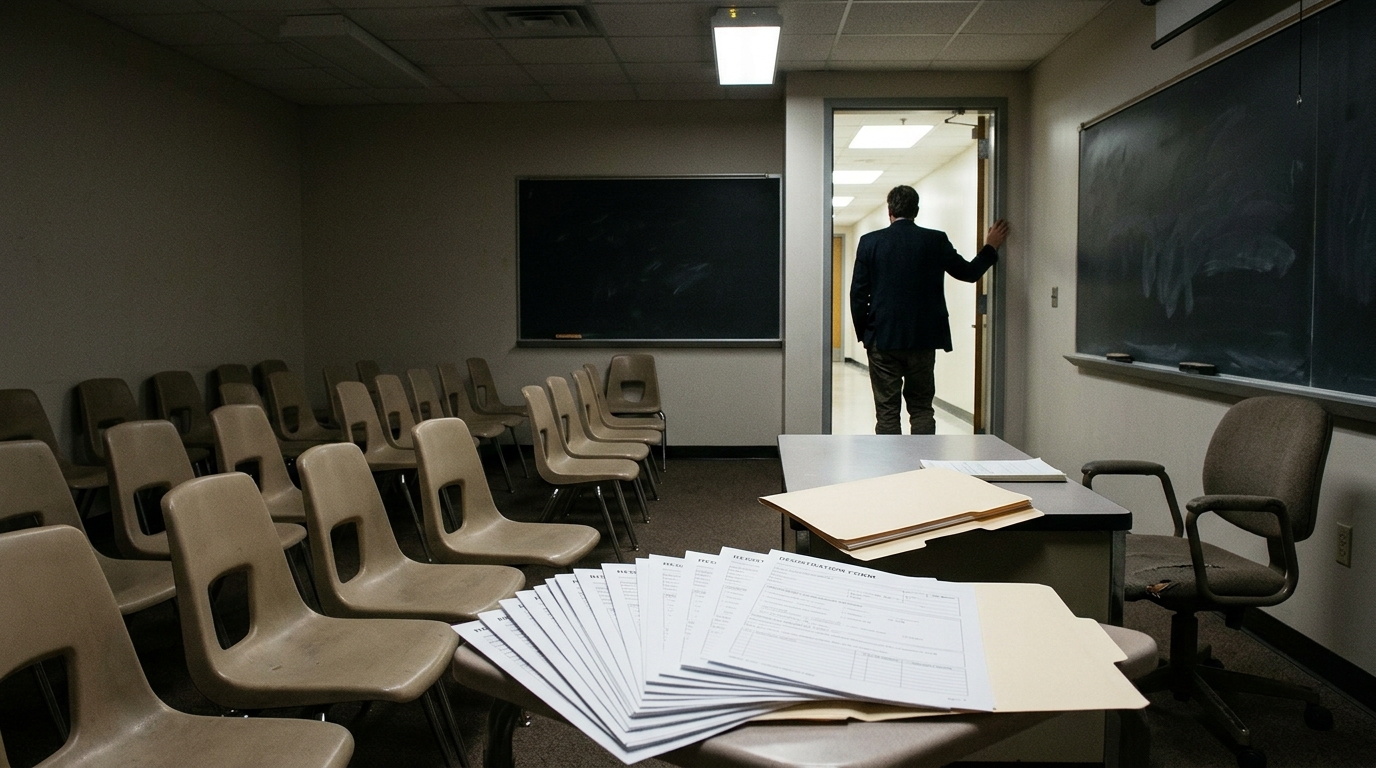
The file came back wrong.
That is how these things start. Not with a tip. Not with a whistleblower. With a financial aid officer at Nunez Community College in Chalmette, Louisiana, looking at a screen and thinking, this name does not belong to a person who is trying to take a class. The address did not match. The coursework did not match. Something about the rhythm of the file was off in the way that twenty years behind a desk teaches you to feel before you can name it.
That was 2022. The complaint went up the chain to the U.S. Department of Education Office of Inspector General. The thread the officer pulled ran out of Louisiana, through twenty-three other states, and ended in Detroit, in a federal courtroom on May 6, 2026, where a man named Brandon Robinson stood up and pleaded guilty.
He had been running the pipeline since January 2015.
Nine years.
Read that slowly. Nine years inside a system that is supposed to be the cleanest pipe the federal government runs. Pell grants. Direct loans. The aid that puts a kid through community college. Robinson, according to his plea, fed it 1,200 identities. Across more than 100 schools. Across 24 states. He submitted the FAFSA. He filled in the income lines. He clicked the boxes that said this person wants to learn. The schools admitted them. The Department of Education awarded over $16 million in federal student aid against those names. More than $10 million of it actually moved.
That is the machine. Not a Ponzi. Not a pump. An enrollment pipeline. A funnel where one end is a Social Security number and the other end is a refund check.
I want to stop here and explain something, because the term will come up and most people do not know it. A federal student aid refund is what happens when the aid award is bigger than the tuition bill. The school takes its cut. The leftover gets sent back to the student. In a real classroom, that is the money the kid lives on. Rent. Books. Bus fare. In Robinson's pipeline, the leftover went to the operator. The student was a name on a form. The classroom was a cover. The refund was the product.
The Department of Education calls people like the names on those forms straw students. The phrase is technical and I do not love it. A straw student is a person enrolled who has no intention of attending. Sometimes the name belongs to a real person whose identity was taken. Sometimes the name is synthetic, stitched together from a Social Security number that belongs to a child or a dead person and a date of birth that belongs to nobody. Robinson pleaded guilty to aggravated identity theft, which tells you that at least some of the names on his forms were real people. Real people who will spend years explaining to a loan servicer that they did not enroll at a community college in another state in 2019.
That part may be the saddest. The taxpayer money is gone. The taxpayer money will always be gone. But the names get to keep carrying the weight.
There is a second pipeline in this case that the headlines mostly missed. Between April 2020 and March 2023, while the country was sending unemployment checks out faster than it could verify them, Robinson admitted to filing over 100 fraudulent unemployment claims. Over $1 million paid out. Same machine. Different valve. He found a system designed to move money fast in a crisis and he put names into it.
Picture it. The pandemic hits. Schools go online. Verification goes from a person in an office to a checkbox on a website. The Department of Education has since acknowledged that before 2020, less than one percent of student aid applicants were ever asked to prove they were who they said they were. Less than one percent. The door was open. Robinson walked through it. So did the woman who pleaded guilty in the same federal district six weeks earlier, on March 23, 2026. Michelle Denise Hill, 48, also of Detroit. She enrolled more than 80 names at Wayne County Community College, got them high school diplomas, and did the online coursework herself to keep the aid flowing. Two and a half million dollars over the better part of a decade.
Two cases, same city, same month, same machine.
The DOE says it has prevented over $1 billion in fraud since January 2025 by adding identity verification to the FAFSA. That is the door being closed. It is being closed because the door was open for fifteen years and people noticed.
Here is the part where the renaming happens. The Department of Education calls this a fraud control problem. The U.S. Attorney's Office calls it wire fraud and aggravated identity theft. Both are correct. Neither captures it. What Robinson built, according to his plea, was a small business. It had vendors. It had repeat customers. It had a workflow. It ran for nine years and crossed twenty-four state lines before a financial aid officer in Louisiana looked at one file and decided it did not feel right.
The legitimate student is the one who pays for this. Not in dollars. In friction. The kid in Fresno who fills out the FAFSA next fall and gets flagged for verification because the system has finally learned to be suspicious. The single mother in Detroit whose application sits in review for six weeks because somewhere upstream, somebody like Robinson taught the machine that names are not people.
Robinson faces up to 20 years for the wire fraud count. The aggravated identity theft count carries a mandatory consecutive 24 months. He is scheduled to be sentenced on September 1, 2026, in the Eastern District of Michigan. His co-conspirators, Antonio Robinson and Joshuan Porter, are scheduled for July 7 and August 4. Three pleas. One pipeline.
The pipeline is closed. The valve is being tightened. The next operator is already looking at the next valve.
He thought he was enrolling students. He was harvesting names.
- CBS News | May 6, 2026 | Detroit man pleads guilty in $16 million federal student aid fraud case
- U.S. Attorney's Office, Eastern District of Michigan | May 6, 2026 | plea announcement, U.S. v. Brandon Robinson
- U.S. Department of Education Office of Inspector General | investigative record, 2022-2026
- U.S. Department of Education | April 4, 2026 | announcement on $1B+ in prevented FSA fraud and identity verification rollout
- U.S. Attorney's Office, Eastern District of Michigan | March 23, 2026 | plea announcement, U.S. v. Michelle Denise Hill
- U.S. Department of Labor Office of Inspector General | unemployment insurance fraud investigative materials
Editorial Notice
MarkTell is a true crime publication about financial fraud. Some scenes, dialogue, and sequential details are reconstructed from court filings, enforcement actions, news reports, and public records. Where the public record does not provide exact details, editorial reconstruction is used to convey the documented pattern of events. Names of private individuals may be changed to protect identity. All factual claims are sourced to public documents cited in the Evidence Trail above. MarkTell does not provide investment, legal, or financial advice. Nothing published here constitutes a recommendation to buy, sell, or avoid any investment. Allegations described in active cases have not been adjudicated and defendants are presumed innocent until proven guilty. Readers should conduct their own due diligence before making financial decisions.