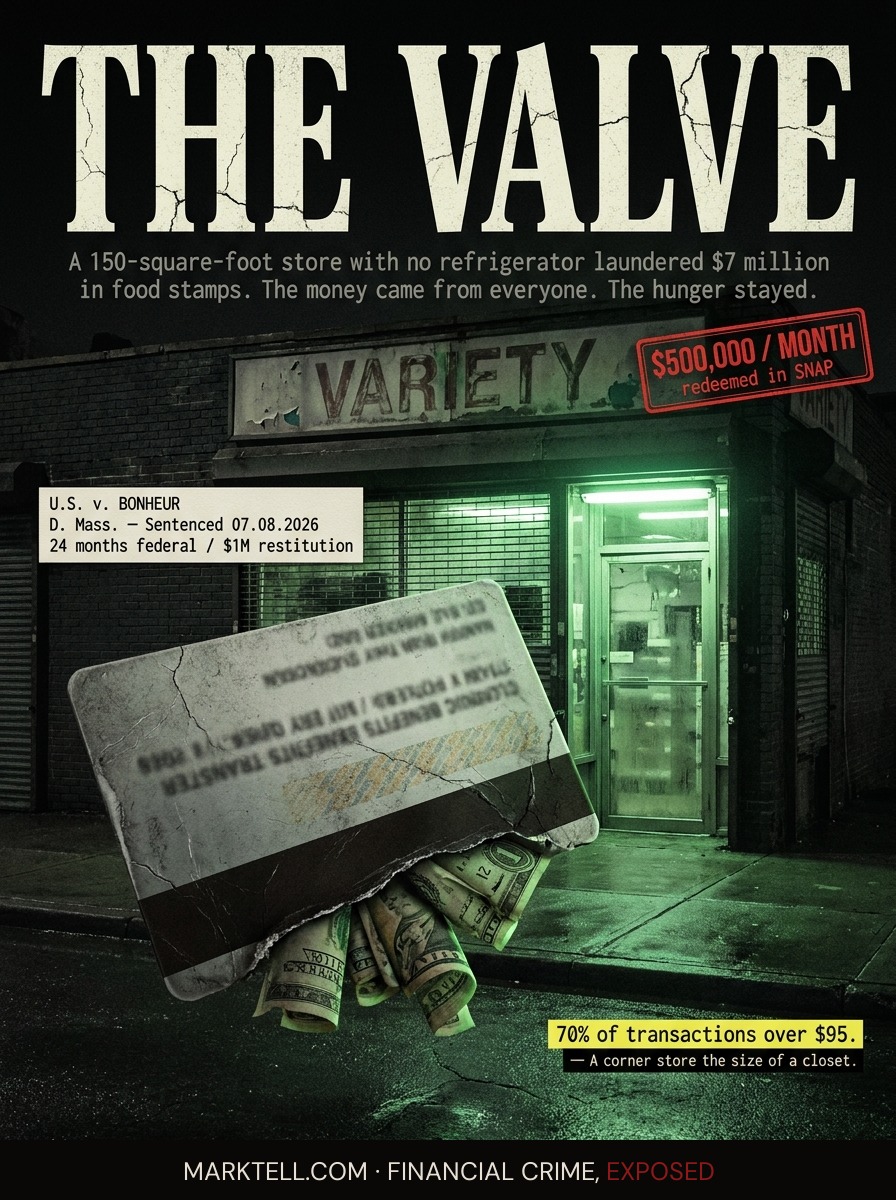
The store was 150 square feet. The redemptions were half a million a month.
Antonio Bonheur ran a 150-square-foot storefront in Mattapan that pulled more SNAP money in a month than a full supermarket. Federal prosecutors say the store had no refrigerator, almost no food, and a bank structure built to hide what the register was actually doing.
Marielle counted the last week of the month on her fingers before she counted it on her card.
Fifty-eight years old. Home health aide. Two grandchildren in the apartment and a mother in the back bedroom whose insulin came before the grocery list. She lived in Dorchester. She shopped where the bus dropped her, which was usually a corner store because the corner store was closer than the supermarket and the supermarket was closer than a car she did not own.
She used SNAP. The Supplemental Nutrition Assistance Program. Food stamps, if you grew up calling it that. A federal benefit loaded onto an EBT card that works like a debit card at the register, but only for food, and only for certain foods, and only until the balance runs out.
Marielle knew the rule everyone in the building knew and no one said out loud. Some corner stores would take the card for things the card was not supposed to buy. Some would give you cash for the balance, sixty cents on the dollar, and you could use the cash for the electric bill or the laundromat or a birthday cake at the grocery store that would not let you buy a birthday cake with the card. It was not a good deal. It was the only deal.
She never used Jesula Variety. She had heard the name. She had walked past the door. It was on the record, though, in a way she did not know until later. Jesula Variety was on the record for taking in seven million dollars in SNAP benefits over three years and change, from a storefront the size of a walk-in closet, with no refrigerator and almost no food.
That is the machine this chapter is about. A valve. A small door in a small building where public money went in and cash came out. Someone had to be standing at the door taking a cut. That someone, according to the U.S. Attorney's Office for the District of Massachusetts, was a seventy-five-year-old man named Antonio Bonheur.
He was sentenced on July 8, 2026. Two years in federal prison. Two years supervised release. A million dollars in restitution as a money judgment. About four hundred thousand dollars in seized funds forfeited outright. He had pleaded guilty in March to one count of food stamp fraud and one count of wire fraud.
The store was called Jesula Variety. One hundred and fifty square feet in Mattapan, a neighborhood in Boston. Prosecutors described it as having limited legitimate food inventory, no refrigeration, and minimal lawful revenue.
Now the number.
Between $100,000 and $500,000. That is what Jesula redeemed in SNAP benefits each month, according to the U.S. Attorney's Office. A full-service supermarket in the same area pulls about $82,000 a month. Jesula, on its bad months, was doing more than a supermarket. On its good months, it was doing six supermarkets.
Read that slowly.
A 150-square-foot store with no refrigerator was redeeming more federal food benefit dollars than the store where you could buy a whole chicken.
That is not a busy corner. That is a valve.
II. The Register
Picture the room. This is reconstruction, not a photograph. Prosecutors describe the store as small, thinly stocked, no cold case. If you have been in a bodega in a low-income neighborhood you can build the rest. A door with a bell. A counter with plexiglass. Shelves with chips and crackers and canned goods and cleaning supplies. Lottery tickets under glass. A register that would ring up a bag of rice the same way it would ring up something that never left the shelf.
The way retailer trafficking works, in plain language, is this. A customer walks in with an EBT card. Instead of buying food, they hand the card over. The clerk rings up a food purchase that never happens. Say the customer wants forty dollars in cash. The register shows a sixty-dollar food sale. The customer walks out with forty dollars in cash. The store keeps twenty. The SNAP system, seeing only the transaction record, believes sixty dollars of food was sold to a hungry household.
That is one transaction. Now do it a thousand times a month.
The paper trail is what gave the pattern away. Investigators found that only about ten percent of SNAP transactions at Jesula were under forty dollars. More than seventy percent were over ninety-five dollars. That is a supermarket pattern. A cart full of groceries. Not a corner store where people come in for a loaf of bread and a can of beans.
Prosecutors also allege the store was selling things it was never supposed to sell in exchange for SNAP. Liquor. And, more specifically, MannaPack meals. Those are rice-and-soy packets manufactured by a nonprofit and donated for distribution to food-insecure children overseas. According to the U.S. Attorney's Office, they were being sold out of Jesula for about eight dollars a packet.
Food meant for children who were starving in another country, sold for cash in a storefront in Mattapan.
That part may be the saddest.
III. The Second Register
The register in the store is only half of it. The other half is the register in the bank.
Seven million dollars does not sit in a shoebox. It has to become the kind of money you can spend without a federal agent asking where it came from. That is called concealment, and prosecutors say Bonheur handled it with a network of secondary bank accounts, moving SNAP proceeds between them, withdrawing, redepositing, so the flow looked like ordinary business activity.
This is the part of the machine most readers never see. The store is the visible half. The visible half looks small, almost pitiful. A little door on a little block. The bank half is where the money actually lived. Deposits into one account, transfers to another, cash withdrawn here, redeposited there, mixed with what small legitimate business the store did, until, on paper, it looked like a working store.
He was, according to the plea, keeping about twenty percent for himself. The other eighty percent was cash paid back to the people who came in with the cards.
There is one more detail, and it is the one that lands hardest for anyone who has stood in a benefits office. Prosecutors say Bonheur himself fraudulently obtained SNAP benefits. The Massachusetts Department of Transitional Assistance issued him an EBT card after he made false statements about his income and assets.
Read that again. The owner of the store the state was subsidizing to the tune of six figures a month, was himself, on paper, poor enough to qualify for food stamps.
IV. The Oversight
Somebody was supposed to catch this.
The Massachusetts Department of Transitional Assistance, DTA for short, runs the state end of the SNAP program. It approves the cards and it approves the recipients. U.S. Attorney Leah Foley, in the announcement of the sentencing, criticized what she called a "lack of oversight" that allowed a "multi-million-dollar scheme" to persist.
The state pushed back. Governor Maura Healey's office said DTA had reported suspicious activity at Jesula Variety to the USDA more than a year before the federal charges came down.
Both things can be true. The state can have flagged it and the federal government can have taken a year to move. The federal government can have received a report and needed time to build a case that would survive a plea deal. Neither excuse makes the timeline shorter. Neither excuse gives back the three-plus years the store ran.
And this is not a Massachusetts problem. It is a program problem. In January 2026, a USDA Inspector General report noted that the federal Food and Nutrition Service has not required states to adopt security standards to prevent SNAP theft. Between October 2022 and December 2024, $322 million in stolen benefits were replaced. The Inspector General forecast $233 million in fraud for fiscal years 2025 and 2026.
Retailer trafficking, the kind prosecutors say Jesula ran, is estimated to cost taxpayers close to $2 billion a year.
That is the machine at scale. Jesula was not an aberration. It was a working example.
V. Marielle at the End of the Month
Marielle finished her month the way she always finished her month. Envelopes on the kitchen table. The balance on her phone at zero, or close enough. The knowledge that the first of the next month would reset the number and that she would spend the next four weeks watching it come down again.
She read about the sentencing in a free paper someone had left in the break room at work. Seven million dollars. Two years in prison. A store in her neighborhood she had walked past.
She did not feel vindicated. The families who lost money to Jesula were not families like hers, at least not directly. The money came out of the federal SNAP budget, which is to say, out of everyone. The immediate victims were the customers who traded a dollar of benefit for sixty cents of cash because the month ran longer than the balance. They lost forty cents on the dollar and got called criminals in the same paragraph as the store owner who took the forty.
The sentence, when she thought about it, was for the seven million. Not for what the seven million said about the arithmetic of her building. Not for the fact that a program designed to feed her mother had, at the retail end, become a valve someone was skimming.
VI. What the Machine Looks Like Next Time
Retailer trafficking is not a Ponzi. It is not a private placement. It is a smaller kind of theft, and a more embedded one. The mark is not the customer at the counter. The mark is the program. The program is funded by the reader.
Look for the pattern.
A small store in a poor neighborhood. Redemption volumes that do not match the shelf space. Transactions clustered above ninety dollars in a store that does not sell ninety dollars of anything. No refrigeration and no fresh food, in a program designed to move fresh food. Bank accounts multiplying under one owner. A state agency that flagged it and a federal agency that took a year.
That is the machine. It is running right now, under other names, in other storefronts, in other cities. The Los Angeles crackdown on July 7, 2026 hit thirty-three retailers in a week. The USDA Inspector General reported nearly a thousand arrests since February 2025.
Seven million dollars is the number that put Antonio Bonheur in a federal courtroom on July 8. It is not the number that describes the system. The system's number is closer to two billion a year, and the system's number does not get sentenced.
Marielle put the paper down and got ready for the second shift. The balance would reset on the first. The store on the corner where she did not shop would stay closed. Another one would open somewhere.
The card in her wallet was for food. The valve was for something else.
- U.S. Attorney's Office, District of Massachusetts | July 8, 2026 | Sentencing announcement, United States v. Antonio Bonheur
- U.S. Department of Justice | March 2026 | Guilty plea, Antonio Bonheur, food stamp fraud and wire fraud
- FBI Boston and USDA OIG | December 2025 | Arrest and initial charging documents
- USDA Office of Inspector General | January 15, 2026 | Report on SNAP security standards and benefit theft
- USDA OIG Testimony, John Walk, House Subcommittee | June 25, 2026 | SNAP fraud enforcement statistics
- Office of Governor Maura Healey | 2026 | Statement regarding DTA reporting to USDA on Jesula Variety
- Townhall.com aggregation of Boston SNAP fraud sentencing | July 9, 2026
Editorial Notice
MarkTell is a true crime publication about financial fraud. Some scenes, dialogue, and sequential details are reconstructed from court filings, enforcement actions, news reports, and public records. Where the public record does not provide exact details, editorial reconstruction is used to convey the documented pattern of events. Names of private individuals may be changed to protect identity. All factual claims are sourced to public documents cited in the Evidence Trail above. MarkTell does not provide investment, legal, or financial advice. Nothing published here constitutes a recommendation to buy, sell, or avoid any investment. Allegations described in active cases have not been adjudicated and defendants are presumed innocent until proven guilty. Readers should conduct their own due diligence before making financial decisions.