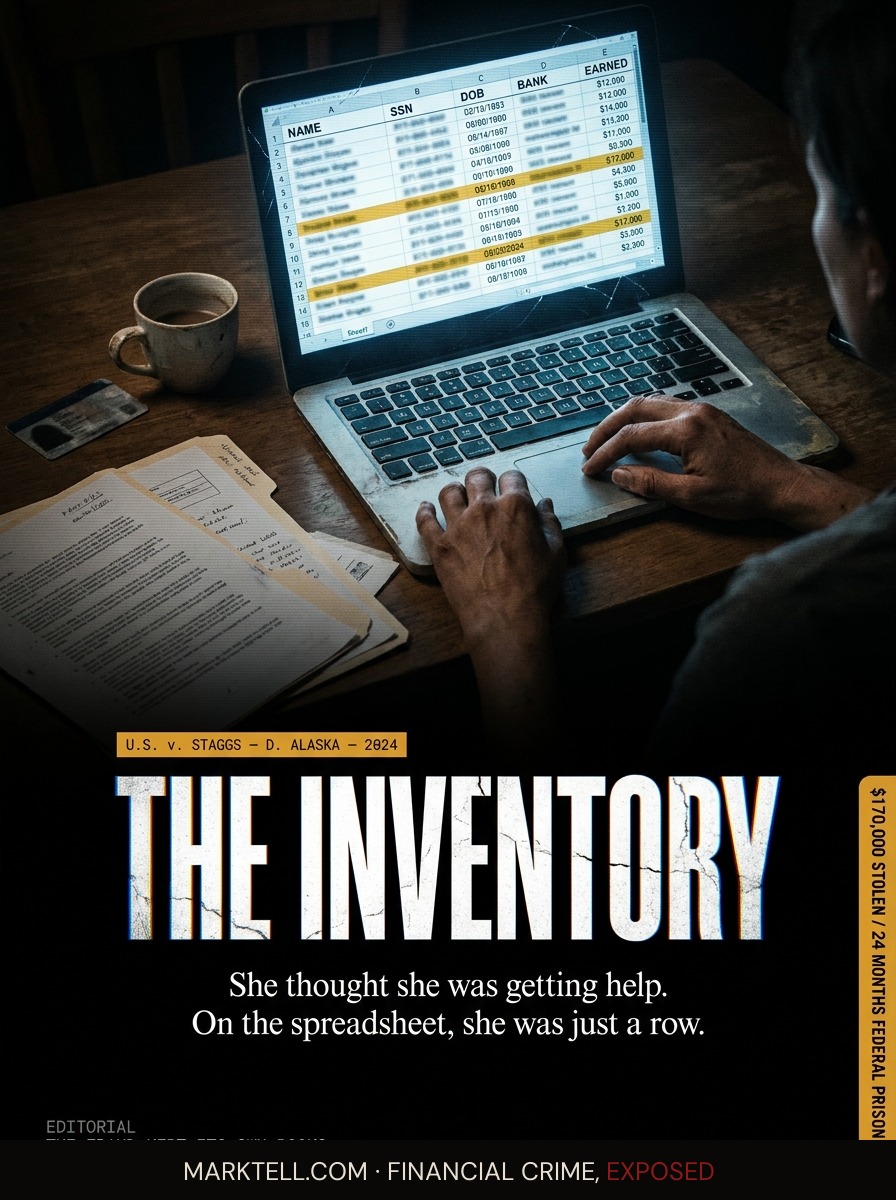
The spreadsheet had names, socials, and a column for what each identity earned
Christopher Staggs ran his pandemic unemployment scheme out of a Chicago LLC and kept a ledger of the people whose identities fueled it. On June 9, 2026, a federal judge gave him two years.
Marisol was thirty-eight when the hotel sent everyone home. She cleaned rooms on the lower floors of a downtown property in Anchorage. Twenty-two rooms a shift, sometimes twenty-four. In March of 2020 the manager called a meeting in the breakroom and told them not to come in on Monday. The state would have a program. There would be forms.
She did not know the forms. She knew the laundry carts and the chemical smell of the bathroom cleaner and which doors stuck in winter. She did not know the unemployment office's website. The website did not want to be known. It crashed when she tried, then asked for documents she did not have ready in a folder.
A friend of a friend said there was a man who could help. He filed claims. He had filed for her cousin, who said the deposit came through.
Marisol opened the email at her kitchen table on a borrowed laptop. The email asked for a copy of her driver's license. It asked for her Social Security number. It asked for the routing number on her checking account. It said the help was free. It said the man took care of everything.
She sent what he asked for.
A deposit arrived a few weeks later. It was less than what she had expected from what her cousin had said. She told herself the rules were different now, the numbers were different now, everything was different now. She did not call to ask. She had been told he took care of everything.
That, more or less, is how the machine ate.
II.
Christopher Staggs, forty-four, lived in Chickaloon, a small place northeast of Anchorage. He also went by Chrisopher Blackburn. He ran a Chicago-based limited liability company called ABN Circle. An LLC is a legal wrapper. It lets a person open bank accounts and sign contracts in a name that is not their own personal name. ABN Circle was, by the description in the federal record, mostly the wrapper. The business was the claims.
The CARES Act passed in March of 2020. Inside it was Pandemic Unemployment Assistance, called PUA. PUA extended unemployment benefits to people who could not normally get them. Gig workers. Self-employed people. The states ran the program with federal money. The states were not built for the volume. The verification systems strained, then bent.
The Paycheck Protection Program, PPP, came through the same statute on the business side. Loans to small employers to keep workers on payroll. Forgivable if the money was spent the right way.
Both programs ran on documents people submitted online. Both programs paid first and verified later. That is the part the indictment turned on.
According to the federal indictment returned by a grand jury on July 18, 2024, Staggs and a co-defendant named Zeb Bewak, forty-two, of Anchorage, ran a conspiracy that filed false unemployment claims in Alaska and other states using ABN Circle as the front. They harvested Personally Identifiable Information, the standard phrase for the things on the email Marisol sent: name, date of birth, Social Security number, bank credentials.
Some of the people whose information they used knew Staggs was filing. They believed he was helping. Others did not know. Their names were on claims they had never heard of.
The proceeds, when they came in, did not all stay with Staggs. He paid a slice to some of the people whose identities he had used. He kept the rest. He split the rest with co-conspirators. People whose identities were stolen outright received nothing.
The DOJ figure, in the press release issued by the U.S. Attorney's Office for the District of Alaska, is over $170,000.
III.
The thing that turns a hustle into a chapter is the spreadsheet.
Federal investigators found one. The court record describes it. Names. Social Security numbers. Account credentials. The amounts laundered out, tracked in a column the way a small business tracks invoices. Investigators also recovered emails in which Staggs described the scheme to his co-conspirators.
Read that slowly. The fraud kept its own books.
That is what separates this from the version of the story where someone panics in a crisis and lies on one form. This was a system. The system needed records because the system had volume. The system had volume because the front-end controls of the relief programs were thin enough to allow volume.
The columns in the spreadsheet are the architecture. A name is an asset. A Social Security number is an asset. A bank login is an asset. The asset gets put through the wrapper. The wrapper produces a payment. The payment gets sorted. Some flows back to the asset so the asset stays quiet. The rest goes to the people running the wrapper.
Marisol was a row.
IV.
On February 18, 2026, Staggs pleaded guilty in federal court in Alaska to one count of conspiracy to commit wire fraud. Bewak had already pleaded guilty to the same charge on March 6, 2025. The plea was the end of the argument about whether the scheme had happened. The remaining question was the sentence.
On June 9, 2026, a federal judge sentenced Staggs to two years in prison and three years of supervised release. Bewak is scheduled for sentencing on June 15, 2026.
Two years is a real number. It is also, against the volume of pandemic-era relief fraud the Department of Justice has been working through since the COVID-19 Fraud Enforcement Task Force was created in May of 2021, a number that lives inside a pattern. Another Alaska case closed earlier this year: Peter Igwacho, sentenced February 26, 2026 to twenty-one months and ordered to pay $182,225.15 in restitution for PPP and EIDL fraud of over $172,000. The numbers rhyme because the machines rhyme.
V.
The cost did not end at sentencing.
It will not end for Marisol either, in the version of the story where the row in the spreadsheet was a person who did not know. The state will, at some point, ask her about the claim filed in her name. The IRS may ask about benefits paid under her Social Security number. The deposit she received was small. The claim that triggered it was not. The risk on the books is hers.
She will explain it to a person on a phone. She will explain it to a person on a different phone. She will be told to send documents. She will not have the documents. The man who filed her claim is in federal custody and will not be returning her email.
That is the part the press release does not measure. The two years go to Staggs. The paperwork goes to the rows.
VI.
The machine is not Staggs. Staggs is a defendant. The machine is the shape of relief programs that pay on submission and verify later, married to identity data that circulates more loosely than the people whose identities they are would prefer to believe. The machine ran in Alaska. It ran in Chicago. It ran under ABN Circle and under other LLCs whose names will be in other press releases. It will run again under another name, with another spreadsheet, when the next emergency creates the next pool of money that has to move quickly to do what it was designed to do.
The next time you read about a relief program rolling out fast, picture the columns. Picture who is being treated as the asset.
Marisol was not stupid. The machine was built to be entered by someone exactly like her, on a borrowed laptop, at a kitchen table, in a month when the hotel was closed and the state's website would not load.
She thought she was getting help.
She was the inventory.
- U.S. Department of Justice, District of Alaska | June 10, 2026 | Press release on sentencing of Christopher Staggs
- U.S. District Court for the District of Alaska | July 18, 2024 | Federal grand jury indictment of Staggs and Bewak on conspiracy to commit wire fraud
- U.S. District Court for the District of Alaska | February 18, 2026 | Guilty plea of Christopher Staggs
- U.S. District Court for the District of Alaska | March 6, 2025 | Guilty plea of Zeb Bewak
- U.S. District Court for the District of Alaska | June 9, 2026 | Sentencing of Christopher Staggs
- U.S. Department of Justice | May 2021 | Establishment of COVID-19 Fraud Enforcement Task Force
- U.S. Department of Justice, District of Alaska | February 26, 2026 | Sentencing of Peter Igwacho for PPP/EIDL fraud
- Your Alaska Link | June 10, 2026 | "Chickaloon man sentenced in $170K COVID relief fraud scheme"
- CARES Act (P.L. 116-136) | March 27, 2020 | Statutory basis for PUA and PPP programs
- American Rescue Plan Act | March 11, 2021 | Extension of pandemic relief programs
Editorial Notice
MarkTell is a true crime publication about financial fraud. Some scenes, dialogue, and sequential details are reconstructed from court filings, enforcement actions, news reports, and public records. Where the public record does not provide exact details, editorial reconstruction is used to convey the documented pattern of events. Names of private individuals may be changed to protect identity. All factual claims are sourced to public documents cited in the Evidence Trail above. MarkTell does not provide investment, legal, or financial advice. Nothing published here constitutes a recommendation to buy, sell, or avoid any investment. Allegations described in active cases have not been adjudicated and defendants are presumed innocent until proven guilty. Readers should conduct their own due diligence before making financial decisions.