The self-checkout was the counter. The refund desk was the register.
Darwin Alberto Corea Calderon was sentenced this week for a three-year scheme that drained more than $464,000 from Home Depot stores across the Carolinas. The mechanism was smaller than a Ponzi and older than the self-checkout aisle.
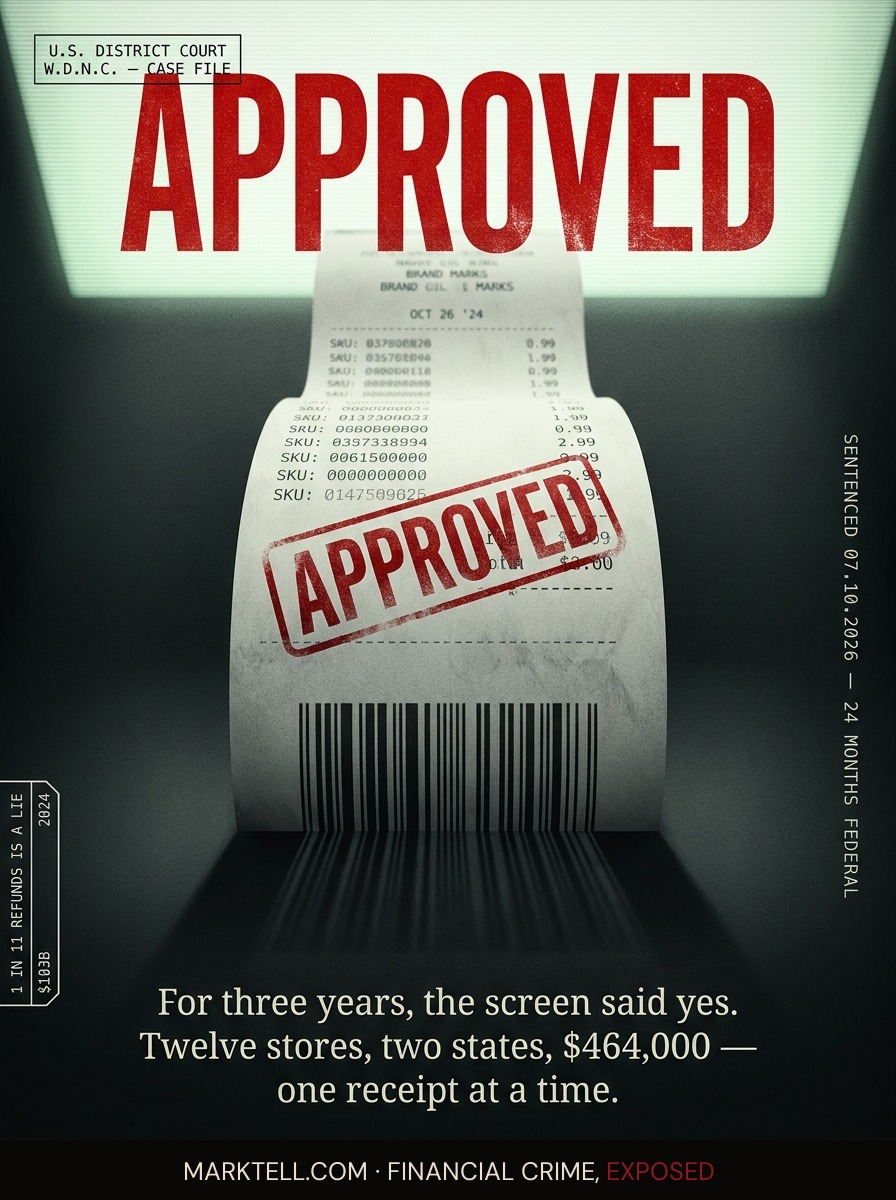
Marisol is fifty-two and has worked the return desk at a Home Depot outside Charlotte for eleven years. She trains the new hires. She teaches them the small choreography of the counter. Ask for the receipt. Scan the barcode at the bottom. Match the SKUs to what is in the customer's hand. If the screen says APPROVED, the screen says APPROVED. Hand back the refund. Say have a good one. Next in line.
She is good at her job. The machine is designed so that she does not have to think about whether the customer is lying. That is the point of the receipt. That is the point of the scanner. The paper is the proof. The barcode is the verdict.
On Friday, July 10, 2026, a federal judge in the Western District of North Carolina sentenced a thirty-four-year-old Honduran national named Darwin Alberto Corea Calderon to twenty-four months in federal prison. He had pleaded guilty to conspiracy to commit wire fraud. According to the U.S. Attorney's Office, the scheme he was part of drained Home Depot of more than $464,000 between 2022 and 2025. The stores hit were in Statesville, Charlotte, Cornelius, Gastonia, Kannapolis, Matthews, Rock Hill, and Spartanburg. Two states. More than a dozen locations. Three years.
The number is not what makes this a chapter. The mechanism is.
I.
There are two doors in a Home Depot. The one at the front and the one at the register. The register is the interesting door.
The scheme, as prosecutors described it, ran on two mechanics. The first was skip-scanning at the self-checkout. You walk into the lane. You pass items across the scanner. You do not scan all of them. Some go into the bag. Some just go. The machine beeps for the ones you scanned. The machine does not beep for the ones you did not. The lane does not know the difference between an honest cashier who missed a beep and a person who never intended to make one.
That is not theft in the classical sense. There is no fence. There is no back door. The thief walks out the front the same way the customer does.
The second mechanic was the refund. This is where the counter comes in. This is where Marisol's screen says APPROVED.
The federal materials do not spell out the exact refund method, and I am not going to invent one for you. What the record supports is this: goods moved out of stores over three years, and refunds were issued that Home Depot's asset protection team eventually tied together across a dozen locations, and the total came to more than $464,000. The counter accepted them. The counter was designed to accept them.
II.
Read that slowly. Four hundred sixty-four thousand dollars. Across three years. Across twelve stores. That is roughly thirteen thousand dollars a month, distributed across enough locations that no single manager saw the shape of it from where they were standing.
That is the whole trick.
A single store loses a few hundred dollars in a month and it looks like ordinary shrink. Every retailer prices in shrink. Shrink is the industry word for what disappears between the loading dock and the customer's car. Some of it is theft. Some of it is breakage. Some of it is a cashier ringing a bag of mulch as a smaller bag of mulch because the customer complained. Shrink is normal. Shrink is the fog the machine hides in.
The scheme worked because it stayed inside the fog. No single day was large enough to trigger a single store's alarm. The pattern only became visible when someone looked across all the stores at once. That someone was Home Depot's asset protection team, which the U.S. Attorney's Office thanked for what it called invaluable assistance to the investigation. Homeland Security Investigations ran the federal case. Assistant U.S. Attorney William Bozin prosecuted it.
The felony larceny prior helped. In 2024, in Cabarrus County, Corea was convicted of stealing power tools, a vacuum, and a microwave from a Lowe's. That is not the federal case. That is the earlier chapter. Prosecutors introduced it at sentencing because it made the pattern legible. Power tools from a Lowe's. Refunds from a Home Depot. The same hands. The same aisles. A different register.
III.
Now go back to Marisol.
She did not do anything wrong. She followed the choreography. She scanned the barcode. She matched the SKUs. The screen said APPROVED and she handed back the money because that is what the screen told her to do. If you had asked her at the end of her shift how many refunds she processed that day and how many were fraudulent, she would have told you the first number and had no way to tell you the second.
That is the part that lives with her.
Not the loss. The loss is Home Depot's problem, and Home Depot has the balance sheet to absorb it. The part that lives with her is that the counter she has worked for eleven years, the small dignity of doing a job correctly, is a piece of infrastructure that can be walked through by anyone with a printer and enough patience to spread the work across a dozen zip codes.
U.S. Attorney Russ Ferguson said Corea's crimes were a calculated scheme motivated by greed, and that retail fraud ultimately drives up prices for consumers. That is true, and it is also the sentence a U.S. Attorney is required to say. The truer sentence is smaller. Retail fraud drives up the surveillance around Marisol. It drives up the cameras in the self-checkout lane. It drives up the friction on the honest customer who wants to return a caulk gun without a receipt. It drives up the sense, at the counter, that trust is a liability the register has to be defended against.
IV.
The industry number is worth stating. Retail return fraud in 2024 was estimated at $103 billion. Roughly nine percent of all returns are fraudulent. Refund and returns policy abuse is now the single most common type of retail fraud that merchants report facing.
$103 billion. Nine percent. One in eleven refunds.
Home Depot and Lowe's have both begun using Flock Safety license-plate readers at select stores. The stated purpose is theft investigation. The systems also feed data to law enforcement for other purposes, including immigration enforcement, which some civil liberties groups have raised concerns about. That is the arc. A refund desk gets exploited across twelve stores. A camera gets installed in a parking lot in Ohio. The response to a failure of trust at the counter is a plate reader at the curb.
Corea, after he serves his twenty-four months, will be transferred to ICE for immigration proceedings. The U.S. Marshals Service holds him now.
V.
I want you to picture Marisol on a Tuesday, six months from now. She is training a new hire. The new hire is nineteen. Marisol is showing him the return desk. She tells him to ask for the receipt. She tells him to scan the barcode at the bottom. She tells him that if the screen says APPROVED, the screen says APPROVED.
Then she pauses. She does not know why she pauses. She has been doing this for eleven years. She has trained a dozen people at this counter and never paused.
She tells the new hire to look at the customer's face too. Not because faces are evidence. Faces are not evidence. But because a counter that only reads barcodes is a counter that can be walked through, and she has decided, without articulating it, that the small human check is the only part of the system she still controls.
The federal case is closed. Twenty-four months. A plea. A sentence. A press release from the Western District of North Carolina thanking Home Depot's asset protection team and Homeland Security Investigations.
The register keeps running.
The receipt is still the proof. The barcode is still the verdict. The screen still says APPROVED.
That is not a bug. That is the design. And the design is what the next person is already reading.
- U.S. Attorney's Office, Western District of North Carolina | July 10, 2026 | Press release announcing sentencing of Darwin Alberto Corea Calderon
- WHKY News | July 2026 | "Honduran National Sentenced in $464,000 Home Depot Refund Fraud Scheme Involving Area Stores"
- Cabarrus County (NC) court records | 2024 | Felony larceny conviction referenced at federal sentencing
- Homeland Security Investigations | 2026 | Lead investigative agency, cited in DOJ release
- National Retail Federation | 2024 | Retail return fraud loss estimates ($103B, 9% of returns)
- ReBound Returns | June 2026 | Research on refund and returns policy abuse
- Reporting on Flock Safety deployment at Home Depot and Lowe's | July 2026
Editorial Notice
MarkTell is a true crime publication about financial fraud. Some scenes, dialogue, and sequential details are reconstructed from court filings, enforcement actions, news reports, and public records. Where the public record does not provide exact details, editorial reconstruction is used to convey the documented pattern of events. Names of private individuals may be changed to protect identity. All factual claims are sourced to public documents cited in the Evidence Trail above. MarkTell does not provide investment, legal, or financial advice. Nothing published here constitutes a recommendation to buy, sell, or avoid any investment. Allegations described in active cases have not been adjudicated and defendants are presumed innocent until proven guilty. Readers should conduct their own due diligence before making financial decisions.