The search bar knew the answer before the world did
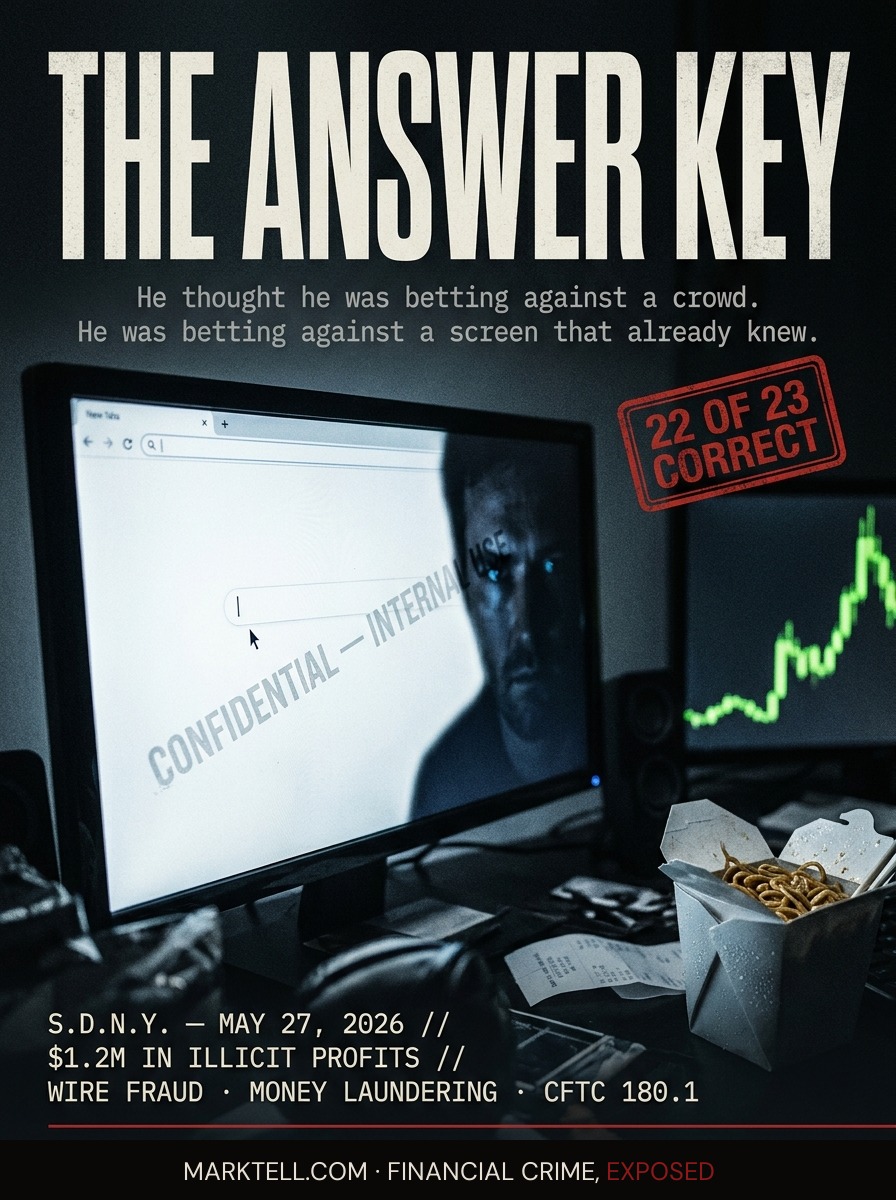
Federal prosecutors say a Google software engineer used an internal tool marked "Google Confidential" to clean up on Polymarket's Year in Search bets. The machine he used was the one sitting on his own desk.
Daniel was eating cold lo mein at his kitchen counter when the D4vd line started moving.
He was thirty-four. A paralegal at a midsize firm in downtown Brooklyn. He had found Polymarket the way most people his age find these things, through a friend who would not shut up about it at a barbecue. He had put in $4,200 over the fall, mostly on election stuff, mostly losing, but he had a theory about the Year in Search market. The theory was that D4vd, a singer whose name he could not pronounce out loud, was not going to be the most-searched person on Google in 2025. The odds said the market agreed with him. D4vd was a long shot. Betting against him was almost free money.
He clicked in for $400. Then another $300 a few days later when the line did not move.
Then, on a Tuesday night in late November, the line moved.
Not a flicker. A push. Somebody on the other side was buying D4vd contracts in size. Daniel watched the order book refresh and told himself what every losing trader tells himself at 11pm on a Tuesday. The market was wrong. The market was about to correct. He topped up.
The market was not wrong.
I.
According to a federal criminal complaint unsealed in the Southern District of New York on May 27, 2026, the person on the other side of Daniel's trade was named Michele Spagnuolo. He was thirty-six. An Italian citizen. A software engineer at Google, based in Switzerland. On Polymarket he traded under the handle AlphaRaccoon, and between October 15 and December 4, 2025, prosecutors say he placed roughly $2.7 million in wagers on the company's Year in Search markets.
He profited, the complaint alleges, more than $1.2 million.
The mechanism is the part you should read slowly. Spagnuolo allegedly accessed an internal Google tool. The screen, according to the filing, was marked "Google Confidential." On that screen sat the running tally of what the world was searching for, in the order the world was searching for it. The list that Google would eventually unveil to the public on December 4, 2025, as its Year in Search. The list that Polymarket had built a market on top of.
Spagnuolo, prosecutors allege, was reading the answer key.
He bet on D4vd, a result the market had assigned what the complaint calls "near-zero probability." He bet on Kendrick Lamar topping the list in October. Across the markets, the government says, he predicted 22 of 23 search rankings correctly.
Twenty-two of twenty-three.
That is not a hot streak. That is a man holding the test.
II.
Picture the room he was sitting in. Nobody outside that operation has seen it, not really, and the complaint does not describe it. But the tool existed. The login existed. The "Google Confidential" watermark existed. Build the room from that.
A laptop. Probably a corporate-issue one. Probably in an apartment in Zurich or a satellite office somewhere quiet. A second window open to Polymarket. Polymarket runs on a crypto wallet, which is a piece of software that holds your money and signs your trades. The AlphaRaccoon wallet is now sitting in an FBI exhibit, a string of hex characters that will be argued over in a courtroom for the next two years.
The bet itself was simple. Polymarket is a prediction market, which means it is a place where people bet on whether something will happen by a certain date. The platform classifies its contracts as swaps, which puts them under the authority of the Commodity Futures Trading Commission, not the SEC. The CFTC has a rule, 180.1, that prohibits trading on material non-public information obtained in breach of a duty. That is the rule the complaint accuses Spagnuolo of breaking.
He also faces wire fraud, with a maximum sentence of twenty years. And money laundering, also twenty years. The commodities count carries a maximum of ten.
He was arrested in New York and released on a $2.25 million bond, with $1 million in cash.
III.
Here is what Daniel did not know that Tuesday night.
He did not know that the market he was betting in was not, in that corner, a crowd. It was a man with a window into next month. The thing prediction markets sell you is the wisdom of the crowd, the idea that lots of people guessing produces something close to truth. That is the pitch. It is on the website. It is in every interview the founders have given for five years.
What the case alleges is that, in at least one market, the crowd was a costume. The price was being set by someone who already knew.
This is the second time in five weeks that federal prosecutors have made that argument. On April 23, 2026, U.S. Army Master Sergeant Gannon Ken Van Dyke was charged in the same district for allegedly using classified military information to bet on the capture of Venezuelan leader Nicolás Maduro. He turned $33,000 into more than $400,000. That was the first criminal case alleging insider trading in a prediction market. Spagnuolo is the second.
Two cases in five weeks is not turbulence. That is a pattern.
IV.
Polymarket says its "market integrity infrastructure flagged" the AlphaRaccoon activity. The company has cooperated with the U.S. Attorney's Office and the CFTC. In March 2026 it updated its rules to explicitly prohibit trades based on "stolen confidential information." The CFTC, for its part, issued its first formal advisory on insider trading in prediction markets in February 2026.
Read those dates in order.
February 2026, the regulator warns.
March 2026, the platform updates its rules.
April 2026, the first criminal case.
May 2026, the second.
The rules were written after the trades. The trades happened in a market that was running on the premise that no rules like that existed. Polymarket's CEO Shayne Coplan had said publicly that "insider information" could be a feature of prediction markets. Not a bug. A feature. That sentence is going to age.
Google placed Spagnuolo on leave. A spokesperson called the conduct a "serious breach of company policy." The U.S. Attorney for the Southern District, Jay Clayton, said the obvious quiet part out loud: "Corporate insiders cannot use confidential business information to turn a profit in our markets." The FBI's James C. Barnacle, Jr. said Spagnuolo "abused his elevated access to confidential trends."
That is the case as the government has framed it. Allegation is not adjudication. Spagnuolo has not entered a plea on the public docket as of this writing.
V.
Daniel closed his Polymarket app sometime in December. He lost the $4,200. He told the friend from the barbecue he was done with it. He did not, then, know about AlphaRaccoon. Nobody did. The complaint sat sealed for almost six months while the FBI built its case off the blockchain, which keeps a permanent receipt of every trade and is, in this one corner of the financial world, the prosecutor's best friend.
When the complaint was unsealed on May 27, Daniel read the CNBC story on his phone on the F train. He thought about the D4vd line moving on that Tuesday night. He did the math on what fraction of his $4,200 had ended up in the AlphaRaccoon wallet. He did not know the answer. He never will. The order book does not work that way.
What he knew was simpler.
He thought he had been betting against a crowd. He had been betting against a screen marked Google Confidential.
He just had not been told which market he was actually in.
- CNBC | May 27, 2026 | "Google employee charged with $1M Polymarket insider trading bet on search term"
- U.S. Attorney's Office, Southern District of New York | May 27, 2026 | Criminal complaint, United States v. Spagnuolo (unsealed)
- Commodity Futures Trading Commission | May 27, 2026 | Parallel civil complaint against Spagnuolo
- CFTC | February 2026 | Advisory on insider trading risks in prediction markets
- Polymarket | March 2026 | Updated platform rules on confidential information
- U.S. Attorney's Office, SDNY | April 23, 2026 | Criminal complaint, United States v. Van Dyke
- Google | May 2026 | Public statement via spokesperson Jaclyn Vazquez
Editorial Notice
MarkTell is a true crime publication about financial fraud. Some scenes, dialogue, and sequential details are reconstructed from court filings, enforcement actions, news reports, and public records. Where the public record does not provide exact details, editorial reconstruction is used to convey the documented pattern of events. Names of private individuals may be changed to protect identity. All factual claims are sourced to public documents cited in the Evidence Trail above. MarkTell does not provide investment, legal, or financial advice. Nothing published here constitutes a recommendation to buy, sell, or avoid any investment. Allegations described in active cases have not been adjudicated and defendants are presumed innocent until proven guilty. Readers should conduct their own due diligence before making financial decisions.