The screen showed $1.2 million. The withdrawal button was the lie.
Wesley Marley watched his money grow on a screen for months. The screen was the product. The growth was the bait. The withdrawal was the trap.
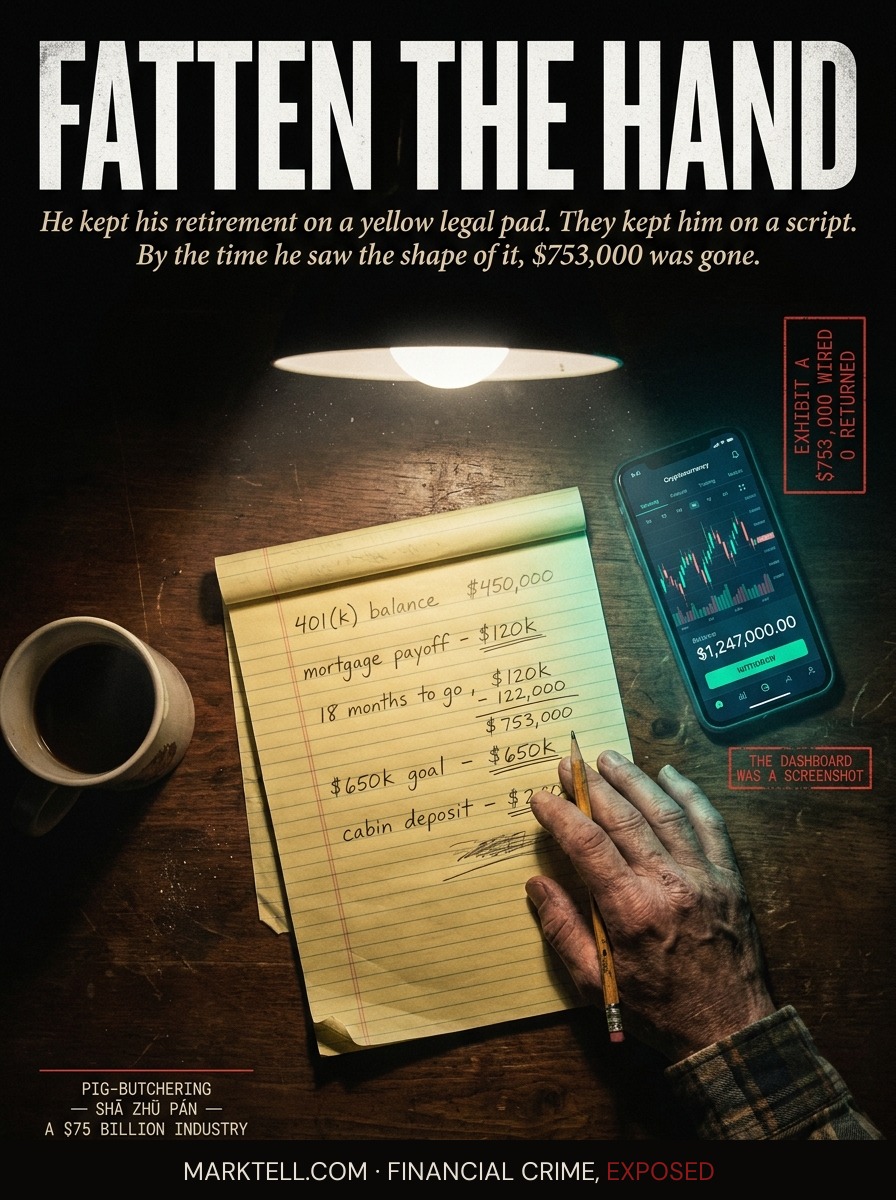
Wesley kept his retirement on a yellow legal pad.
He was sixty-one. He lived in Fuquay-Varina, a town south of Raleigh that used to be two towns before a hyphen made it one. He worked in logistics for a company that moved building materials, and he had been there long enough that his coworkers brought him cake on his anniversary every September. He had a calendar in the kitchen with the date circled. Eighteen months until he could stop driving in at six in the morning.
The legal pad sat on the counter next to the coffee maker. He wrote his 401(k) balance on it once a month in pencil. He wrote the mortgage payoff date. He wrote what he thought the house would sell for if he and his wife decided to move closer to their daughter in Charlotte. The pad was the kind of accounting a man does when he has been thinking about the same number for twenty years and wants to see it sitting in his own handwriting.
The text message arrived on a Tuesday.
It came from a number he did not recognize, and it said something polite and slightly confused, the way a wrong number does. A woman apologizing for bothering him. A name he did not know. He almost did not answer. He answered because his mother had raised him to answer.
That is the part that may be the saddest. The decency was the door.
I. THE FATTENING
The thing they do has a name. The people who study it call it pig-butchering. The Chinese phrase is Shā Zhū Pán, which translates literally and is not a metaphor anyone tried to soften. You fatten the animal before you kill it. You feed it for months. You make it trust the hand.
The hand, in Wesley's case, belonged to a woman who said she lived in Singapore and worked in commercial real estate. She sent photos. She asked about his day. She remembered things he had told her two weeks earlier. When his back hurt from a long shift, she said she was sorry. When his daughter called, she asked how the call went.
Read that slowly. None of it was about money yet.
That is the architecture. The pitch does not come at the beginning. The pitch comes after the relationship is load-bearing. By the time the investment opportunity is mentioned, the victim is not evaluating a financial product. He is being shown a way to spend more time with someone who already matters to him.
Pig-butchering operations are run, according to the FBI and the State Department, out of compounds in Cambodia, Laos, and Myanmar. Many of the people sending the messages are themselves trafficked, working under threat, scripted by managers who own their passports. The woman texting Wesley was reading from a playbook. She may also have been a prisoner. Both things can be true.
Wesley did not know any of that. He knew her name. He knew her morning was his evening. He knew she had mentioned, casually, that her uncle had taught her how to trade a particular kind of cryptocurrency contract and that her returns had been steady for years.
II. THE DASHBOARD
She walked him through it patiently.
He opened an account on a real cryptocurrency exchange. The name of the exchange does not matter for this story; it was one of the big ones, the kind that runs ads during football games. He linked his bank account. He bought a small amount of crypto, a few thousand dollars, to learn how the buttons worked.
Then she sent him a link to a trading platform.
The platform looked clean. It had a logo. It had a customer service chat. It had a dashboard with green and red candles moving in real time. He transferred his crypto from the legitimate exchange into the platform's wallet, and the dashboard showed the deposit, and a few days later the dashboard showed a profit.
Here is what was happening on the other side of the screen.
The crypto Wesley had transferred was not sitting in a trading account. It had been moved, within minutes of arrival, into a series of wallets controlled by the operators. The dashboard was a website. The numbers on the dashboard were typed. The candles were a graphic. The customer service chat was the same team that had told him good morning.
The platform was a screenshot that updated.
He invested more. The dashboard showed more. He withdrew a small amount early on, two thousand dollars, to test it. The withdrawal worked. This is part of the design. The first small withdrawal is the proof of concept the mark needs. It is the cheapest piece of marketing the operators will ever buy.
After that he stopped testing.
III. THE NUMBER
By the time the dashboard showed over a million dollars, Wesley had wired in $753,000.
The money came from his savings. It came from a portion of his 401(k) he liquidated and accepted the tax penalty on. It came from a home equity line of credit. It came from the place a man's retirement comes from when he has spent thirty years pointing every spare dollar at the same target.
$753,000.
Stop on the number. That is not a figure on a spreadsheet. That is the inside of a yellow legal pad. That is the eighteen months he had circled on the kitchen calendar, multiplied out across the rest of a life.
He tried to withdraw.
The platform told him there was a tax owed on his gains before the withdrawal could process. The figure was something like fifteen percent. He did not have it. The woman in Singapore was sympathetic. She said she had been through this herself and the tax was real and once it was paid the funds would release. She offered to lend him part of it. He took out another line of credit instead.
He paid the tax.
The platform asked for an anti-money-laundering verification fee.
He paid that too.
The platform asked for a final compliance deposit.
There is a moment in every one of these stories where the mark sees the shape of the thing. Where the second fee, or the third, or the fourth, lands as a kind of cold air in the room. Wesley sat at his kitchen table and looked at the dashboard and looked at the legal pad and looked at the screen and did the math and did not finish doing the math because he did not need to.
The woman stopped responding that week.
IV. THE MACHINE
What Wesley walked into is not a scam in the small sense of the word. It is an industry.
A University of Texas study estimated that pig-butchering operations moved more than $75 billion out of victims globally between January 2020 and February 2024. The FBI's 2023 internet crime report attributed nearly ninety percent of the $4.57 billion in reported investment scam losses to crypto-related fraud. These are not figures from one bad actor. These are the receipts of a sector.
In May 2026, the FBI announced Operation Blackout. According to public statements from the bureau, the operation produced over 300 arrests across Cambodia, Dubai, and Thailand, and seized approximately $8 billion in cryptocurrency tied to scam compounds. In March 2026, the U.S. Attorney's Office for the Eastern District of North Carolina, working with Homeland Security Investigations out of the Raleigh field office, announced the seizure of more than $61 million in USDT, a dollar-pegged crypto token, linked to pig-butchering schemes. In June, Thailand issued an arrest warrant for a Chinese businessman whose wallets allegedly received millions in proceeds from these operations between 2021 and 2022.
These are real numbers. They are also small numbers next to the seventy-five billion.
The machine has parts. The compound is one part. The script is one part. The dashboard is one part. The legitimate exchange that processes the initial purchase is one part, used without its knowledge. The cross-border laundering network is one part. The fake customer service team that handles withdrawal denials is one part. The fees are one part. The silence at the end is one part.
The romance is the only part the mark sees clearly. Everything else is dressed to look like infrastructure.
V. THE LETTER
Wesley reported it to the FBI.
He sat in front of a federal agent and walked through the timeline. He brought the legal pad. He brought screenshots of the dashboard. He brought every transaction confirmation from the legitimate exchange showing the moments his money had left his control and entered the wallets of people whose faces he had never seen.
He waited.
More than a year later, the bureau came back to him with a number. Roughly $630,000 of the $753,000 might be recoverable. The DOJ has reported that federal authorities recovered close to $2.5 billion in crypto-linked cybercrime proceeds in fiscal year 2025, up from $248 million five years earlier. The seizures are real. The recoveries take time. Whether Wesley will actually see that $630,000, and when, is a separate question the record does not yet answer.
Picture him reading that letter.
He is sixty-two now. The calendar in the kitchen still has the date circled, but the date has moved. The legal pad has a new column with smaller numbers in it. His wife reads the letter over his shoulder. They do not say anything for a while.
He had been counting down to a finish line. The finish line is now somewhere past the horizon. The years he spent earning the money the first time were years he had. The years he would need to earn it again are years he does not.
That is the cost the dashboard never showed.
VI. THE THING TO REMEMBER
If you take one thing from this, take this.
The wrong-number text is the front door. The friendly stranger who remembers your daughter's name is the hallway. The dashboard with the green candles is the room. The withdrawal button is the trapdoor.
The machine does not need you to be greedy. It needs you to be polite.
It needs you to answer the text because your mother raised you to answer. It needs you to be lonely enough on a Tuesday evening to keep the conversation going. It needs you to be close enough to retirement that the math of compounding sounds like a kindness. It needs you to trust a person before it asks you to trust a platform.
Wesley was not stupid. Wesley was decent and tired and eighteen months from a finish line.
The yellow legal pad is still on the counter.
He keeps writing the numbers down.
- The Cool Down | June 27, 2026 | "North Carolina man nearing retirement loses $753,000 in 'pig-butchering' crypto scam"
- FBI / DOJ public statements | May-June 2026 | Operation Blackout announcement; FBI Director Kash Patel public warning (June 20, 2026)
- U.S. Attorney's Office, Eastern District of North Carolina | March 12, 2026 | Announcement of $61M USDT seizure with HSI Raleigh
- Royal Thai Police / international reporting | June 25, 2026 | Arrest warrant for Wang Yicheng
- U.S. Department of Justice | FY2025 reporting | Crypto-linked cybercrime recovery figures (~$2.5B in FY2025)
- FBI Internet Crime Complaint Center | 2023 IC3 Report | Investment scam loss figures
- University of Texas at Austin | 2024 study | Global pig-butchering loss estimate (>$75B Jan 2020 - Feb 2024)
- FBI / State Department public materials | Pig-butchering modus operandi and Southeast Asia compound operations
Editorial Notice
MarkTell is a true crime publication about financial fraud. Some scenes, dialogue, and sequential details are reconstructed from court filings, enforcement actions, news reports, and public records. Where the public record does not provide exact details, editorial reconstruction is used to convey the documented pattern of events. Names of private individuals may be changed to protect identity. All factual claims are sourced to public documents cited in the Evidence Trail above. MarkTell does not provide investment, legal, or financial advice. Nothing published here constitutes a recommendation to buy, sell, or avoid any investment. Allegations described in active cases have not been adjudicated and defendants are presumed innocent until proven guilty. Readers should conduct their own due diligence before making financial decisions.