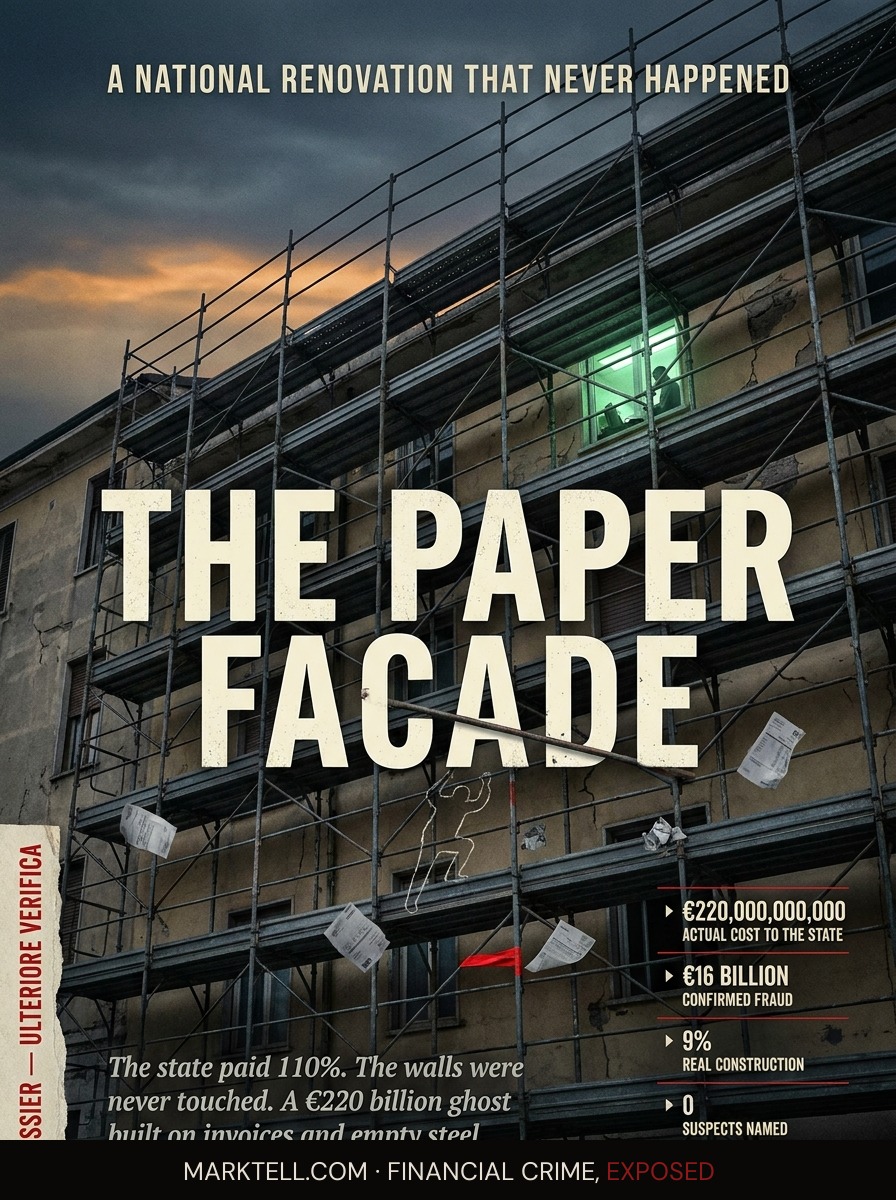
The scaffolding stayed up for two years. Nobody ever climbed it.
Italian prosecutors say more than half a billion euros in state tax credits moved through over sixty shell companies for renovation work that never happened. The scaffolding was the alibi. The state was the mark.
Giulia is thirty-eight years old. She works in a regional office of the Agenzia delle Entrate, the Italian tax authority, in a building with bad fluorescent lights and a coffee machine that has been broken since March. Her job, on the morning we are imagining, is to certify that a condominium in the province actually received the energy efficiency upgrades the state has already paid for.
On her desk is a dossier. Inside the dossier is everything you would want. A sworn statement from an engineer. Invoices from a contractor for €380,000 of thermal insulation. A second set of invoices, from a different company, for the scaffolding. A third, for the disposal of construction waste. Stamps. Signatures. A fiscal code for every party.
On her monitor is a satellite photograph of the building. The image is from last month. The facade is the same color it was in 2019.
This is the part of the story nobody films. The auditor at the desk, comparing the paper to the picture, learning quietly that the paper is a lie.
I.
The scaffolding.
That is the metaphor and it is also a fact. Across Italy, for almost five years, scaffolding went up around buildings as if a national renovation had begun. Some of it was real. Behind some of it, workers actually insulated walls and replaced boilers and reinforced beams against earthquakes. Behind a great deal of it, nothing happened at all. The scaffolding was the proof. The scaffolding was the alibi. The scaffolding was the front of the stage set.
The state was the audience. The state was also paying for the tickets.
II.
What was the Superbonus.
The Superbonus 110% was a tax credit, launched in July 2020 by the Conte II government, that paid Italian homeowners 110% of the cost of certain renovations. Read that again. One hundred and ten percent. The state paid more than the work cost. The extra ten percent was the incentive for the contractor to take the credit instead of cash.
A tax credit is a number you can subtract from the taxes you owe. Normally it sits with the taxpayer. The Superbonus did something unusual. It let the credit be sold. Transferred. A homeowner could hand the credit to the contractor as payment. The contractor could sell the credit to a bank. The bank could use it against its own tax bill, or sell it again.
In plain English, the credit became money. Not money you could spend at the grocery store, but money you could move from one fiscal code to another with a click on a government portal. Economists later called it a parallel fiscal currency. They were not exaggerating.
The original budget for the program was around €35 billion over fifteen years. By 2023, according to figures the Italian Court of Auditors and the Agenzia delle Entrate have published, the actual cost was approaching €220 billion. That is roughly 12% of Italy's gross domestic product. Prime Minister Giorgia Meloni has called it "the biggest scam" the Italian state has ever suffered. Her Economy Minister, Giancarlo Giorgetti, used the word "devastating."
Picture €220 billion. Now picture that nobody can tell you, building by building, what was actually built.
III.
How the machine worked.
A shell company is a legal entity that exists on paper but does no real business. It has an address. It has a director, sometimes a real person, sometimes a person whose ID was photographed in a bar. It has a bank account and a fiscal code. It can issue invoices.
The Superbonus fraud machine, as Italian prosecutors have described it in operation after operation, ran on shell companies the way a furnace runs on fuel.
Step one. Shell Company A claims to perform renovation work on a building. The building may exist. The work does not.
Step two. Shell Company A issues an invoice to the building's owner. The owner is sometimes complicit, sometimes a paper figure, sometimes a real homeowner who has been promised a free renovation.
Step three. The invoice generates a tax credit at 110% of the invoice value.
Step four. The credit is transferred. To Shell Company B. To Shell Company C. To a more reputable-looking holding company. To, in some cases, a bank that did not look hard enough at where the credit came from.
Step five. The credit is monetized. Someone uses it to offset taxes they actually owe, or sells it for cash at a discount.
Step six. The shells dissolve. The director vanishes. The bank account is emptied. The scaffolding, if any went up, comes down.
The case Il Sole 24 ORE reported this week involves more than sixty shells and over half a billion euros. It is not the first. In May 2024 the Guardia di Finanza ran an operation that seized roughly €1 billion in tax credits, investigating 311 people across 85 companies in ten Italian regions, all of it traced to false invoices for work that had not happened. On May 12, 2026, finance police in Turin seized €7 million and placed an administrator, two architects, and an engineer under investigation for aggravated fraud, false invoices, and money laundering connected to a single condominium where the renovation existed only on paper.
The same machine. Different fiscal codes. Different scaffolding.
IV.
What Giulia sees.
Back at the desk. Giulia knows the look of these files now. She has seen dozens. She is not the only one. There are auditors like her in every regional office, and there is a unit at the Guardia di Finanza, and there is a database that cross-references invoice flows against credit assignments, and still the machine moved faster than the audits could.
The auditors notice the same patterns. A contractor with no employees on the social security rolls billing for €2 million of work in three months. An engineer's signature on a sworn statement for a building she has never visited. Five shells with the same registered address, an apartment above a bar in a town none of them appear to do business in. Invoices issued to and from companies whose directors share a birthday, a postcode, a lawyer.
The Court of Auditors has estimated that fraud across the Superbonus and related building bonuses reached roughly €16 billion by April 2024. That figure, in any other country, would be a national emergency. In Italy, in 2024, it was a Tuesday.
Giulia closes the dossier. She marks it for further review. She knows, because she has done this work for six years, that "further review" means it joins a stack of other files, in other offices, attached to other shells, and that the people who actually moved the money are by now in a different jurisdiction with a different passport.
That part may be the saddest. Not the fraud. The pace of the response.
V.
What the program was supposed to do.
Read this part slowly. The Superbonus was not a stupid idea. Italy has old housing stock. Italy has earthquakes. Italy needed to insulate millions of buildings against energy costs that would later spike when Russia invaded Ukraine. The Five Star Movement, which championed the program, was not wrong that the country needed a stimulus during COVID and a push toward seismic safety.
The flaw was structural, and it was a flaw a securities lawyer would have flagged in twenty minutes. When the state pays more than the cost of the work, the homeowner has no reason to negotiate the price. When the credit can be transferred to a third party, the person claiming the work was done is not the person collecting the money. When monitoring lags by months and the credit can be sold in days, the fraud clears before the audit begins.
These are not exotic vulnerabilities. They are the same vulnerabilities that make any incentive program leak. The Superbonus did not invent fraud. It built a frictionless rail for it and waited to see who would ride.
A great many people rode.
VI.
The bystanders.
Not everyone behind the scaffolding was a criminal. This matters. Hundreds of thousands of legitimate renovations happened. Real workers were hired. Real buildings got real insulation and real seismic reinforcement. The construction sector added an estimated 410,000 jobs by April 2022. Scaffolding prices rose more than 400% by the end of 2021 because demand was real, even where supply was being gamed.
Earlier this year, on May 4, 2026, the Italian Competition Authority opened an investigation into Mapei, Fin-Firel, Kerakoll, Sika AG, and Sika Italia for what regulators allege was a coordinated effort to inflate wholesale prices on chemical products used in renovations, exploiting the Superbonus demand surge. The companies have not been adjudicated to have done anything wrong. The investigation is ongoing. Allegation is not adjudication.
But notice the shape of it. The shells defrauded the state by inventing work. The chemical suppliers, prosecutors allege, may have helped inflate the cost of work that actually happened. The state paid both. The state, in this story, is the mark who keeps writing checks.
VII.
Giulia at the end of the day.
Picture her again. She is leaving the office at 7:40 PM. She is walking past a building three blocks from her office that has had scaffolding around it since 2022. The mesh is faded. The metal pipes are rusting. She has never seen a worker on it. She has wondered, more than once, whose name is on the file.
The 2026 Budget Law has phased out the Superbonus, with narrow exceptions for projects in earthquake zones that met specific deadlines. The program is essentially over. The fraud files are not. They will keep arriving on desks like Giulia's for years. Some shells will be unwound. Some directors will be charged. Some money will be recovered. Most of it will not.
The estimated €16 billion in fraud, set against approximately €220 billion in total spending, is the smaller number. The larger number is what Italy paid for buildings that exist and renovations that may or may not have happened. The auditors will be sorting that pile for the rest of their careers.
VIII.
The reframe.
Giulia thought her job was to catch the people who lied on the dossiers.
Her job was to be the only friction the system built in. The scaffolding was the lie. She was the audit. The state was both the buyer and the victim, and the parallel fiscal currency it printed to stimulate the economy was, in the end, spent partly on the economy and partly on itself.
A tax credit you can sell is money. A building you cannot see behind the scaffolding is a story. A story the state paid for, in full, plus ten percent.
The scaffolding is coming down now. In some places, there was never anything behind it. That is the part nobody films.
- Il Sole 24 ORE | June 2026 | "Superbonus: massive fraud scheme worth over half a billion euros uncovered, involving more than 60 shell companies"
- Guardia di Finanza press releases | May 2024 | Operation seizing approximately €1B in tax credits, 311 persons investigated, 85 companies, 10 regions
- Guardia di Finanza, Turin command | May 12, 2026 | Seizure of €7M and investigation of administrator, two architects, and an engineer related to condominium Superbonus fraud
- Italian Competition Authority (AGCM/ICA) | May 4, 2026 | Opening of investigation into Mapei S.p.A., Fin-Firel S.p.A., Kerakoll S.p.A., Sika AG, and Sika Italia S.p.A. for suspected anticompetitive agreement
- Corte dei Conti (Italian Court of Auditors) | 2023-2024 reports | Estimates of Superbonus expenditure and fraud
- Agenzia delle Entrate | public statistics | Total Superbonus expenditure figures
- Public statements | 2023-2025 | Prime Minister Giorgia Meloni and Economy Minister Giancarlo Giorgetti characterizations of Superbonus
- Italian Budget Law 2026 | January 2026 | Phase-out provisions for Superbonus 110%
Editorial Notice
MarkTell is a true crime publication about financial fraud. Some scenes, dialogue, and sequential details are reconstructed from court filings, enforcement actions, news reports, and public records. Where the public record does not provide exact details, editorial reconstruction is used to convey the documented pattern of events. Names of private individuals may be changed to protect identity. All factual claims are sourced to public documents cited in the Evidence Trail above. MarkTell does not provide investment, legal, or financial advice. Nothing published here constitutes a recommendation to buy, sell, or avoid any investment. Allegations described in active cases have not been adjudicated and defendants are presumed innocent until proven guilty. Readers should conduct their own due diligence before making financial decisions.