The same flat, sold twice, while the tower was never built
A Mumbai court rejected Amarjeet Shukla's request to leave custody for spinal surgery on April 26, 2026. The people he allegedly sold homes to are still waiting for those homes, which is a separate kind of pain that no court date fixes.
I. The Agreement
The paper is dated. That is the first thing you notice. A sale agreement has a date on it, and a unit number, and a floor, and a price, and two signatures at the bottom. It is the kind of document a family keeps in a specific place, not in a junk drawer, somewhere deliberate. A folder. A steel cabinet. The top shelf of a wardrobe where serious things go.
Somewhere in the Oshiwara neighborhood of Mumbai, a family has a folder like that.
Somewhere else, the prosecution alleges, another family has a folder like that. Same unit number. Same floor. Same building. Same date range.
One address. Two folders. Two families who each believed, based on a signed document, that they were buying the same home.
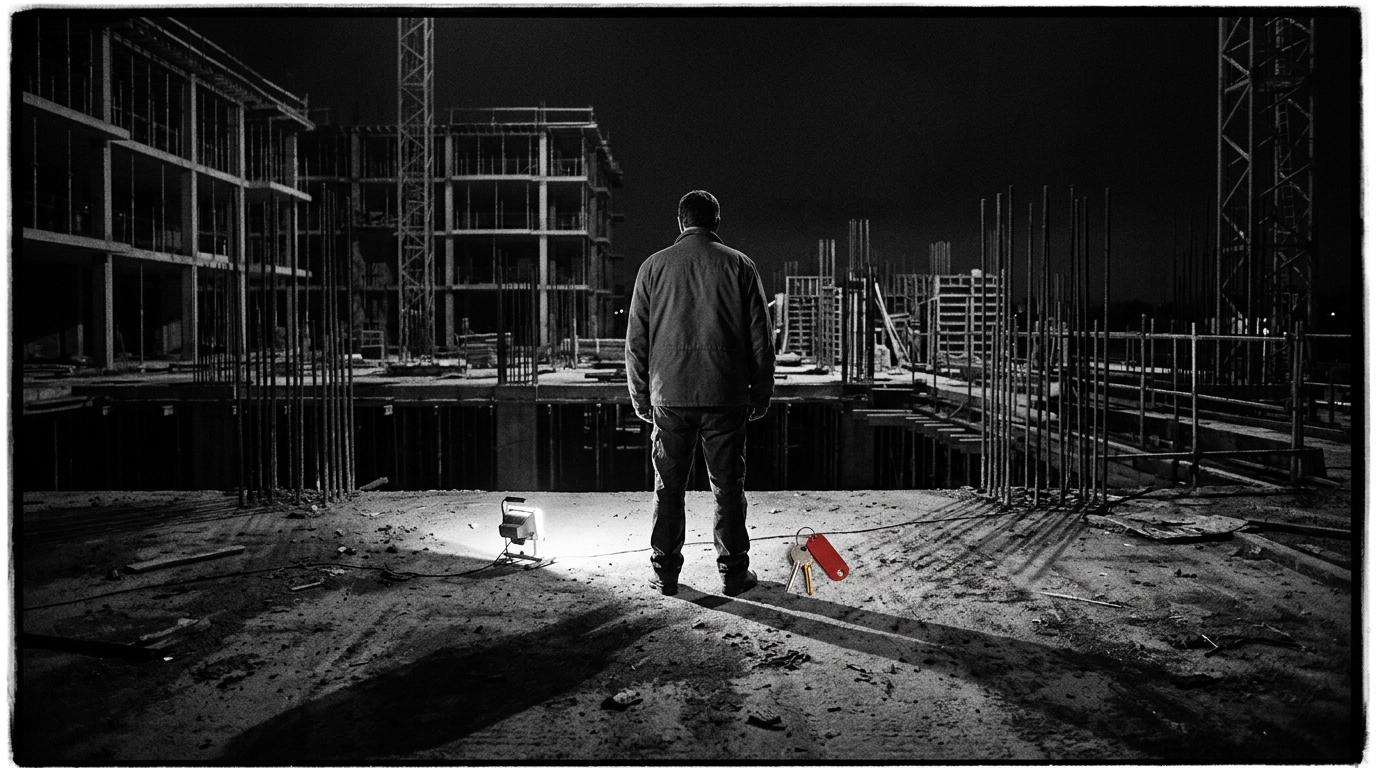
That is the machine at the center of this case. Not a complex financial instrument. Not a cryptocurrency wallet or a leveraged derivative. A key. Handed twice. To two different families who did not know about each other until they compared papers.
The accused is Amarjeet Shukla, identified in court records as a partner at a Mumbai development company called Mid-City Heights. He was arrested in August 2025. On April 26, 2026, a special court operating under Maharashtra's MPID Act rejected his request to leave custody for spinal surgery at a private hospital. He had cited degenerative disc disease and lumbar spine problems. The court said the condition did not clear the legal bar for emergency release. It said JJ Hospital, a state-run facility, was adequate for his treatment.
The people who are allegedly still waiting for their flats did not get a ruling on their pain.
The Maharashtra Protection of Interest of Depositors Act, which governs this case, is a law designed specifically for situations where builders take money from the public and do not deliver what they promised. It treats that kind of collection like a deposit scheme. It gives courts specific tools, including property attachment, to address the gap between what was promised and what was built.
The gap alleged here is Rs 55.71 crore. That is approximately $6.7 million USD. That is the amount prosecutors say was collected. The number does not include the years of waiting. Courts do not have a line item for that.
II. The Society
To understand what the victims allegedly lost, you need to understand what they were offered.
The Zakaria Aghadi Nagar No 3 Co-operative Housing Society is the kind of Mumbai housing arrangement that has existed for decades in neighborhoods the city has slowly absorbed. Society members own their flats collectively through the society structure. Redevelopment is the process by which an old building is knocked down and replaced with a new one, and the original members get upgraded units in exchange for surrendering their place in the old structure while construction happens.
It sounds like a reasonable exchange. New building. Better flat. Done correctly, it works.
Done incorrectly, it becomes a mechanism for collecting money and delivering nothing. The builder takes the redevelopment mandate, begins collecting from buyers, and somewhere between the excavation and the occupancy certificate, things stop. The old residents have already surrendered their arrangements. The new buyers have already paid. The builder is the only one holding anything, and what he is holding is the money.
The prosecution alleges that is what happened here.
It alleges Shukla's company took money from society members on the promise of new flats in the redeveloped building. It also alleges the company sold those same units to outside buyers. Two sets of people. One set of apartments. The building's completion was never delivered to either.
Cases have been registered at three separate police stations: Oshiwara, Gaondevi, and Kotharud. Three stations means complaints came in from multiple directions. The scheme, according to the case record, was not contained to one transaction or one group of buyers.
Read that slowly. Three police stations.
That is not a dispute. That is a pattern with a geography.
III. How the Double Key Works
Picture it. A developer controls a construction project. He is the only one who knows the full list of unit assignments. The buyers each know only their own agreement. There is no central registry that a buyer in Oshiwara can check before signing to confirm nobody else already signed for unit 4B on the sixth floor.
That gap in visibility is the machine's fuel.
The double-selling scheme, which prosecutors allege is what happened here, relies on the buyer's inability to see the other buyer. Each person's agreement looks real because it is real. The paper exists. The stamp duty may have been paid. The signature is genuine. Nothing in the folder is forged. The fraud is not in any one document. The fraud is in the relationship between two documents the buyer has no way to know exist simultaneously.
The discovery moment, when it comes, tends to arrive the way this kind of discovery always arrives. Not through a government database. Not through a regulator's alert. Through a conversation. A neighbor. A relative who knows someone. Two families comparing notes over tea, and one of them pulling out a folder, and the other one going quiet.
Nobody outside that first conversation knows exactly what was said. But we can read what came next in the court filings. Complaints. Multiple stations. A Rs 55.71 crore (about $6.7M USD) allegation with enough individual complainants that prosecutors could build a case substantial enough to hold someone through a bail denial.
The machine became visible when the keys stopped fitting.
IV. The Bail Hearing
On April 26, 2026, Shukla appeared before the special MPID court on a medical bail application.
Medical bail in India requires a high threshold. The court's language in this case was precise: the condition must represent a "credible, specific and urgent need," not "general or future apprehensions." Degenerative disc disease and lumbar spine problems, the conditions Shukla cited, are painful and real. The court did not dismiss them as fabricated. It assessed them against the legal standard and concluded they did not meet it.
The prosecution pushed back on the urgency. Intervenors representing the victims did the same. The state's position was that JJ Hospital, the government facility where he is receiving care, is equipped to handle his condition without requiring release into private care.
The court agreed.
That ruling is not a verdict on the underlying fraud. The MPID case continues. Shukla remains in custody, not because he has been found guilty, but because his medical argument did not clear the statutory bar for release.
There is something worth sitting with in the structure of that hearing. A man alleged to have collected Rs 55.71 crore from families who needed homes argued that his back required private hospital care. The families who needed homes were represented by intervenors who argued the urgency was overstated. The court sided with the families on the narrow question of bail.
On the larger question, the one about the money and the flats and the three police stations, the court has not yet ruled.
V. The Pattern
This case does not exist in isolation. The Mumbai real estate record in the spring of 2026 reads like a ledger of the same transaction written under different names.
April 27, 2026: a 75-year-old doctor allegedly defrauded of Rs 6.7 crore (about $800,000 USD) in a real estate partnership arrangement.
April 22, 2026: a builder granted anticipatory bail in a Lalbaug redevelopment case where flat purchasers alleged losses totaling more than Rs 200 crore (about $24M USD).
April 17, 2026: Rs 275 crore (about $33M USD) in fraud alleged in a Slum Rehabilitation Authority project. Complaints filed with the Enforcement Directorate and SEBI.
March 27, 2026: the Enforcement Directorate seized flats and commercial space worth Rs 41.70 crore (about $5M USD) in a Goregaon project fraud against homebuyers.
That is four separate cases in thirty days. Different builders. Different neighborhoods. Different victims. The same mechanism. A project is announced. Money is collected. The project does not complete. The money is not returned. The buyers are left holding agreements that open no doors.
The double key is not Amarjeet Shukla's invention. It is an old tool. Mumbai's housing market, with its chronic shortage, its opacity around unit assignments, and its dependence on builder-controlled information, creates the conditions for it. A buyer who needs housing badly enough will sign before checking everything there is to check. The builder knows this. The timeline between collection and delivery is long enough that problems can be deferred. By the time two families discover they hold the same agreement, the money has traveled through enough layers that tracing it takes a court order and an investigator with months to spare.
The MPID Act exists because this pattern became visible enough that Maharashtra's legislature decided it required a specific legal response. The Act gives courts teeth: property attachment, special proceedings, a framework that treats taking public money for real estate and not delivering it as something closer to a financial crime than a civil contract dispute.
It does not make the families whole. It attaches assets and moves cases through a dedicated track. The distinction matters.
VI. The Folder
Somewhere right now, a family in Oshiwara has a sale agreement in a folder.
They have had it for years, possibly. Long enough that the folder has been moved from one shelf to another, long enough that children have grown a year or two waiting for the building to be finished and the move to happen. Long enough that the family has learned to stop answering certain questions about when they are moving, because the answer keeps changing.
The agreement has a date. It has a unit number. It has a signature.
It does not have a key to anything real.
The case is ongoing. The allegations have not been adjudicated. A court has not determined whether everything the prosecution says about Mid-City Heights and Amarjeet Shukla is true.
But the three police stations are real. The Rs 55.71 crore figure in the filings is real. The MPID court's continuing jurisdiction is real. The fact that a bail application was heard and denied on April 26, 2026, is real.
And the folder is real.
Whatever the courts ultimately determine about what happened and who is responsible, the folder is sitting somewhere on a shelf in Mumbai, holding a document that someone paid real money to obtain.
That part is not in dispute.
The question the case has to answer is what that document was actually worth when it was signed.
- The Times of India | April 26-27, 2026 | "No medical bail to Mumbai businessman in Rs 56 crore real estate fraud"
- Maharashtra Protection of Interest of Depositors (MPID) Act | Public legislation | Maharashtra state statute
- Special MPID Court Mumbai | April 26, 2026 | Medical bail rejection ruling (as reported)
- Times of India / Indian Express Mumbai coverage | April 27, 2026 | Rs 6.7 crore doctor fraud (Hiten Seth, Milan Seth)
- Mumbai Sessions Court reporting | April 22, 2026 | Lalbaug redevelopment case, Sumit Jain anticipatory bail
- Indian Express / Hindustan Times Mumbai | April 17, 2026 | Rs 275 crore SRA project fraud allegation, ED and SEBI complaints
- Enforcement Directorate press release / reporting | March 27, 2026 | Rs 41.70 crore Goregaon Pearl CHS Project seizure
Editorial Notice
MarkTell is a true crime publication about financial fraud. Some scenes, dialogue, and sequential details are reconstructed from court filings, enforcement actions, news reports, and public records. Where the public record does not provide exact details, editorial reconstruction is used to convey the documented pattern of events. Names of private individuals may be changed to protect identity. All factual claims are sourced to public documents cited in the Evidence Trail above. MarkTell does not provide investment, legal, or financial advice. Nothing published here constitutes a recommendation to buy, sell, or avoid any investment. Allegations described in active cases have not been adjudicated and defendants are presumed innocent until proven guilty. Readers should conduct their own due diligence before making financial decisions.