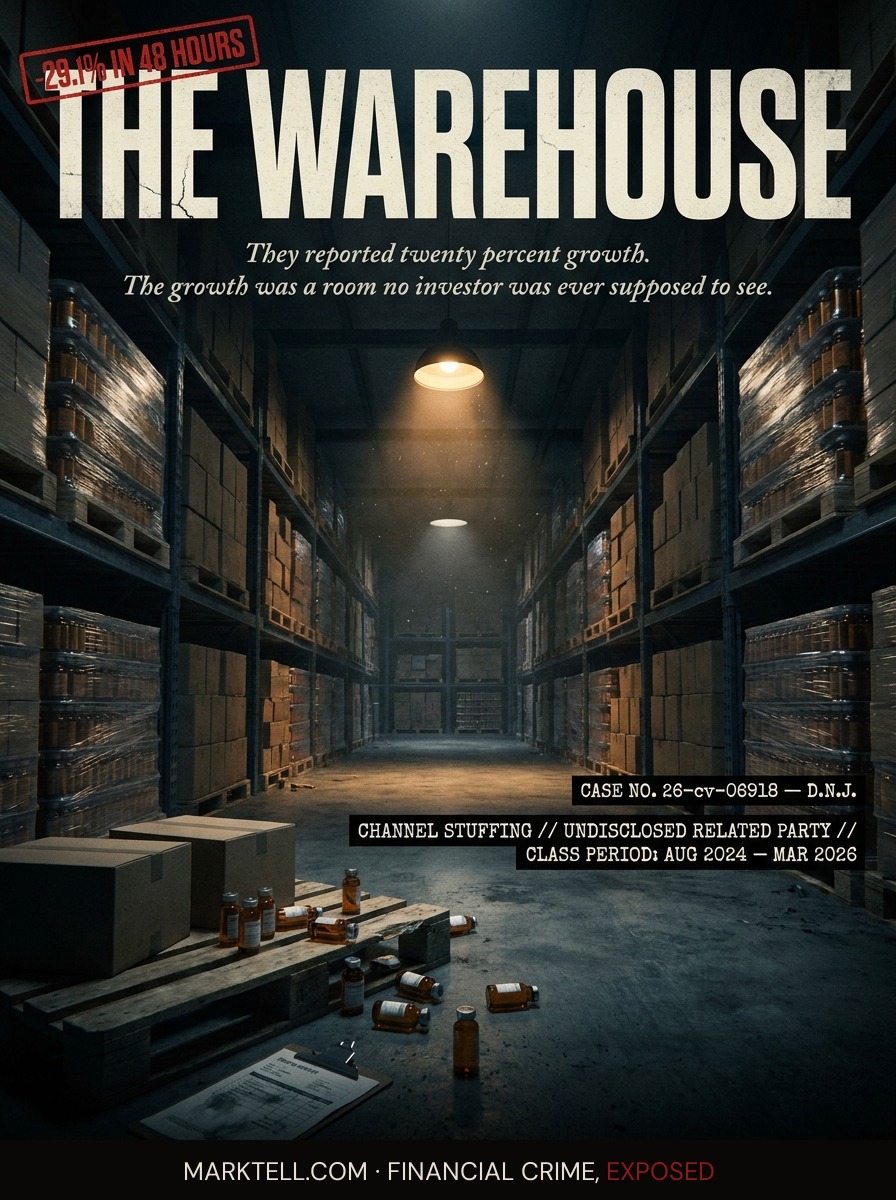
The revenue grew twenty percent. The growth was a warehouse no one was supposed to see.
A class action filed in New Jersey alleges ADMA Biologics inflated its 2025 revenue through channel stuffing and an undisclosed related-party distributor tied to its own vice chairman. In two trading days, the stock lost twenty-nine percent.
Ellen is sixty-seven. She worked twenty-nine years behind the counter at a chain pharmacy outside Allentown, counting tablets into amber vials and explaining to mothers what a Z-Pak was for. She retired in 2022 with a small pension and a rollover IRA that her son-in-law helped her move into a Fidelity account.
She is not reckless with money. She does not buy meme stocks. When she added ADMA Biologics to her IRA in late 2024, she did it because she had read about the company in a Motley Fool email and the business made sense to her in the way pharmacy work had made sense. Plasma collected. Antibodies concentrated. Immune-deficient children kept alive. The flagship product, ASCENIV, had an FDA label. The revenue was real revenue, from hospitals and specialty pharmacies. Boring. Boring was the point.
On the morning of Tuesday, March 24, 2026, she sat at her kitchen table with a mug of coffee that had been hot when she made it and was not hot anymore. Her phone was open to the brokerage app. ADMA was down. Not a normal down. Down sixteen and a half percent before lunch.
She refreshed. The number got worse.
By the close on March 25, the stock had fallen $3.96 from where it closed on March 23. A drop of 29.1 percent in two trading days. Ellen's position lost about a third of its value while she made and ate a sandwich and watched the news and went to bed and got up and watched it happen again.
She did not know yet what had been published. She did not know yet about a short seller called Culper Research. She did not know yet about a company called Genesis BioPharma Services that allegedly shared a corporate address with the company in her IRA.
She just knew the boring stock was not behaving boringly.
II. The warehouse
There is a move in pharmaceutical accounting that has a polite name and an ugly mechanism.
The polite name is channel stuffing. The mechanism is this. A drug company has a quarter to close. The sales number it has promised Wall Street is higher than the sales number actual end-users are going to generate. So the company goes to its distributors. It offers a rebate. It offers extended payment terms. Take more product. Stock it on your shelves. We will count it as a sale when it leaves our dock, not when it leaves yours.
That is not a sale. That is a warehouse.
The product sits with the distributor. The distributor has not actually sold it through to a hospital or a pharmacy. But on the manufacturer's books, the revenue has been recognized. The number Wall Street wanted is the number Wall Street gets. The story holds for one more quarter.
The warehouse fills up. Eventually, either real demand catches up to the inventory, or it does not. If it does, nobody notices. If it does not, the music stops.
On March 24, 2026, a short-selling research firm called Culper Research published a report titled "ADMA Biologics Inc (ADMA): Channel Stuffing, an Undisclosed Related Party Distributor, and -3% Real Growth in 2025 vs. +20% Reported."
Read that headline slowly.
According to the report, ADMA's 2025 growth was not 20 percent. According to the report, real growth was negative 3 percent. The gap between the two numbers, Culper alleged, was the warehouse.
The complaint that followed, filed in the District of New Jersey as Mazzarino v. ADMA Biologics, Inc., et al., No. 26-cv-06918, repeats and expands these allegations. It covers investors who bought ADMA securities between August 9, 2024, and March 25, 2026. It alleges channel stuffing. It alleges inadequate internal controls. And it alleges something else, which is the part that turns a revenue-quality dispute into a securities fraud case.
It alleges that one of the distributors absorbing the excess product was not arm's-length. It alleges the distributor was a related party. It alleges ADMA did not say so.
III. The address
Genesis BioPharma Services. That is the full name in the Culper report. In ADMA's SEC filings, according to the complaint, the entity appears as "GenesisBPS." The shortened name does what shortened names do. It blurs.
Culper alleged that Genesis BioPharma Services operated from the same corporate address as ADMA Biologics. Culper alleged it was controlled by Jerrold Grossman, ADMA's Vice Chairman and the father of ADMA's President and CEO, Adam Grossman.
A related party is a legal term with a plain meaning. It is anyone close enough to a company that a transaction between them needs to be disclosed in writing to investors, because a reasonable investor would want to know that the customer is not really a customer in the ordinary sense. A subsidiary. An officer's spouse. A company controlled by a director. The rules exist because if you do not see the relationship, you cannot judge the revenue.
If the Culper allegations are accurate, an executive at ADMA was on both sides of a distribution agreement. ADMA was selling to ADMA, through a name that read like a third party.
ADMA disputes this. On March 25, 2026, the day the stock fell another 15 percent, ADMA issued a press release titled "ADMA Biologics Addresses Misleading Short-Seller Report." The release described the Culper report as "premised on speculative assertions derived from unidentified and unreliable sources" and called its statements "misleading, false and inaccurate."
That is the company's position. It is entitled to it. The allegations are allegations.
But on March 26, Cantor Fitzgerald downgraded ADMA to Neutral from Overweight. The bank's note cited concern about both the report and the response. On March 29, the stock closed at $8.29, down another $1.34, or 13.9 percent, from the prior close.
The math on Ellen's IRA from the March 23 close to the March 29 close: down roughly 39 percent.
IV. What Ellen could see and what Ellen could not
This is the part that matters for the next Ellen.
What Ellen could see, sitting at her kitchen table with a Motley Fool email and a Fidelity app, was the topline. Twenty percent revenue growth. ASCENIV up fifty-one percent. A long-term company target of $1.1 billion in annual revenue by 2029. An FDA label expansion to pediatric patients. A vertically integrated business. A CEO who had been with the company for a long time.
What Ellen could not see, without reading SEC filings line by line with a lawyer's attention, was whether one of the distributors carrying that growth shared a building with the company, and a last name with the executive suite.
She could not see the inventory at the distributor level. She could not see the payment terms. She could not see the rebate structures.
She could see the press release.
She could not see the warehouse.
This is the structural problem. The press release is for her. The disclosure is for someone else. The pediatric label gets the headline. The related-party question gets a defined term in a footnote, if it gets anything at all.
V. The pattern
I have seen this room before. Different industry, same furniture.
In the metals room in Chicago, the close came when the customer asked the question we did not want answered. The answer was scripted. The script worked because the customer had no way to check the script in real time. By the time they could check, the wire had cleared.
A reported revenue number is a script. The investor has no way to check it in real time. The investor checks it years later, in a complaint, in a deposition, in a restated 10-K.
Channel stuffing is not new. The SEC has brought cases on it for thirty years. Related-party transactions are not new. The disclosure rules exist because companies have, repeatedly, tried to use related parties to make their numbers look better than the numbers were.
What is new each time is the wrapper. The wrapper is FDA approvals and a pediatric label and a plasma collection footprint and a $1.1 billion target. The wrapper is sincere. The wrapper may even be partly true. The wrapper does not tell you whether the warehouse exists.
Five things, plainly. The class period runs from August 9, 2024 to March 25, 2026. The trigger was a short-seller report. The stock fell 29.1 percent in two days and another 13.9 percent on the downgrade. The lead plaintiff deadline is August 10, 2026. The case is Mazzarino v. ADMA Biologics, No. 26-cv-06918, D.N.J.
The allegations remain allegations. ADMA denies them. A court will decide.
VI. The cooling mug
Ellen still owns the shares. She has not sold. She does not know yet whether the case will settle, whether the company will restate, whether the boring stock she chose was boring after all in some chastened, post-litigation form, or whether the warehouse goes deeper than the complaint says.
She told her daughter about it on the phone, the Saturday after the second drop. Her daughter asked if she had read the short report. She had not. She did not know what a short report was. Her daughter read it to her over the phone, parts of it, in the kitchen, where the same mug was on the same table and the coffee in it was, again, cold.
What Ellen said, after a while, was that she had picked it because it felt like the safe one.
She had. That is what the wrapper is for.
The warehouse was just a building she was never shown.
- Culper Research | March 24, 2026 | "ADMA Biologics Inc (ADMA): Channel Stuffing, an Undisclosed Related Party Distributor, and -3% Real Growth in 2025 vs. +20% Reported"
- Mazzarino v. ADMA Biologics, Inc., et al. | filed 2026 | No. 26-cv-06918 (D.N.J.)
- ADMA Biologics press release | March 25, 2026 | "ADMA Biologics Addresses Misleading Short-Seller Report"
- Cantor Fitzgerald research note | March 26, 2026 | Downgrade to Neutral from Overweight
- ADMA Biologics Q1 2026 earnings release | May 7, 2026
- Plaintiff law firm notices | June 11-29, 2026 | Robbins LLP, Levi & Korsinsky, Kahn Swick & Foti, Bronstein Gewirtz & Grossman, Pomerantz LLP, Kessler Topaz Meltzer & Check
- NASDAQ historical price data | March 23-29, 2026 | ADMA closing prices
Editorial Notice
MarkTell is a true crime publication about financial fraud. Some scenes, dialogue, and sequential details are reconstructed from court filings, enforcement actions, news reports, and public records. Where the public record does not provide exact details, editorial reconstruction is used to convey the documented pattern of events. Names of private individuals may be changed to protect identity. All factual claims are sourced to public documents cited in the Evidence Trail above. MarkTell does not provide investment, legal, or financial advice. Nothing published here constitutes a recommendation to buy, sell, or avoid any investment. Allegations described in active cases have not been adjudicated and defendants are presumed innocent until proven guilty. Readers should conduct their own due diligence before making financial decisions.