The reserve fund was a sentence. The sentence was the whole machine.
A 47-year-old Nolensville man was indicted this week on eleven federal counts tied to an alleged crypto Ponzi run through Star Credit Holdings. Prosecutors say the pitch included a reserve fund that did not exist and personal loans investors took out in their own names.
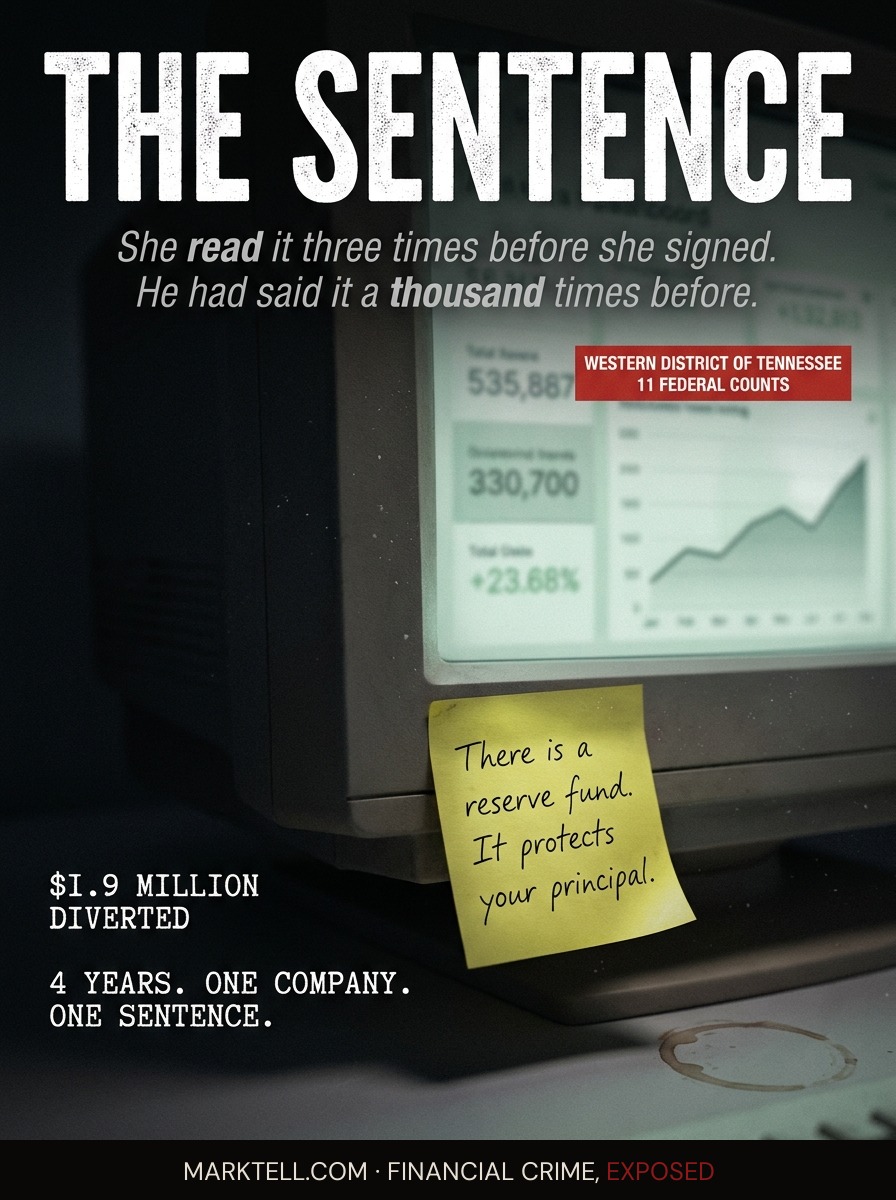
Marisol read the sentence three times before she signed.
It was the sentence about the reserve fund. The one the man on the video call said in every conversation, the way people say grace before dinner. There is a reserve fund. It protects your principal. We keep more than enough on hand to cover any drawdown. She wrote it down on a Post-it the first time she heard it and stuck the Post-it to the side of her monitor in the dental office where she had cleaned teeth for twenty-six years. When the loan officer at the credit union asked her what the money was for, she did not say cryptocurrency. She said investment. She said the word the way the man on the call had said it. Calm. With a reserve fund behind it.
She was fifty-eight. Her son was finishing nursing school in Knoxville. Her car was a 2017 Camry with a check engine light that came on every other Tuesday. She had thirty-one thousand dollars in a retirement account and a personal loan application open in the other browser tab. The man on the call had walked her through the loan application himself. He told her the returns from the fund would cover the loan payments and then some. He said it would be like the loan was paying for itself.
That sentence is also worth writing down.
I.
On Friday, June 12, 2026, the U.S. Attorney's Office for the Western District of Tennessee announced an eleven-count federal indictment against Misam M. Abidi, 47, of Nolensville. The indictment alleges that between 2020 and 2024, Abidi operated a cryptocurrency Ponzi scheme through a company called Star Credit Holdings. The counts include three of wire fraud, two of operating an unlicensed money transmitting business, three of aiding and assisting in the preparation of false tax returns, and three of money laundering. The indictment alleges that Abidi diverted more than $1.9 million of investor funds to himself and his family.
That is the structure of the case. Eleven counts. One company. Four years. Read those numbers slowly. They are the legal shape of what prosecutors say happened. They are not yet what a jury has found. Allegation is not adjudication. He is presumed innocent until proven guilty.
But the shape is worth looking at because the shape is familiar.
II. The sentence.
Every Ponzi has a sentence. One line the operator repeats until the people listening stop hearing it as a claim and start hearing it as a fact. Bernie Madoff had a sentence about a split-strike conversion strategy. Allen Stanford had a sentence about a portfolio of liquid investments. The sentence does not need to be true. It needs to be repeatable.
According to the indictment, Abidi's sentence was about a reserve fund. He told investors he maintained a substantial reserve to protect their investments. He told them he managed significantly more capital than he actually controlled. He promised guaranteed high rates of return. Those three sentences are the entire machine. Everything else is decoration.
A Ponzi scheme, in case you have never had it defined for you in plain English, is this. The operator takes money from new investors and uses it to pay returns to older investors. There is no real trading. There is no real product. The money coming in the front door pays the money going out the back door, and the operator skims from the middle. It works until the money coming in slows down. Then it stops working all at once.
The reserve fund in Abidi's pitch was, the indictment alleges, the same kind of sentence Madoff's split-strike was. It existed to answer the only question that mattered. What happens if something goes wrong. The answer was the reserve. The reserve was the answer. The answer was a sentence.
III. The loan.
The part of the indictment that makes the stomach turn is not the wire fraud counts. It is the allegation that Abidi assisted investors in securing personal loans in their own names to funnel additional money into Star Credit Holdings. And, per prosecutors, that he falsified at least one affidavit claiming an investor's identity had been stolen in order to obtain such a loan.
Read that again. The operator did not just take what the investors had. He allegedly helped them borrow more, in their own names, against their own credit, to give to him. And when one of those loans went sideways, the indictment says he signed an affidavit claiming the investor was a victim of identity theft. Not a victim of him. A victim of a stranger who did not exist.
This is the part Marisol does not know yet, the night she sits at the kitchen table with the loan application open. She does not know that the man on the call has done this before. She does not know that the friendly walk-through of the loan paperwork is not customer service. It is recruitment. The loan is not a bridge to her investment. The loan is the investment, from his side. Her signature on the credit union form is the asset he is acquiring.
She signs.
IV. What the screen showed.
For four years, according to prosecutors, the screen showed numbers going up. That is what these schemes do. The customer-facing dashboard is the cheapest part of the operation. A spreadsheet. A web portal. A monthly PDF. Marisol checked hers on her phone during lunch breaks at the dental office. The number on the phone said her account had grown. The number on the phone was a sentence too.
The numbers on the phone did not have to match anything. There were no real trades. There was no real reserve. The indictment alleges Abidi was not running a fund. He was running a database. The database said what he needed it to say to keep the wires coming in.
He also, per the tax counts, allegedly failed to report the income from the business on his federal returns. That is the part that quietly tells you the operator knew what the business was. You do not hide income from a legitimate trading firm. You hide it because reporting it would require explaining where it came from.
V. Visible.
The machine became visible on a Friday afternoon in June, the way these machines usually become visible. A press release from a U.S. Attorney's Office. A grand jury indictment unsealed. A name and an age and a town. Nolensville, Tennessee. Forty-seven years old. Eleven counts.
For Marisol, the visibility came earlier than the press release, in the slow way it always does for the people inside. The withdrawal that took longer than the last one. The email that took three days to answer instead of three hours. The call that went to voicemail. The dashboard that still showed the number, beautiful and growing, while the actual money behind the number was, the indictment alleges, somewhere else entirely. With him. With his family. In the over $1.9 million prosecutors say he diverted.
The dashboard kept showing the number. That part may be the cruelest. The sentence about the reserve fund kept being true on the screen long after it had stopped being true anywhere else.
VI. What the loan does not know.
The loan does not know the fund collapsed. The loan does not read indictments. The loan does not care about wire fraud counts or money laundering charges or what the U.S. Attorney announced on a Friday in June. The loan only knows the monthly payment is due.
If convicted on all counts, Abidi faces decades in federal prison. Twenty years on each wire fraud count. Ten on each money laundering count. The math gets large quickly. The math the investors are doing is smaller and more immediate. It is the math of a personal loan payment against a household income that did not change when the fund went dark.
This is the part of a Ponzi scheme that does not get written about enough. The fraud ends. The debt does not. The criminal case proceeds on its own timeline, which is measured in years. The loan payment is measured in months. For some of the people who, prosecutors allege, were walked through loan applications by the operator himself, the debt is now the longest-running part of the relationship. The fund is gone. The loan is still here. They are still paying him, in a way. They are paying the bank that paid him.
VII.
Marisol still has the Post-it on the side of her monitor. The one with the sentence about the reserve fund. She has not taken it down. She is not sure why. Maybe because taking it down would be the moment she admits she believed it. Maybe because leaving it up is the only evidence she has, in her own handwriting, that the sentence was ever said.
The indictment is the public evidence. Eleven counts. The Western District of Tennessee. A grand jury. A trial date that has not been set.
The Post-it is the private evidence. One sentence about a reserve fund, written down by a woman who took the man at his word because she had no reason not to.
He has not been convicted of anything. He is presumed innocent. The case will move through the court the way these cases do, slowly, with motions and continuances and a jury, eventually, that will hear the sentence about the reserve fund and decide what it was.
Marisol already knows what it was.
It was the whole machine.
- U.S. Department of Justice, U.S. Attorney's Office for the Western District of Tennessee | June 12, 2026 | Press release announcing indictment of Misam M. Abidi
- Federal grand jury indictment, United States v. Misam M. Abidi | June 2026 | Eleven-count indictment, Western District of Tennessee
- Decrypt | June 12, 2026 | "Tennessee Man Indicted for Alleged Crypto Ponzi Scheme That Stole Millions From Investors"
- CFTC enforcement materials | September 2025 | Michael and Amanda Griffis, "Blessings through Cryptocurrency" (contextual comparable)
Editorial Notice
MarkTell is a true crime publication about financial fraud. Some scenes, dialogue, and sequential details are reconstructed from court filings, enforcement actions, news reports, and public records. Where the public record does not provide exact details, editorial reconstruction is used to convey the documented pattern of events. Names of private individuals may be changed to protect identity. All factual claims are sourced to public documents cited in the Evidence Trail above. MarkTell does not provide investment, legal, or financial advice. Nothing published here constitutes a recommendation to buy, sell, or avoid any investment. Allegations described in active cases have not been adjudicated and defendants are presumed innocent until proven guilty. Readers should conduct their own due diligence before making financial decisions.