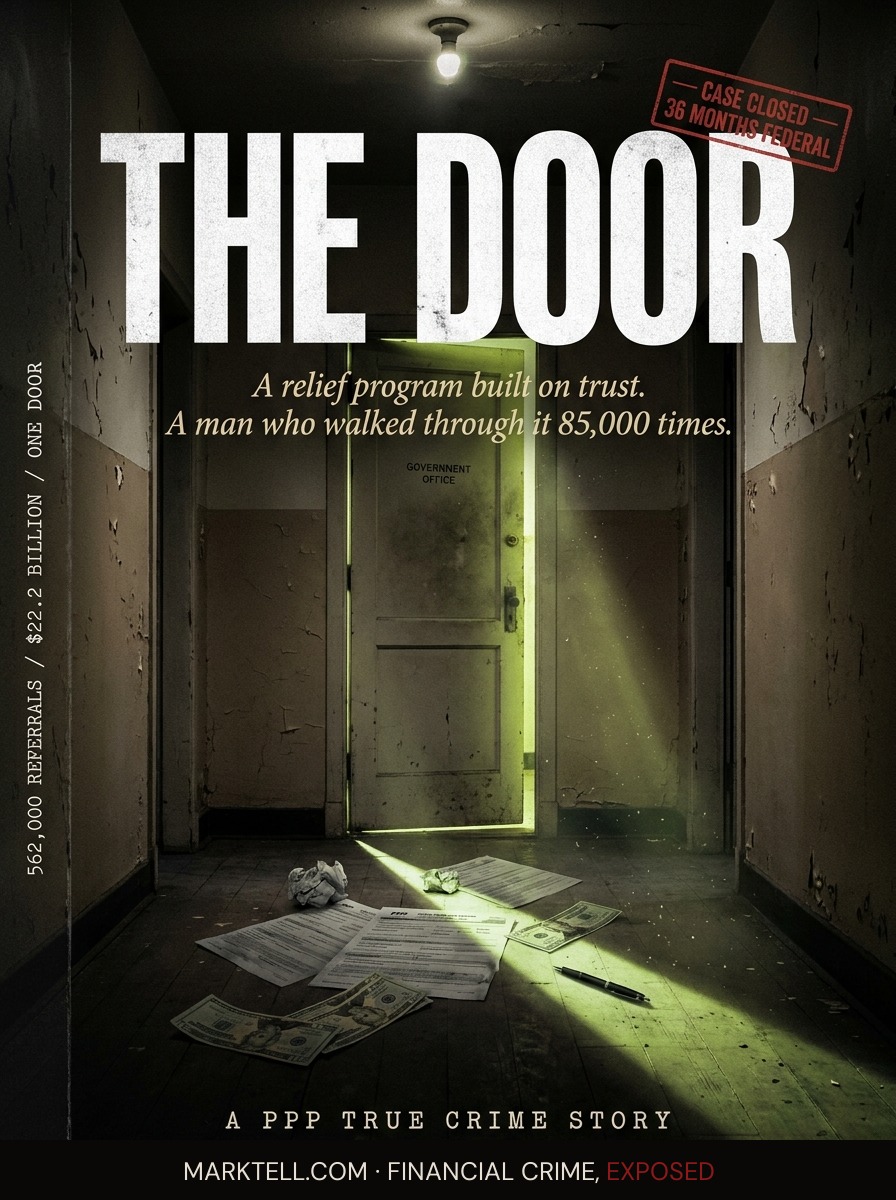
The relief program had a door. He walked through it eighty-five thousand times.
Absalom Hall walked into a federal relief program designed for businesses that did not exist and walked out with $85,401. On May 15, a judge sent him to prison for three years. The door he used is still open for thousands of others.
Marisol filled out her PPP application at the kitchen table in April 2020. She was fifty-eight. She kept the books for a diner in Rockford that had eleven employees on the payroll before the shutdown and four left by the time she opened the laptop. She had the W-2s in a folder. She had the 941s. She had the bank statements. She typed the gross revenue number in twice because her hands were not steady.
She got the loan. The diner survived. That part of the story worked.
This is not her story. This is the story of the door she walked through, and the man who walked through the same door with nothing in his hand but a number he made up.
Absalom Hall is thirty-seven. He lives in Rockford too. On May 15, 2026, U.S. District Judge Lindsay C. Jenkins sentenced him to three years in federal prison for defrauding the Paycheck Protection Program of $85,401. He pleaded guilty in December 2025 to wire fraud, false statements, and engaging in monetary transactions in property derived from specified unlawful activity. The court ordered him to forfeit the $85,401 and pay $30,866 in restitution to the IRS for a separate tax fraud he admitted to in the same plea.
That is the headline. The headline is not the story.
I.
The Paycheck Protection Program was a door. That is the most honest way to describe it. Congress built it in March 2020 inside the CARES Act because real businesses with real employees were closing in real time and the usual machinery of small business lending could not move fast enough. The door was designed to open quickly. It was designed to trust the person knocking. The Small Business Administration would guarantee the loan. A participating bank would issue it. If the borrower used at least 60 percent of the money on payroll and met a few other conditions, the loan would be forgiven. Free money to keep workers paid.
The trust was the feature. The trust was also the flaw.
Hall's applications, according to the plea, contained false statements and misrepresentations about businesses that either did not exist or did not look anything like what the paperwork claimed. Fabricated gross revenue. Fabricated payroll. Fabricated operational expenses. He submitted multiple applications. He received $85,401.
Picture the form. There is a box for the number of employees. He typed a number. There is a box for average monthly payroll. He typed a number. There is a signature block where the applicant certifies, under penalty of perjury, that the information is true. He signed it.
The money cleared.
II.
Marisol's diner had a landlord who was waiting on rent. It had a line cook who was driving for DoorDash because the dining room was closed. It had a coffee supplier who had stopped delivering until the last invoice cleared. The PPP money paid the cook. It paid the rent. It bought coffee.
She kept the documentation for two years in the same folder she used for the original application, because she had read every line of the forgiveness rules and she did not want anyone showing up later asking questions she could not answer.
Nobody showed up. The forgiveness came through. The diner reopened.
What she did not know, what almost nobody knew at the time, was that the door she had walked through carefully had been walked through carelessly by hundreds of thousands of other applicants. The SBA Office of Inspector General has estimated that roughly $64 billion in PPP loans were fraudulent. On May 1, 2026, the SBA announced it had referred approximately 562,000 suspected fraudulent PPP and COVID Economic Injury Disaster Loan applications, totaling $22.2 billion, to the Treasury for collection and the Department of Justice for investigation.
Read that again. 562,000 referrals. $22.2 billion. That is one slice of one program.
Hall is one of those 562,000. He is also one of the ones who got caught.
III.
The thing the government wants you to understand about Hall is not the loan. It is the second crime. Because the second crime is where the man behind the paperwork becomes visible.
In addition to the PPP fraud, Hall operated a business called Lootland Tax Prep. He prepared tax returns for other people. He did this without an IRS-issued preparer tax identification number, which is the credential the IRS requires anyone who prepares returns for compensation to obtain. The PTIN is not a hard credential to get. It is a basic registration. He did not have it.
He also did not report the income from Lootland Tax Prep on his own 2021 and 2022 individual tax returns. The restitution to the IRS, $30,866, comes from that.
So there is a man in Rockford running an unlicensed tax preparation business, hiding the income from the IRS, and during the same window filing fraudulent applications to a federal relief program. The IRS Criminal Investigation special agent in charge in Chicago, Adam Jobes, put it this way at sentencing: Hall "exploited a program designed to help Americans survive an unprecedented crisis" and chose "greed over integrity."
The quote is the kind of thing federal agents say at sentencing. It is also true.
IV.
The machine here is not complicated. That is what makes it worth describing.
A real relief program. A real emergency. A door built for speed. A signature block that asks the applicant to certify the truth. A bank that processes the loan because the SBA is guaranteeing it. A regulator that will get to the verification later, because later is the only option when the building is on fire.
The fraud is the gap between the signature and the verification.
Hall sat in that gap for $85,401. Others sat in it for millions. The Queens home care agency that settled on May 19, 2026, paid $2.3 million for its own version of the same move: false certifications of eligibility on PPP applications. Same door. Different amount.
Congress has now extended the statute of limitations for PPP fraud to ten years. The Department of Justice has said it will keep going. A former federal prosecutor noted on May 12, 2026, that the cases are still being worked aggressively. The math says they will be working them for the rest of the decade.
V.
There is a question worth asking, and it is not the comfortable one.
The comfortable question is whether three years is enough for an $85,401 fraud. Federal sentencing guidelines for losses under $100,000 typically suggest a range from probation to twelve to eighteen months. Hall got thirty-six months. The aggravating factors, multiple fraudulent applications and the separate tax fraud, did the work the guidelines allow.
The uncomfortable question is what the door cost the people who used it correctly.
Marisol's diner survived. So did thousands of other small businesses whose owners filled out the form honestly. The program did what it was supposed to do for them. But every dollar that went to a fabricated business is a dollar that left the system. Every fraudulent forgiveness is a forgiveness the taxpayer absorbed for a payroll that never existed. The $64 billion in estimated fraud is not an abstraction. It is the bill that came due on the trust.
The honor-system door was the right design for the emergency. It was also the wrong design for the country we actually live in.
Hall will serve his three years. The forfeiture and restitution orders will follow him. Lootland Tax Prep is closed. Somewhere in a federal facility, he will have time to think about the boxes he typed numbers into.
Marisol still keeps the folder. She does not need it anymore. She keeps it because she is the kind of bookkeeper who keeps things.
She also reads the news. She read about the sentencing. She read about the 562,000 referrals. She read the line about greed over integrity and she did not feel vindicated. She felt tired.
The door was the door. It opened for everyone who knocked.
That was the design.
That was the flaw.
That was the bill.
- CBS News | May 2026 | Rockford man sentenced to 3 years in prison for scheme to get $85,000 in PPP loans through fraud
- U.S. Department of Justice, U.S. Attorney's Office, Northern District of Illinois | May 15, 2026 | Sentencing announcement (Boutros, Jobes, Bucciarelli, Howell)
- U.S. Small Business Administration | May 1, 2026 | Referral announcement re: ~562,000 suspected fraudulent PPP/EIDL loans totaling $22.2B
- SBA Office of Inspector General | PPP fraud estimate (~$64B)
- CARES Act, 2020 | PPP statutory framework
- U.S. District Court, Northern District of Illinois | December 2025 | Hall guilty plea (wire fraud, false statements, monetary transactions in property derived from specified unlawful activity)
- U.S. District Court, Northern District of Illinois | May 15, 2026 | Sentencing order, Judge Lindsay C. Jenkins
- DOJ press release | May 19, 2026 | Queens home care agency $2.3M PPP settlement
Editorial Notice
MarkTell is a true crime publication about financial fraud. Some scenes, dialogue, and sequential details are reconstructed from court filings, enforcement actions, news reports, and public records. Where the public record does not provide exact details, editorial reconstruction is used to convey the documented pattern of events. Names of private individuals may be changed to protect identity. All factual claims are sourced to public documents cited in the Evidence Trail above. MarkTell does not provide investment, legal, or financial advice. Nothing published here constitutes a recommendation to buy, sell, or avoid any investment. Allegations described in active cases have not been adjudicated and defendants are presumed innocent until proven guilty. Readers should conduct their own due diligence before making financial decisions.