The relief line had a back door, and the chef knew where it opened
Philip Camino built restaurants in three states and a fraud across more than twenty PPP and EIDL applications. On May 28, a federal judge called it what it was. Just greed.
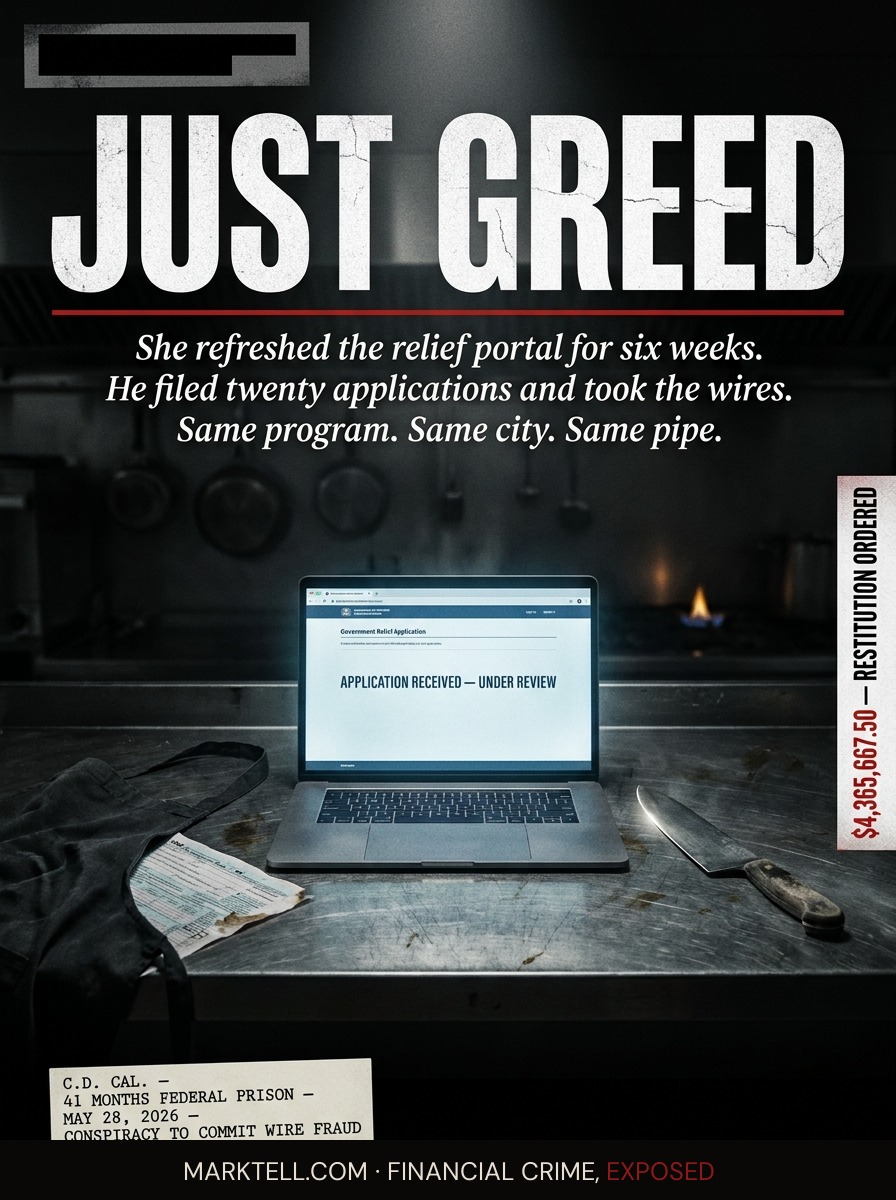
Marisol was fifty-two and her hours had been zero for nine days.
She sat at the kitchen counter in the apartment she had been renting since her younger son started middle school, and she refreshed the EIDL portal on a laptop her older son had given her when he upgraded. The screen showed the same thing it had shown the day before. Application received. Under review.
She had been a line cook for nineteen years. The last seven of them in a kitchen off Washington Boulevard in Culver City, working the saute station, six nights a week, family meal at four-thirty. In the middle of March the owner had pulled the crew into the dining room and said the words everyone already knew were coming. Indefinite. Until further notice. Take care of yourselves.
She had filed for unemployment. She had filed for the EIDL. She had asked her son to help her with the PPP language because the form used the word "payroll" and she was not on payroll, she was on a 1099, and nobody she knew could explain to her whether that mattered.
The number she was waiting for was ten thousand dollars. It was the advance the SBA had promised to small operators and gig workers within three days of application.
It had been nine days.
She refreshed the portal again.
This is the part of the story you already know. Picture the kitchen. Picture the counter. Picture the woman who is the reason the program existed in the first place.
Now picture the other end of the pipe.
II. The Pipe
The Paycheck Protection Program and the Economic Injury Disaster Loan program were stood up in a hurry in the spring of 2020. PPP was a forgivable loan run through banks. The idea was simple. If you kept your workers on the payroll, the government would erase the loan. EIDL was a direct SBA loan with a small upfront advance. Both programs were built to move fast. Speed was the design goal. Speed was also the vulnerability.
According to the U.S. Attorney's Office for the Central District of California, between April 2020 and April 2021, a Culver City restaurant owner named Philip Frederick Camino submitted more than twenty fraudulent applications to those two programs. Across multiple companies. Across multiple banks. Across multiple states.
He owned a hospitality group that developed restaurants and hotels in California, Tennessee, and Kentucky. Locations in Hollywood, Westwood, Studio City, Beverly Hills. The Hudson. Fellow. A new one called Imari was in development. On paper, he looked like exactly the kind of operator the relief programs were built to save.
On the applications, prosecutors said, he inflated the number of employees. He attached federal tax forms that had never actually been filed with the IRS. He certified, falsely, that the money would be spent on permissible business expenses. Rent. Utilities. Payroll.
When the wires hit, the money did not go to payroll.
It went, in significant part, to Camino. And, prosecutors said, more than $100,000 of it went to an accomplice. A kickback. The accomplice is not named in the public materials.
That is the pipe. That is the machine.
III. The Distance Between Two Counters
Read that slowly.
Marisol, the line cook, was refreshing a portal that was supposed to wire her ten thousand dollars within three days. The portal said "under review." She did not get her advance for almost six weeks. When it came, it was a fraction of what had been announced.
Somewhere in the same Los Angeles County, in the same months, in the same program, the applications Camino is now admitted to submitting were going through. Not all of them. Some were caught. Enough of them were not.
Over $4 million in funds were collected on those applications. The exact figure the court ordered as restitution at sentencing was $4,365,667.50.
Four million three hundred sixty-five thousand six hundred sixty-seven dollars and fifty cents.
That is the number that landed on May 28, 2026, in a federal courtroom in Santa Ana, when United States District Judge Fred W. Slaughter sentenced Camino to 41 months in federal prison. Three years and five months. Plus restitution. Plus the $249,990 the government had already seized, which will be credited against what he owes.
Judge Slaughter, according to the DOJ release, described the motivation in two words.
Just greed.
IV. The Plea
Camino pleaded guilty in August 2024 to one count of conspiracy to commit wire fraud. Wire fraud is the federal charge that covers using interstate wires, which includes the internet, to carry out a scheme to obtain money by false statements. The conspiracy charge means the government had evidence of at least one other person working with him. That other person, the accomplice who received over $100,000, remains unnamed in the materials made public to date.
At the plea, according to court records, Camino said the following.
"I pleaded guilty because I am guilty. What I did was wrong. I am not here to offer excuses. I knew what I had done was indefensible. I am deeply sorry to the government, to the public and to this court."
Read that too. Slowly. It is a clean statement. It is also a statement that arrives more than three years after the last fraudulent application was filed, and only after the federal investigators from Homeland Security Investigations, the FBI, and IRS Criminal Investigation had assembled the file.
At sentencing this week, prosecutors also raised new allegations that Camino had defrauded investors in his hospitality projects. Those allegations were considered by the court in fashioning the sentence. They remain allegations. The wire fraud conviction is the only count to which he pleaded guilty.
V. What the Pipe Was Built To Do
PPP was supposed to keep Marisol on the schedule.
That is not editorial. That is the design specification. The forgiveness formula was tied to maintaining headcount. Every dollar that went out the front of the pipe was supposed to come out the back of the pipe as wages. The whole architecture of the program assumed the operator on the receiving end was telling the truth about how many people he had on payroll, and that he was going to spend the money on those people.
Inflate the headcount, and the loan amount goes up. Submit a tax form that was never filed, and the lender does not see the gap because the lender is moving thousands of applications a day. Certify that the money is for payroll, and the wire clears.
Then route the money to yourself. Then kick a piece to a friend.
The program was a lifeline. The fraud was not a hack of the program. The fraud was an exact use of the program by an operator who understood that speed was the goal and verification was the casualty.
Marisol's six-week wait was not a coincidence with Camino's twenty applications. It was the same pipe under load.
VI. The Counter, Six Years Later
Marisol kept her apartment. Barely. She picked up shifts at a sandwich place in El Segundo for the back half of 2020. She went back to the Culver City kitchen in May 2021 when the dining room reopened at limited capacity. She does not follow federal sentencing news. She does not know the name Philip Camino.
If you told her that a restaurant owner in her city had taken more than $4 million from the same programs she had spent six weeks refreshing a portal for, she would not be surprised.
That part may be the saddest. The lack of surprise.
The Department of Justice announced on April 7, 2026, the creation of a new National Fraud Enforcement Division specifically focused on prosecuting fraud against the American people. The statute of limitations for fraud affecting financial institutions is ten years, which means PPP and EIDL applications from April 2020 can be prosecuted until April 2030.
There are more files. There will be more sentencings. The pipe ran for a year. The cases will run for nine more.
Camino reports to prison with a 41-month sentence and a restitution number that begins with a four and ends in a fifty-cent piece. He admitted what he did. The court accepted the admission. Judge Slaughter named the engine.
Just greed.
The line cook never got the advance on time. The operator got the wires. Then he got the courtroom.
The pipe is still there. Somebody is still standing at both ends of it.
- U.S. Attorney's Office, Central District of California | May 28, 2026 | Press release on sentencing of Philip Frederick Camino
- Westside Today | May 2026 | "Culver City restaurant owner Philip Camino sentenced to prison for four million dollar COVID loan fraud"
- U.S. Department of Justice | April 7, 2026 | Announcement of National Fraud Enforcement Division
- U.S. District Court, Central District of California | August 2024 | Plea agreement and plea colloquy, United States v. Camino
- U.S. Small Business Administration | 2020-2021 | PPP and EIDL program rules and application requirements
Editorial Notice
MarkTell is a true crime publication about financial fraud. Some scenes, dialogue, and sequential details are reconstructed from court filings, enforcement actions, news reports, and public records. Where the public record does not provide exact details, editorial reconstruction is used to convey the documented pattern of events. Names of private individuals may be changed to protect identity. All factual claims are sourced to public documents cited in the Evidence Trail above. MarkTell does not provide investment, legal, or financial advice. Nothing published here constitutes a recommendation to buy, sell, or avoid any investment. Allegations described in active cases have not been adjudicated and defendants are presumed innocent until proven guilty. Readers should conduct their own due diligence before making financial decisions.