The relative who died in 1977 kept collecting checks until last week
Tamera Ruth Powers, 68, of Tonganoxie, Kansas, drew government benefits under two names for nearly two decades. One of the names belonged to a relative who had been dead since 1977.
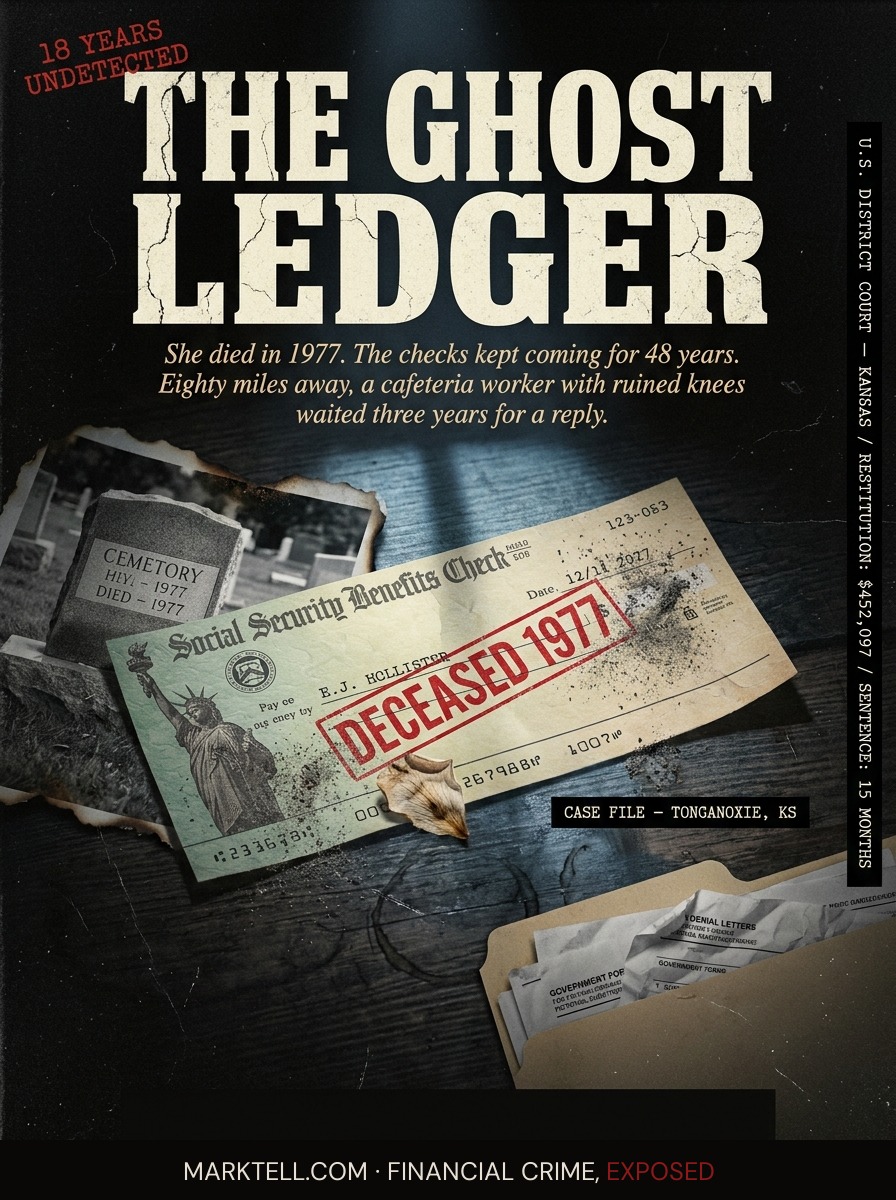
Diane keeps the denial letters in a manila folder on top of the refrigerator. She is seventy-one. She worked the cafeteria line at a Topeka elementary school for thirty-one years and her knees gave out the way knees give out when you have stood on tile under fluorescent light for three decades. She filed for disability in 2022. She is still waiting.
The folder is thick now. Requests for more documentation. Requests for the same documentation again. A notice that her file had been reassigned. A notice that her file had been reassigned a second time. Diane opens the mail at the kitchen table because that is where the light is good and where her reading glasses live.
Eighty miles east of Diane's kitchen, in Tonganoxie, a woman named Tamera Ruth Powers was, according to federal prosecutors, doing something with the same system that Diane was waiting on.
She was, the government says, being two people.
I.
Minda Sue Rakestraw died in 1977.
She was Powers' relative. The court record does not dwell on which kind. What the record dwells on is the date. 1977. Carter was president. The Bee Gees were on the radio. Minda Sue Rakestraw was buried, and the paperwork of her short life went into whatever drawer paperwork goes into when someone stops needing it.
In April 2005, almost three decades later, an application landed at the Social Security Administration. The name on it was Minda Sue Landis. Landis was a married name. Powers, the government says, had married a man named Landis using her dead relative's identity. She had obtained a Kansas identification card in that name. Read that again. A state-issued ID was printed for a woman who had been in the ground for twenty-eight years.
That is not a glitch. That is a door that nobody was watching.
The application was for disability. It was approved. Minda Sue Landis, who did not exist, began receiving monthly payments from the federal government.
II.
The thing about running two selves is that you have to run both of them.
In August 2012, according to the U.S. Attorney's Office for the District of Kansas, Powers applied for disability benefits a second time. This time in her real name. On the form, she stated that she had not previously applied for Social Security benefits.
She had. The other her had. For seven years by then.
In August 2013, she applied for Supplemental Security Income, which is the federal program for people with almost nothing. She used her real name. She did not disclose the alias. She did not disclose her marital status.
That same month she applied to the State of Kansas for help paying her heating bill, through the Low Income Home Energy Assistance Program. She also applied for food assistance through SNAP. On those forms, prosecutors say, she did not report that she was married. She did not report her spouse's income.
In December 2013, Kansas Medicaid began covering her. Same omissions.
Picture the desk where these applications sat. Picture the caseworker who took them. Picture the boxes on the form. Marital status. Other names used. Household income. Each box is a door. Each door, the indictment alleges, was walked through with a lie.
By the time it was over, Powers had defrauded federal and state programs of roughly $450,000. The restitution order, entered when she was sentenced last week, is for $452,097.
That is the number. Let it sit.
III.
Diane's denial in 2024 said the file needed additional medical documentation. She got it. She mailed it. The next letter said the file needed additional medical documentation.
She does not know about Powers. There is no reason she should. The queue she is in does not show her who else is in it. She just knows that the line is long and the line is slow and the line is, in the way of all underfunded government lines, indifferent to her knees.
This is the part that does not show up in the press release. The Kansas Inspector General, Steven D. Anderson, said at sentencing that the case "sends a strong message that schemes to defraud the Medicaid, SNAP, LIEAP, and Social Security Disability programs will not be tolerated." That is the official line. It is true as far as it goes.
What it does not say is who else was in the room. The room is the queue. The queue is finite. Every dollar that went out under the name of a woman buried in 1977 was a dollar that did not go to a woman standing on a tile floor in a cafeteria.
That part may be the saddest.
IV.
The machine has a name. Call it the ghost ledger.
The ghost ledger is the second life kept alive on paper after the real person is gone. It needs three things to run. It needs a name nobody is looking for. It needs a state agency willing to print an ID against a thin proof. And it needs a bank willing to open an account.
Powers, the record shows, had all three. The Kansas ID. Two bank accounts, one for each self. The benefits programs that, in 2005, were not yet wired to the Social Security Death Master File in a way that would have flagged a 1977 death certificate against a living disability claim.
The ghost ledger ran for eighteen years.
It might have run longer. In June 2023, according to court documents, Powers applied for Retirement Insurance Benefits through Social Security. She used her real name. On the form, she stated she was not married. She did not disclose her aliases.
That was the application, prosecutors say, that brought the two selves into the same field of view. When the system looked at Tamera Powers' retirement filing and looked at Minda Sue Landis' disability file, the math stopped working.
The grave caught up.
V.
Powers pleaded. She was sentenced last week to fifteen months in federal prison. She was ordered to pay back $452,097 she does not, in all likelihood, have.
Fifteen months. Do the math. About $30,000 per month of fraud, against about $30,000 per month of sentence. The exchange rate of the ghost ledger.
Diane is still waiting on her file. She does not know any of this. She will read about Powers in the Topeka Capital-Journal, or she will see a clip on KCTV, and she will shake her head the way people shake their heads at the news, and she will go back to the manila folder on top of the refrigerator.
The folder is the story. The grave is the story. The Kansas ID printed in 1977's name is the story.
The machine that issued it is still running.
It just needs another name nobody is looking for.
- U.S. Attorney's Office, District of Kansas | press release on sentencing of Tamera Ruth Powers | 2026
- KCTV News | Kansas woman sentenced for stealing dead relative's identity to defraud government | June 2026
- Statement of Steven D. Anderson, Kansas Inspector General | at sentencing | 2026
- Background on Social Security Death Master File and benefits verification | Social Security Administration Office of the Inspector General, public materials
Editorial Notice
MarkTell is a true crime publication about financial fraud. Some scenes, dialogue, and sequential details are reconstructed from court filings, enforcement actions, news reports, and public records. Where the public record does not provide exact details, editorial reconstruction is used to convey the documented pattern of events. Names of private individuals may be changed to protect identity. All factual claims are sourced to public documents cited in the Evidence Trail above. MarkTell does not provide investment, legal, or financial advice. Nothing published here constitutes a recommendation to buy, sell, or avoid any investment. Allegations described in active cases have not been adjudicated and defendants are presumed innocent until proven guilty. Readers should conduct their own due diligence before making financial decisions.