The regulator walked away. The machine is still running.
In March 2026, the SEC settled a three-year case against one of crypto's most powerful operators for ten million dollars and a charge that required only negligence, then dismissed everything else. The people who bought the tokens when the trading looked real got nothing.
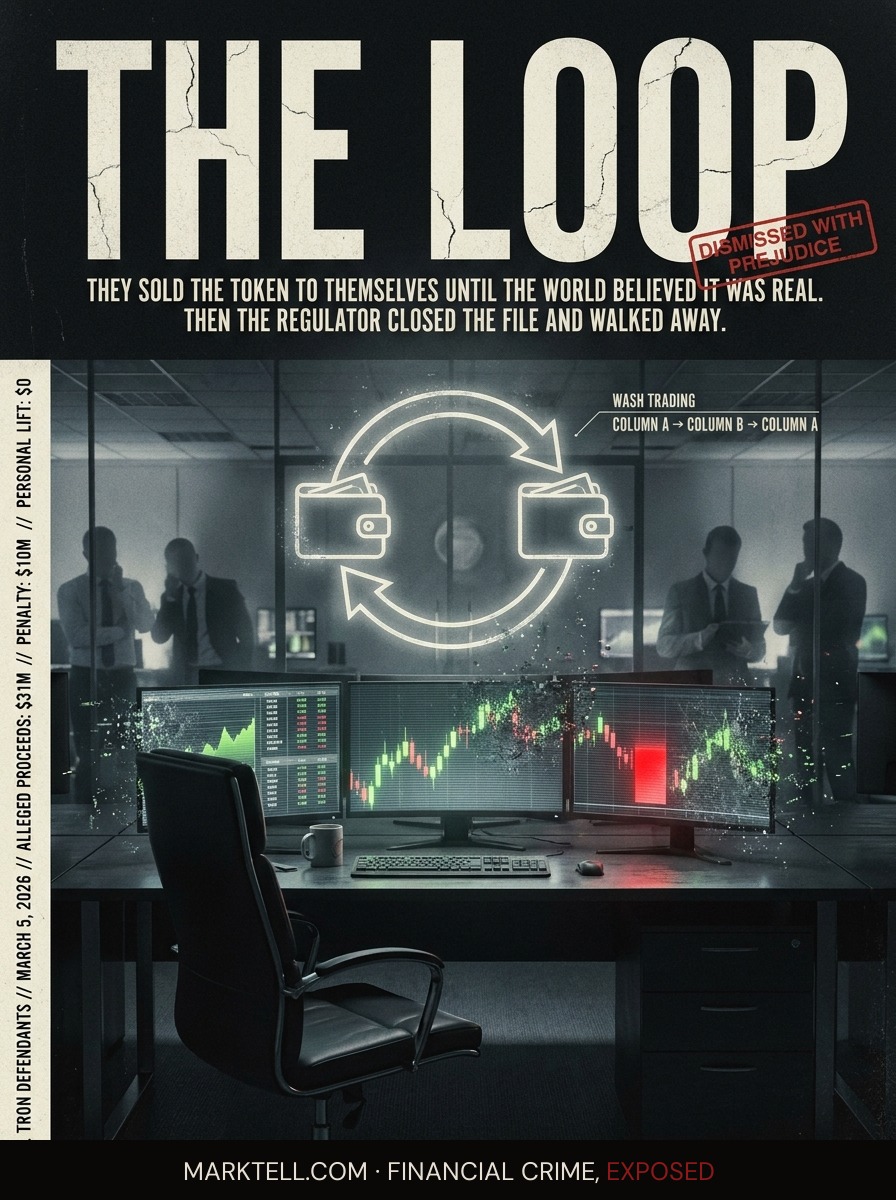
Picture the spreadsheet.
Not the one Justin Sun's lawyers filed. The one his trading desk ran. The one that tracked which wallets were buying and which wallets were selling and how, at the end of each cycle, both of those wallets belonged to the same operation. Column A sells to Column B. Column B sells back to Column A. The price moves. The volume climbs. On every exchange screen in the world, TRX looks like something people want.
The SEC called it wash trading. That is when a trader buys and sells the same asset to themselves, or to coordinated accounts they control, to manufacture the appearance of real market activity. There is no genuine buyer and seller. There is only the performance of a transaction, repeated until the audience believes it.
The audience believed it.
---
I.
The original complaint landed in March 2023. The SEC alleged that the Tron Defendants, which included Rainberry Inc. (the company that owns and operates the BitTorrent protocol), the Tron Foundation, the BitTorrent Foundation, and Justin Sun personally, had spent years running a market they controlled while selling it to people who did not know who controlled it.
The specific allegations: coordinated wash trading in TRX, the Tronix token, and BTT, the BitTorrent token, to create a false appearance of trading volume and investor demand. Unregistered offers and sales of those tokens as securities. And a celebrity promotion scheme: the SEC alleged Sun paid eight celebrities to tout TRX and BTT on social media without disclosing that they had been paid to do so.
The disgorgement figure the SEC put on the table for the unregistered sales alone was $31 million. Disgorgement means giving back money you made illegally. The SEC wanted $31 million returned to the people the money came from.
That number did not survive the settlement.
---
II.
There is a woman I want you to think about. I do not know her name. She does not appear in any of the SEC filings. She never will.
She is around forty-five. She found TRX in late 2021, during the part of the cycle when everyone's portfolio was going up and the people who had been early were posting screenshots and the phrase "do your own research" was in every comment thread. She did her research. She watched the volume. Volume is the number of tokens trading hands in a given period, and high volume is supposed to mean real demand, real participation, real people making real decisions. The volume on TRX looked real. It was not.
She put in a number that felt manageable. Not retirement money. Money she had been saving toward something. She watched the price move the way the price was designed to move, and she thought she understood the market, and she was wrong about what she was looking at.
The SEC's complaint was filed fourteen months after the peak. By then, TRX had lost most of what it had gained. The complaint alleged that the volume had been manufactured. The woman with the savings did not get a check. She got a news alert.
I have been the community manager who told people the volume was real. I believed it was real. That is not an excuse. It is a data point about how the machine works.
---
III.
On March 5, 2026, the SEC filed a proposed final judgment.
Read that phrase carefully. Proposed final judgment. Not a conviction. Not an admission. A settlement, which means both sides agreed to stop fighting under terms that required no one to say what actually happened.
The terms: Rainberry Inc., the BitTorrent company, agreed to pay a civil penalty of $10 million and accept a permanent injunction against future violations of Section 17(a)(3) of the Securities Act of 1933.
Here is what Section 17(a)(3) means in plain English. It is the lightest of the three fraud provisions under the Securities Act. To violate it, you do not need to have intended to deceive anyone. You only need to have been negligent, which means careless, in conducting a transaction that operated as a fraud on investors. The original charges against the Tron Defendants included scienter-based violations. Scienter means intent, knowledge, the mental state of knowing you were doing something wrong. Those charges were dropped.
The settlement said: Rainberry was careless.
It did not say Justin Sun knew what he was doing.
All claims against Sun personally were dismissed with prejudice. That phrase means the SEC cannot refile them. The case against the man who ran the operation is over. It ended without him paying a dollar.
---
IV.
Ten million dollars.
Stop there for a moment.
The SEC's original complaint alleged $31 million in proceeds from unregistered token sales. The settlement penalty was $10 million, paid by the company, not the founder. There was no disgorgement. Disgorgement, again: the return of ill-gotten gains. The SEC had asked for it in its amended complaint. The final judgment did not include it.
The math is not complicated. If the allegations were accurate, the operation generated more than it was fined. The company paid a penalty. The founder walked.
I am not telling you what that means. You can do the arithmetic.
What I will tell you is that on the same day the SEC filed that proposed judgment, March 5, 2026, it also voluntarily dismissed five separate cases against crypto firms accused of wash trading, including Gotbit Consulting, CLS Global, Vy Capital, and ZM Quant. Those cases had been brought under the previous SEC administration. The current administration, under Chairman Paul Atkins, has been explicit about its direction: away from what it describes as "regulation by enforcement," and toward clearer written rules.
The written rules arrived March 17, 2026. The SEC, joined by the Commodity Futures Trading Commission, which oversees commodity markets and increasingly overlaps with crypto regulation, issued interpretive guidance on when a crypto asset is a security and when it is not. A security is an investment contract, meaning you put in money expecting profits from someone else's work. If a token is a security, the company selling it has to register with the SEC and follow disclosure rules. If it is not, different rules apply or fewer rules apply.
The new guidance is the first serious attempt to draw that line in writing. That is not nothing. Unclear rules can be used as weapons by bad actors who sell tokens and then claim later they did not know the rules applied.
But the guidance and the dismissals arrived together, in the same month. One hand extended a rulebook. The other hand closed the cases.
---
V.
On March 26, 2026, three weeks after the Tron settlement, the SEC filed charges against a man named Krish Kumar, an Oklahoma resident who had raised $7.8 million from investors through two funds he managed, Future Fractal Investments LLC and Arcane Resonance Fund LLC.
According to the SEC's complaint, Kumar moved nearly $7 million of that money into his own personal accounts.
The accounts the complaint describes are not offshore. They are not layered through a chain of shell companies the way sophisticated financial fraud usually gets laundered. They are personal accounts. The movement was direct.
The SEC is seeking disgorgement, pre-judgment interest, and civil monetary penalties. Monetary remedies have not yet been determined. The case was filed as settled, meaning Kumar consented to the judgment without admitting or denying the allegations.
I want you to notice the difference between these two cases. Justin Sun: alleged to have run coordinated wash trading across an ecosystem that touched millions of wallets, allegedly generating $31 million in proceeds, settled for $10 million with no personal liability. Krish Kumar: alleged to have moved $7 million to his own accounts, facing disgorgement and penalties that the court will set.
One of these cases involved a man most retail crypto investors had heard of. The other involved a man running two funds most people never encountered.
The machine was bigger in one case.
The penalty was bigger in the other.
---
VI.
There is a version of the next two years where the SEC's new guidance works the way it is supposed to. Token issuers read the taxonomy. They register when registration is required. The rules get clearer. The people who were planning to do the wash trading thing look at the rulebook and decide it is not worth it.
I want to believe that version is possible.
Here is what I also know, because I built parts of this architecture. A wash trading operation does not require the founder to be in the room when the trading happens. It requires accounts. It requires coordination. It requires someone to watch the spread between what is being bought and sold. It does not require intent to be proven in a courtroom. It requires, as the settlement established, only that the activity operated as a fraud on investors. The word "operated" is doing a lot of work in that sentence. It means the effect was fraudulent, regardless of what anyone meant.
The woman with the savings did not need Sun to have meant to deceive her. She needed the volume to be real. It was not real. The effect was the same.
The SEC's new rules tell the market what a security is. They do not stop someone from manufacturing the appearance of demand for that security before the investors figure out they are watching a performance.
That part is still running.
Sun welcomed the settlement publicly. He described it as closure and said he was focused on building blockchain solutions and collaborating with regulators. The Tron network is still operating. The TRX token is still trading.
The spreadsheet with the two columns is not in the final judgment.
Nobody asked for it.
- Morrison & Foerster LLP, "Top 5 SEC Enforcement Developments for March 2026," April 21, 2026. https://www.mofo.com/resources/insights/260421-top-5-sec-enforcement-developments-for-march-2026
- SEC v. Rainberry Inc., Justin Sun, Tron Foundation Limited, and BitTorrent Foundation Ltd., Proposed Final Judgment, filed March 5, 2026, U.S. District Court.
- SEC Original Complaint against Tron Defendants, filed March 2023, alleging wash trading, unregistered offerings of TRX and BTT, and undisclosed celebrity promotions.
- SEC v. Krish Kumar, Complaint filed March 26, 2026, charging violations of Section 17(a) of the Securities Act of 1933, Section 10(b) of the Securities Exchange Act of 1934 and Rule 10b-5, and Sections 206(1), 206(2), and 206(4) of the Investment Advisers Act of 1940.
- SEC and CFTC Joint Interpretive Guidance on Crypto Assets, issued March 17, 2026.
- SEC Voluntary Dismissals of five crypto wash trading cases (CLS Global FZC LLC, Gotbit Consulting LLC, Vy Pham, ZM Quant Investment Ltd.), March 31, 2026.
- SEC Enforcement Director Resignation of Margaret A. Ryan and appointment of David Woodcock as Director, Division of Enforcement, March 16, 2026.
- Federal court order requiring SEC to disclose internal penalty calculation spreadsheets related to off-channel communications sweeps, March 5, 2026.
- SEC Enforcement Results, Fiscal Year 2025, published April 7, 2026, reporting $17.9 billion in total monetary remedies.
- American Securities Association FOIA complaint leading to court order on SEC text messaging penalty spreadsheets, resolved March 5, 2026.
Editorial Notice
MarkTell is a true crime publication about financial fraud. Some scenes, dialogue, and sequential details are reconstructed from court filings, enforcement actions, news reports, and public records. Where the public record does not provide exact details, editorial reconstruction is used to convey the documented pattern of events. Names of private individuals may be changed to protect identity. All factual claims are sourced to public documents cited in the Evidence Trail above. MarkTell does not provide investment, legal, or financial advice. Nothing published here constitutes a recommendation to buy, sell, or avoid any investment. Allegations described in active cases have not been adjudicated and defendants are presumed innocent until proven guilty. Readers should conduct their own due diligence before making financial decisions.