The register at Taste of India rang up groceries nobody carried out
For six years, a small grocery in Lynchburg, Virginia ran a second business behind the first one. The customers came in for cash. The register did the rest.
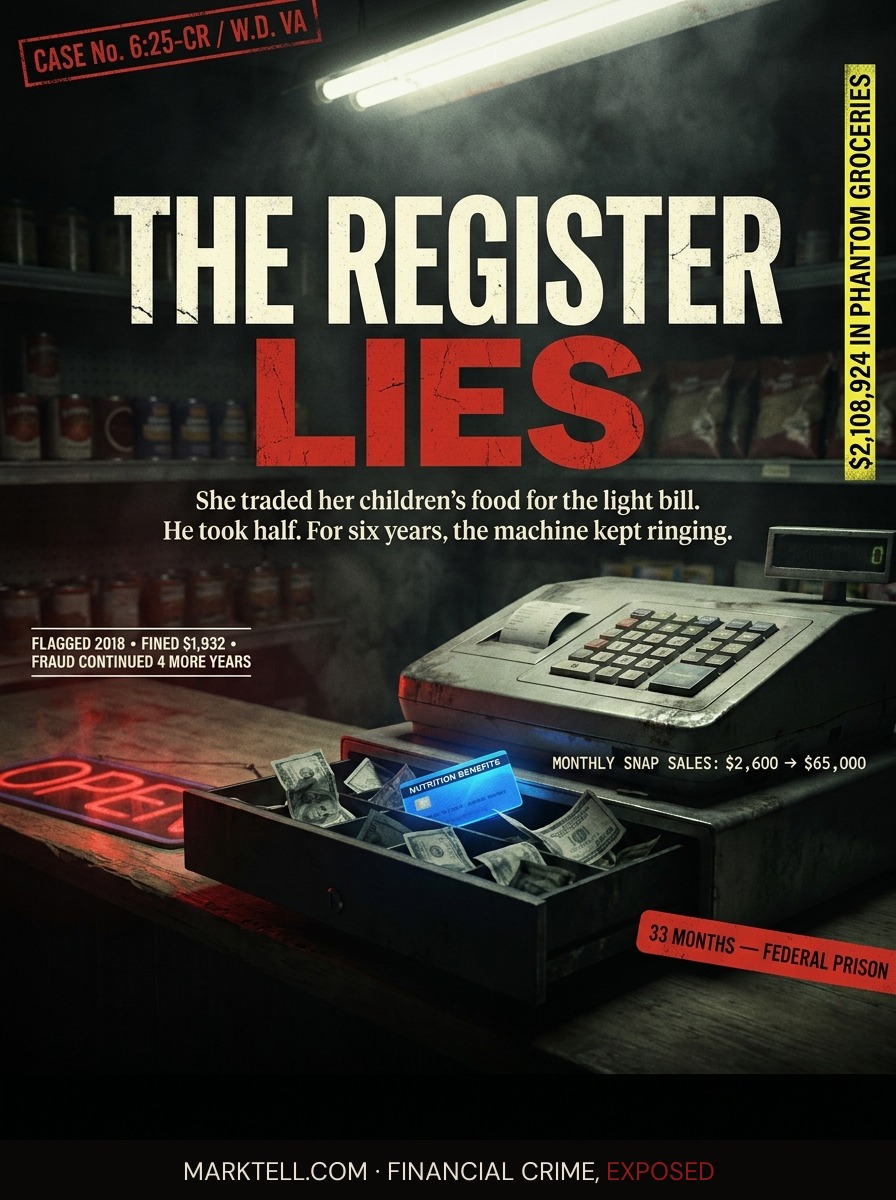
Denise stood in the back aisle of Taste of India on a Tuesday afternoon in the spring of 2022, holding a blue EBT card with $230 left on it and a math problem she had already solved in her head.
Rent was short. The light bill was past due. Her younger one needed shoes. The card could buy food. The card could not pay the light company. She knew what the card could do at this store because a woman at the bus stop had told her two months earlier. You go to the Indian place on the boulevard. You ask. He rings something up. He gives you cash. Not all of it. About half.
Half of $230 is $115. Half of $230 is the light bill.
She walked to the counter. She did not buy any food.
This is the part of the story nobody likes to tell. The federal program that fed Denise's kids was real. The fraud was real. And the person standing in the aisle making the trade was not a villain. She was a 47-year-old home health aide working twelve-hour shifts who needed cash the program would not give her. She was the smallest piece of a machine she did not build. The machine was the register.
I.
Rajan Babbar was 60 years old when a federal judge in the Western District of Virginia sentenced him on June 11, 2026, to 33 months in federal prison. He had owned Taste of India, a medium-sized grocery on a commercial stretch of Lynchburg, for years. He pleaded guilty in March. The charge was federal food stamp fraud and transacting in criminally derived property. The number on the restitution order was $2,108,924. The number on the forfeiture order was over $380,000 in seized assets, which is what the government found in cash and accounts and was willing to take.
Judge Norman K. Moon signed it.
The mechanism was simple. SNAP, the Supplemental Nutrition Assistance Program, is the modern food stamp program. The federal government loads benefits onto a card. The card works like a debit card. It can be used at authorized retailers to buy food. Not cash. Not alcohol. Not the light bill. Food.
Babbar was an authorized retailer. The Department of Agriculture's Food and Nutrition Service had cleared his store to accept the card. The clearance meant the federal government trusted him to ring up groceries and submit the transactions for reimbursement.
He rang up groceries that did not exist.
Then he handed over cash for roughly half the value. The other half stayed in the register and, eventually, in his accounts. Multiply that by six years.
II.
The Food and Nutrition Service knew something was wrong in 2018.
In 2018, Taste of India was averaging about $2,600 a month in SNAP transactions. That is consistent with a medium-sized grocery in Lynchburg. By 2023, the monthly average had climbed to $65,000. Read that slowly. A 2,500 percent increase in five years, at a store that did not grow, in a city that did not grow that fast, in a category of spending that does not move like that.
The average individual SNAP transaction at Taste of India during the fraud years was $115.77. The statewide average for similar stores was $40.61.
FNS noticed. FNS put the store on a Watch List.
Then, in 2020, the federal government and Rajan Babbar reached a civil settlement. He paid $1,932. He was allowed to keep operating as a SNAP retailer.
$1,932.
The fraud continued for another four and a half years.
III.
In the spring of 2023, federal investigators stopped watching from the analytic side and started walking through the door.
The USDA's Office of Inspector General, the FBI, and the Lynchburg Police Department ran undercover operations. Agents went into Taste of India with SNAP cards. According to the case record, Babbar agreed on multiple occasions to exchange SNAP benefits for cash. He rang up phantom items. He handed over money. The transactions were recorded.
A federal grand jury returned the indictment in January 2025. Babbar pleaded in March 2026. Sentence in June.
The case was prosecuted by Assistant U.S. Attorney Lee Brett of the Western District of Virginia. The announcement came from First Assistant U.S. Attorney Robert N. Tracci, USDA-OIG Special Agent in Charge Charmeka Parker, and FBI Richmond Special Agent in Charge Ian Kaufmann.
That is the trail. Analytics. Civil penalty. Undercover. Indictment. Plea. Sentence. It took seven years from the first flag to the cuffs.
IV.
Now come back to Denise.
She did not testify. She is not named in the record. The record names the store, the owner, the numbers, and the agencies. The thousands of people who walked in with cards and walked out with cash are the unseen layer of this case. The government did not charge them. The government rarely does.
But they were there. They had to be. You do not move $2.1 million in fraudulent SNAP transactions without recipients on the other side of the counter. Some of them were running their own small businesses with the cash. Some were buying things SNAP does not cover and never should have to cover. Some were paying the light bill. Some were buying things you would not approve of.
The program is built on a premise. The premise is that food is the need that must be met because food is the need that cannot be met any other way. The premise is honest. The premise is also incomplete. A mother who cannot pay the electric bill cannot store the food in the refrigerator. A mother who cannot pay the rent does not have a kitchen. The program does not see those problems. The register at Taste of India saw them and offered a trade.
The trade was a tax. Half the benefit went to Babbar. Half went to the customer. The federal government paid the full amount and the customer received the discounted version. The discount was the price of converting food into rent.
That part may be the saddest part of the case. The fraud worked because the program had a gap the fraud could fill. The fraud did not create the gap. It rented it.
V.
There is a pattern here and it is worth naming.
Retailer SNAP trafficking is not a fringe crime. The Food and Nutrition Service estimates benefit trafficking alone runs about $1.3 billion annually nationwide. The broader SNAP overpayment rate climbed from just over 2 percent in 2012 to more than 10 percent in 2023, costing taxpayers roughly $10 billion a year.
The mechanism at Taste of India is the mechanism everywhere it happens. A retailer with authorization. A register that can be made to lie. A community where cash is harder to find than groceries. A customer base that knows.
The defense the federal government has against this is the analytics. The math at the FNS desk that says no store like this should be ringing $65,000 a month. The math that put Taste of India on a Watch List in 2018.
The civil penalty in 2020 is the part that should make a reader angry, if the reader is going to be angry about anything. The store was flagged. The store was caught. The fine was $1,932. The fraud was, by the time it ended, $2,108,924. Babbar paid less than one tenth of one percent of the eventual total and was allowed to continue operating.
That is not a deterrent. That is a license fee.
VI.
The morning after the sentence, Denise was not in court. She did not read the press release. She might have heard about it from a neighbor. She might have driven past the boulevard and noticed the store was still open, because grocery stores under federal SNAP disqualification do not always close. The owner goes to prison. The store sometimes finds a new owner. The authorization can sometimes be renewed under a new name.
The light bill came again. The rent came again. The card had a new month's balance on it.
The register at Taste of India was a small piece of a national machine that runs because the gap is real and the program does not close it. Babbar fed the gap and skimmed from it. The federal government found him. The federal government sentenced him. The gap is still there.
What the court settled this week is who pays for the register's lies. What the court did not settle is why the register kept finding customers for six years.
The trade was always available. Babbar was the man who answered the door. He was not the door.
- U.S. Attorney's Office, Western District of Virginia | June 11, 2026 | Press release on sentencing of Rajan Babbar
- WSET News | June 2026 | "Lynchburg business owner sentenced to 33 months in federal prison for SNAP fraud"
- USDA Food and Nutrition Service | program data | SNAP retailer trafficking statistics and Watch List procedures
- U.S. District Court, Western District of Virginia | June 11, 2026 | Sentencing order, Judge Norman K. Moon
- Federal grand jury indictment | January 2025 | United States v. Rajan Babbar
- USDA-OIG, FBI Richmond Division, Lynchburg Police Department | 2023 | Joint undercover investigation
- Government Accountability Office and USDA reporting | 2012-2023 | National SNAP overpayment and trafficking estimates
Editorial Notice
MarkTell is a true crime publication about financial fraud. Some scenes, dialogue, and sequential details are reconstructed from court filings, enforcement actions, news reports, and public records. Where the public record does not provide exact details, editorial reconstruction is used to convey the documented pattern of events. Names of private individuals may be changed to protect identity. All factual claims are sourced to public documents cited in the Evidence Trail above. MarkTell does not provide investment, legal, or financial advice. Nothing published here constitutes a recommendation to buy, sell, or avoid any investment. Allegations described in active cases have not been adjudicated and defendants are presumed innocent until proven guilty. Readers should conduct their own due diligence before making financial decisions.