The realtor on the phone was an inmate with a contraband cell
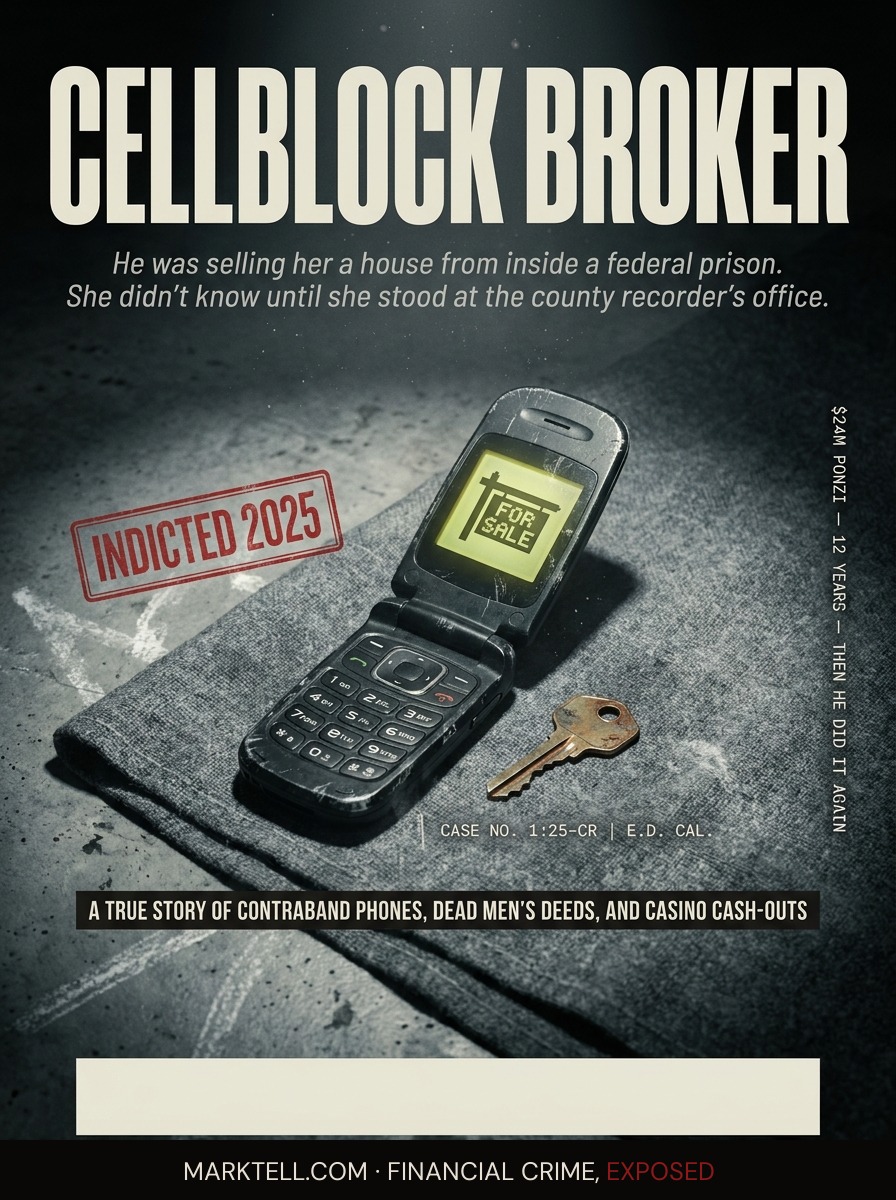
Seth Adam Depiano was already serving twelve years for a $24M real estate Ponzi when prosecutors say he built another one from inside federal prison. The second machine ran on contraband phones, dead people's houses, and a 26-year-old who just pleaded guilty.
Marisol sat at the kitchen table on a Tuesday morning in the spring of 2022 with a printed listing in front of her and a yellow legal pad to the side. Three bedrooms. A detached garage. A price that was lower than it should have been but not so low that it screamed. She had circled the broker's number in blue pen. She was fifty-eight. She had worked payroll for the school district for nineteen years. The down payment in her savings account was for her daughter, who was getting married in the fall and wanted a small rental property to start a life around.
She called the number. A man answered on the second ring. He said his name was Marcus Lazaro. He sounded busy in the way people who close deals sound busy. He took her questions one at a time. He did not push. He said he would email the disclosures by the end of the day.
She did not know the voice was coming from inside a federal prison.
That is the part that is hard to hold. A man in custody, serving twelve years for a real estate fraud he had already pleaded guilty to, was on the other end of the line, selling her a house that was not his to sell, using a name that did not exist, from a phone that was not supposed to be in his hand.
According to the federal indictment unsealed in 2025, Seth Adam Depiano, 44, of Clovis, ran the operation from his cellblock. He used contraband cell phones and contraband computers. He used fake broker identities. Marcus Lazaro. Steven Baron Sr. He marketed properties that were not for sale, including, prosecutors say, homes belonging to people who had died.
This is the machine. The phone in a place where there should not have been a phone.
I.
Depiano was not new to this. In 2018 he pleaded guilty to running a $24 million real estate Ponzi scheme. The court sentenced him to twelve years and ordered him to pay more than $19.6 million in restitution. That is adjudicated. That is in the record. The man on Marisol's call had already been measured for the prison jumpsuit he was wearing while he spoke to her.
The new scheme, prosecutors allege, ran from roughly March 2021 to December 2022. A second machine, built from inside the walls of the first sentence.
He did not work alone. On Monday, June 29, 2026, Gilberto Barron, 26, of Delano and Las Vegas, pleaded guilty in federal court in Fresno to conspiracy to commit wire fraud, money laundering conspiracy, and aggravated identity theft. The U.S. Attorney's office announced the plea that day. Sentencing is scheduled for September 28, 2026, before U.S. District Judge Jennifer L. Thurston. Barron faces up to twenty years on the wire fraud and money laundering counts and a mandatory two-year minimum on the aggravated identity theft count, to run consecutively.
Barron was the body in the room. The face buyers met when the paperwork needed signing. The hand that slid the fabricated deeds and title reports across the table.
II.
The mechanism worked like this.
A listing went up online for a property the operators did not own. Sometimes the real owner was alive and had no idea their house was for sale. Sometimes the real owner was dead and the heirs had not yet sorted the estate. A buyer would call. A voice that said it was a broker would answer. Documents would arrive that looked correct. A deed. A title report. A closing statement. The buyer would wire funds to an account in the name of a shell company that mimicked a legitimate one closely enough to pass a tired eye.
Then the money moved.
According to court filings, the laundering ran through Las Vegas casinos. Co-defendant Zahria Barber, 28, was sentenced to one year in prison for her role. The pattern prosecutors describe is familiar to anyone who has worked a casino money-laundering case. Large amounts of cash fed into gaming machines. Minimal play. A cash-out ticket pulled almost immediately. A clean record at the cage that says: this person won at the slots. The money walks out with a receipt and a story.
The cleaned money, prosecutors say, was then used to buy real property. Real deeds. Real names. Real keys.
So the picture is this. Marisol's wire transfer, sent for a house that was not for sale, ended up as someone else's house that was. The machine consumed her down payment and produced a roof for someone she would never meet.
III.
Picture it.
A slot machine in a Las Vegas casino at two in the afternoon on a weekday. The lights. The carpet. A person sitting in front of the screen feeding in a printed ticket worth several thousand dollars. A pull. Maybe two. A cash-out. A walk to the cage. A new ticket in hand. A signature. A receipt. The casino's books say a customer played and cashed out. The federal records, prosecutors allege, say something else entirely.
This is what laundering looks like in practice. Not a back room. Not a briefcase. A chair, a screen, a ticket, a cage.
IV.
For Marisol, the moment the machine became visible was not dramatic. It was administrative.
She drove to the county recorder's office because she wanted to see her name on the deed in the public record. The clerk pulled up the parcel. The owner of record was not her. The owner of record was not the seller she had wired money to either. The owner of record was a person she had never heard of, who, the clerk said gently, had passed away the year before.
She drove home. She sat at the kitchen table. The listing was still on the printer tray. The yellow legal pad with her questions was still there. The questions had all been answered, on the phone, by a man who sounded like he knew what he was doing.
She did not call her daughter for two days.
That part may be the saddest.
V.
The ugly question is not how Depiano did this. The ugly question is how he did it twice.
A man pleads guilty to a $24M real estate fraud. He is sentenced to twelve years. He is ordered to pay $19.6M in restitution. He goes to federal prison. And then, prosecutors allege, he runs a second real estate fraud, worth about $10M, from inside the walls of his sentence, for nearly two years before the indictment lands.
The federal prison system has known about contraband cell phones for at least fifteen years. The Bureau of Prisons has published reports. Congress has held hearings. Phones get in. They get used. The technology to jam them exists and has been debated and partially deployed. The gap between the known problem and the working solution is the gap that Depiano, prosecutors say, walked through.
A buyer in the Central Valley has no way to know that the broker on the phone is an inmate. The buyer is looking at a listing. The buyer is comparing prices. The buyer is asking what kind of financing the seller will accept. The buyer is doing what the system tells buyers to do.
The system did not tell the buyer to ask whether the voice on the phone was incarcerated.
VI.
What the buyer can ask is this.
Pull the deed yourself. Before the wire. Not after. The county recorder's website in most California counties will show you the owner of record for free or for a few dollars. If the name on the deed does not match the name of the person selling you the house, stop.
Verify the broker's license with the California Department of Real Estate. Not by clicking a link the broker sent you. By going to the DRE website directly and searching the name. A real license has a number, a status, and a history. A fabricated identity does not.
Insist on title insurance through a title company you chose, not one the seller recommended. The fee is small. The protection is the entire reason title insurance exists.
If the seller is unwilling to meet in person at a title company office to close, that is not a logistical problem. That is a signal.
These are not the exciting questions. These are not the questions that make a house feel like a home. These are the ugly questions. The ones that protect the down payment your daughter is counting on.
VII.
Barron pleaded guilty on a Monday. The plea was the system catching up to a scheme that had already done its damage. The properties had been bought. The casino tickets had been cashed. The voices on the phones had hung up.
The sentencing will come in September. Restitution will be ordered. Some money will be recovered. Most of it will not.
Depiano's underlying case remains pending. The indictment alleges. The court will decide. Allegation is not adjudication. That distinction matters even when the pattern is loud.
But the pattern is loud.
A man who pleads guilty to a $24M real estate fraud and then, while serving the sentence for that fraud, is charged with running a $10M real estate fraud from his cell is not a person who made a mistake. He is, prosecutors allege, a machine operator. The machine sat idle for a moment when he was arrested in 2018. It started up again when he had a phone.
Marisol still works payroll at the school district. Her daughter still got married in the fall of 2022. The rental property never happened. The down payment is gone. The civil recovery, if it comes, will come slowly and in pieces.
She does not talk about it much. When she does, the part she returns to is not the money. The part she returns to is the voice on the phone. How calm it was. How patient. How it took her questions one at a time and answered them in a tone that sounded exactly like trust.
That was not turbulence. That was a man in a cell with a phone that should not have been in his hand, building a second life on the wreckage of the first.
The machine works as long as nobody asks where the voice is coming from.
- U.S. Attorney's Office, Eastern District of California | June 29, 2026 | Press release announcing guilty plea of Gilberto Barron
- Department of Justice | 2018 | Guilty plea and sentencing of Seth Adam Depiano in $24M real estate Ponzi scheme, $19.6M restitution order
- Federal indictment | January 2025 | Charges against Seth Adam Depiano for $10M real estate fraud scheme operated from federal prison
- Court records, Eastern District of California | 2025-2026 | Sentencing of Zahria Barber to one year for casino-based money laundering
- Fresno Bee | June 29, 2026 | "Second Valley fraudster pleads guilty in $10M real estate scheme with Clovis man"
- Federal Bureau of Investigation | Annual reports | Statistics on real estate-related crime complaints
Editorial Notice
MarkTell is a true crime publication about financial fraud. Some scenes, dialogue, and sequential details are reconstructed from court filings, enforcement actions, news reports, and public records. Where the public record does not provide exact details, editorial reconstruction is used to convey the documented pattern of events. Names of private individuals may be changed to protect identity. All factual claims are sourced to public documents cited in the Evidence Trail above. MarkTell does not provide investment, legal, or financial advice. Nothing published here constitutes a recommendation to buy, sell, or avoid any investment. Allegations described in active cases have not been adjudicated and defendants are presumed innocent until proven guilty. Readers should conduct their own due diligence before making financial decisions.