The rally got narrower. Goldman called it mania. The pitch in your inbox called it opportunity.
The S&P 500 just posted its strongest earnings quarter in five years while oil burned through $126 a barrel and the Strait of Hormuz stayed shut. Goldman analysts called the rally "mania." That word is now traveling through inboxes attached to pitches that have nothing to do with Apple or Caterpillar.
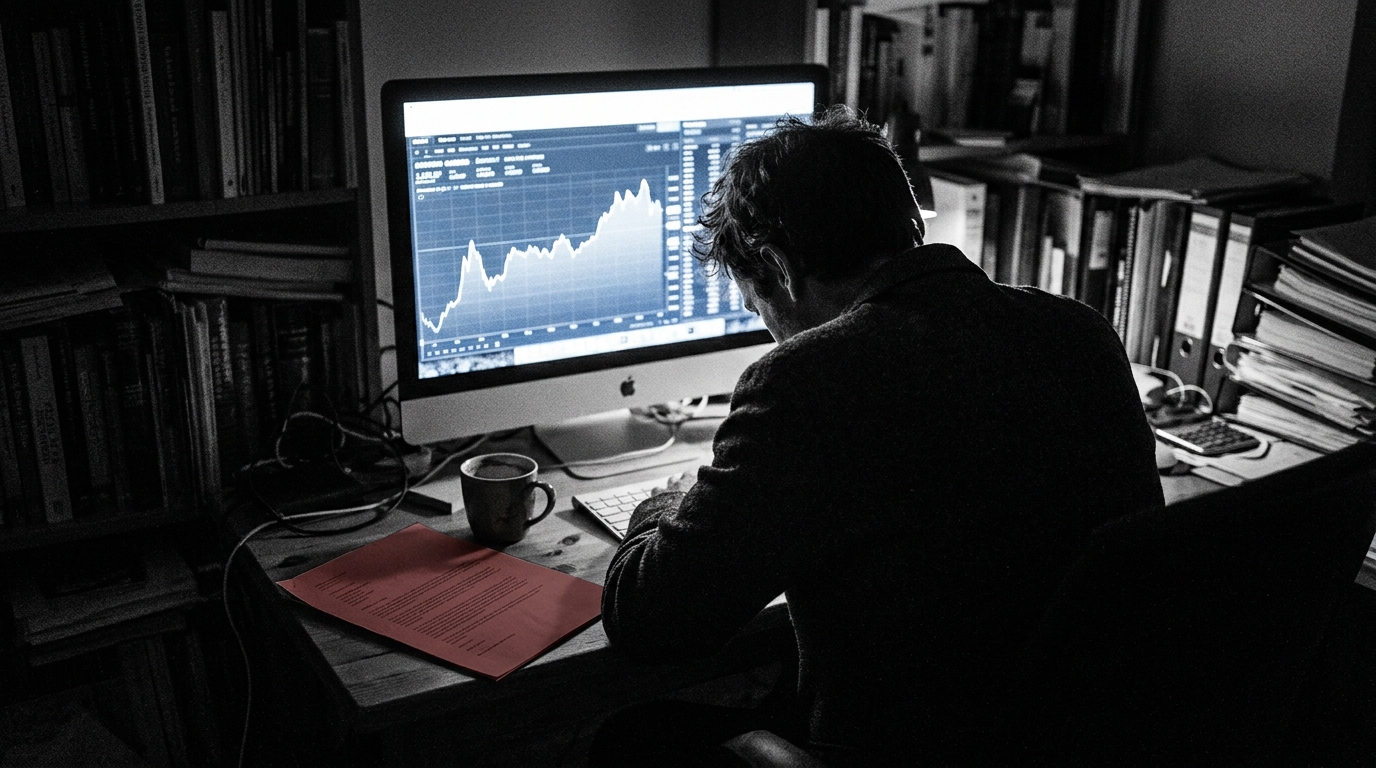
The man at the kitchen table is sixty-three. He is on his second cup of coffee. The laptop is open to an email that arrived at 6:14 AM Eastern, which means somebody sent it before the market opened, which means somebody wanted it read before he could think.
The subject line says: AI infrastructure. The window is closing.
Inside the email there is a screenshot. The screenshot is from Reuters. It is real. The headline at the top of the screenshot says Morning Bid: Never mind the oil, feel the earnings. The byline is Wayne Cole. The date is May 1, 2026. Below the screenshot the email says: while the headlines scream about oil, the smart money is buying the picks and shovels of the AI buildout.
Then a ticker. Not Nvidia. Not Alphabet. Not Caterpillar. Something smaller. Something he has never heard of. Something the email calls "the next leg."
He is the mark. He does not know it yet. He has not done anything wrong. He has not even clicked.
Picture him there.
I.
Here is what was true that morning, on the record.
According to FactSet, with sixty-three percent of S&P 500 companies reporting, the blended earnings growth rate for the first quarter of 2026 was 27.1 percent. That is the highest quarterly growth rate since the fourth quarter of 2021. Eighty-four percent of companies had beaten earnings estimates, the highest beat rate since the second quarter of 2021. Aggregate earnings came in 20.7 percent above estimates.
Those numbers are not the fraud. Those numbers are the bait.
Caterpillar shares rose nearly ten percent on a single day after the company beat Street forecasts, with much of the upside attributed to data-center power equipment demand. Apple beat. Alphabet surged more than six percent on cloud strength. Meta dropped more than six percent because investors did not like what it was spending. Hyperscaler capital expenditure for the year was tracking above $700 billion across the largest tech firms.
That is real. That happened. You can pull the transcripts.
Now read the next part slowly.
Goldman Sachs analysts, looking at the same rally, called it one of the narrowest on record. They wrote that the move was concentrated in semiconductors, information technology, and communications. They used the word mania.
Mania is not a word the sell side uses lightly. The sell side gets paid when the rally continues. When the sell side calls its own rally mania, that is the house quietly turning the lights up.
Meanwhile Brent crude had peaked at $126.41 per barrel. The Strait of Hormuz, which carries roughly twenty percent of the world's oil trade, was closed. The IEA was calling the disruption the largest in its history. The U.S. national average gasoline price was $4.392, the highest in four years. The European Central Bank and the Bank of England were openly warning about June rate hikes. The Federal Reserve was holding, with three regional presidents voting to strip the easing bias from the statement.
The market chose to look at the earnings. The market chose not to look at the rest.
That choice is the door the email walked through.
II.
I worked phone rooms for the better part of fifteen years. Metals first, in Chicago, in a room with a hundred desks and a hundred phones. Then timeshare. Then small-cap shares in a blimp company that did not actually make blimps.
What I am about to tell you is not from a filing. It is from memory.
When a real news story breaks that supports your pitch, you do not waste it. You print it. You screenshot it. You read it aloud to the prospect. You let Reuters do the closing for you. The prospect is not buying your pitch. The prospect is buying Reuters. You are just the person who happened to be on the phone when Reuters said the thing you were already going to say.
The technique has a name in the rooms. Borrowed credibility. You borrow the institution's credibility for the length of one phone call. The institution does not know you borrowed it. The prospect does not know you borrowed it. By the time anyone realizes the borrow happened, the wire has cleared.
On May 1, 2026, every boiler room in North America with a thematic AI pitch had a screenshot of that Reuters headline in its sales kit before the opening bell. I am not guessing. I have sat at the desk where the screenshot gets pasted into the deck. The deck does not have to lie. The deck just has to be next to something true.
The Caterpillar number is true. The Alphabet number is true. The $700 billion in hyperscaler spending is true.
The ticker at the bottom of the email is not Caterpillar. The ticker at the bottom of the email is the part the deck does not want you to look at.
III.
This is what the narrowness machine looks like from the inside.
Goldman said the rally was the narrowest on record. Translate that. A handful of stocks were doing the work of the index. The index looked healthy. Most of the names inside the index did not.
If you wanted to be in the move, the move was already crowded. Nvidia was Nvidia. Alphabet was Alphabet. Caterpillar had already run ten percent in a session. The retail investor reading the Morning Bid at his kitchen table was not getting in early on any of them. He was getting in late.
Late is the condition the boiler room needs.
The pitch is never the giant. The pitch is always the adjacent name. The pick and shovel of the pick and shovel. The supplier to the supplier. The small-cap that sits next to the big story and borrows its weight.
Watch the structure.
The big name has earnings. The small name has a press release.
The big name has a transcript. The small name has a pitch deck.
The big name has a balance sheet. The small name has a narrative.
The big name has a CEO who answers analyst questions. The small name has a CEO who books a podcast.
The big name closes up six percent on volume. The small name closes up sixty percent on no volume, then halves on Monday.
Each pair sharpens against the next. The structure is the argument.
IV.
The man at the kitchen table does not know any of this. He knows gas costs $4.39. He knows his 401(k) statement was flat last quarter. He knows his neighbor's son made money on something called an AI ETF and will not stop talking about it. He knows the email in front of him has a Reuters screenshot in it and a phone number at the bottom.
He clicks the phone number.
That is the moment.
Not the wire. Not the signature. The click.
Once he clicks, a voice answers. The voice is calm. The voice has the Reuters article open on its own screen. The voice will read him the same earnings numbers he just read. The voice will say the word infrastructure four times in the first two minutes. The voice will mention Caterpillar by name, because Caterpillar is the safest reference, because Caterpillar is real, because Caterpillar is not what is being sold.
The voice will say the window is closing.
The window is not closing. The window is the close.
V.
I am not telling you the email is fraud. I cannot see the email. Neither can you. I am telling you the structure of the morning is the structure that boiler rooms have used for forty years, and the May 1 Morning Bid is the kind of news cycle the rooms wait for.
Here are the ugly questions. Not the exciting ones.
Why did this email arrive on the morning the Reuters piece ran, and not the morning before.
Why is the ticker in the email a name you cannot find on a major exchange's most-active list.
Why does the pitch quote the FactSet earnings number but not the Goldman mania quote from the same news cycle.
Why is the closing pressure measured in hours instead of quarters.
Why is the person on the phone able to take your money today but unable to send you an audited financial statement this week.
Those are the questions the room does not want.
VI.
The Reuters piece is not the problem. Wayne Cole did his job. The earnings numbers are real. The oil shock is real. The Goldman warning is real and quoted in the same piece, for anyone who reads to the bottom.
The problem is what happens to a real piece of journalism in the eighteen hours after it publishes. The piece becomes furniture. The piece gets cut up and arranged into rooms it was never written for. The piece gets pasted into pitch decks at firms whose names will not survive the next enforcement cycle.
By the time the SEC writes the complaint, the email will have been forwarded a thousand times. The screenshot will have been re-screenshotted. The Reuters logo will still be visible at the top of the image. The article will still be live on the Reuters website, untouched, unaware.
That is the machine. The machine does not need to lie. The machine needs you to read something true and then read something next to it.
The man at the kitchen table closes the laptop. He has not clicked yet. Maybe he will. Maybe he will not. The coffee is cold.
Goldman called it mania.
The email called it opportunity.
The gap between those two words is where the money lives.
- Reuters | May 1, 2026 | Morning Bid: Never mind the oil, feel the earnings (Wayne Cole)
- FactSet Earnings Insight | Q1 2026 | John Butters, blended earnings growth and beat-rate data
- Goldman Sachs analyst commentary | as reported in Reuters Morning Bid coverage, late April–May 1, 2026
- International Energy Agency | April 14, 2026 | Oil Market Report, demand revision and Strait of Hormuz disruption
- Reuters | April 23, 2026 | Morning Bid: stocks and oil go separate ways
- Reuters | April 30, 2026 | Morning Bid: Oil fear shrouds tech splurge
- Federal Reserve | FOMC statement, late April 2026 | regional president dissent on easing bias
- European Central Bank and Bank of England | April 2026 policy commentary | inflation risk warnings
- U.S. Energy Information Administration | weekly retail gasoline price data, week ending May 1, 2026
- Author's direct experience | Chicago metals room, small-cap phone rooms, 1980s–1990s | composite scene reconstruction
Editorial Notice
MarkTell is a true crime publication about financial fraud. Some scenes, dialogue, and sequential details are reconstructed from court filings, enforcement actions, news reports, and public records. Where the public record does not provide exact details, editorial reconstruction is used to convey the documented pattern of events. Names of private individuals may be changed to protect identity. All factual claims are sourced to public documents cited in the Evidence Trail above. MarkTell does not provide investment, legal, or financial advice. Nothing published here constitutes a recommendation to buy, sell, or avoid any investment. Allegations described in active cases have not been adjudicated and defendants are presumed innocent until proven guilty. Readers should conduct their own due diligence before making financial decisions.