The procurement card was for office supplies. The charges were at FedEx Forum on a Saturday.
A federal indictment unsealed Monday accuses Shelby County General Sessions Court Clerk Tami Sawyer of running personal expenses through procurement cards belonging to her staff. The charges name the bars, the basketball games, and the friend's PayPal account.
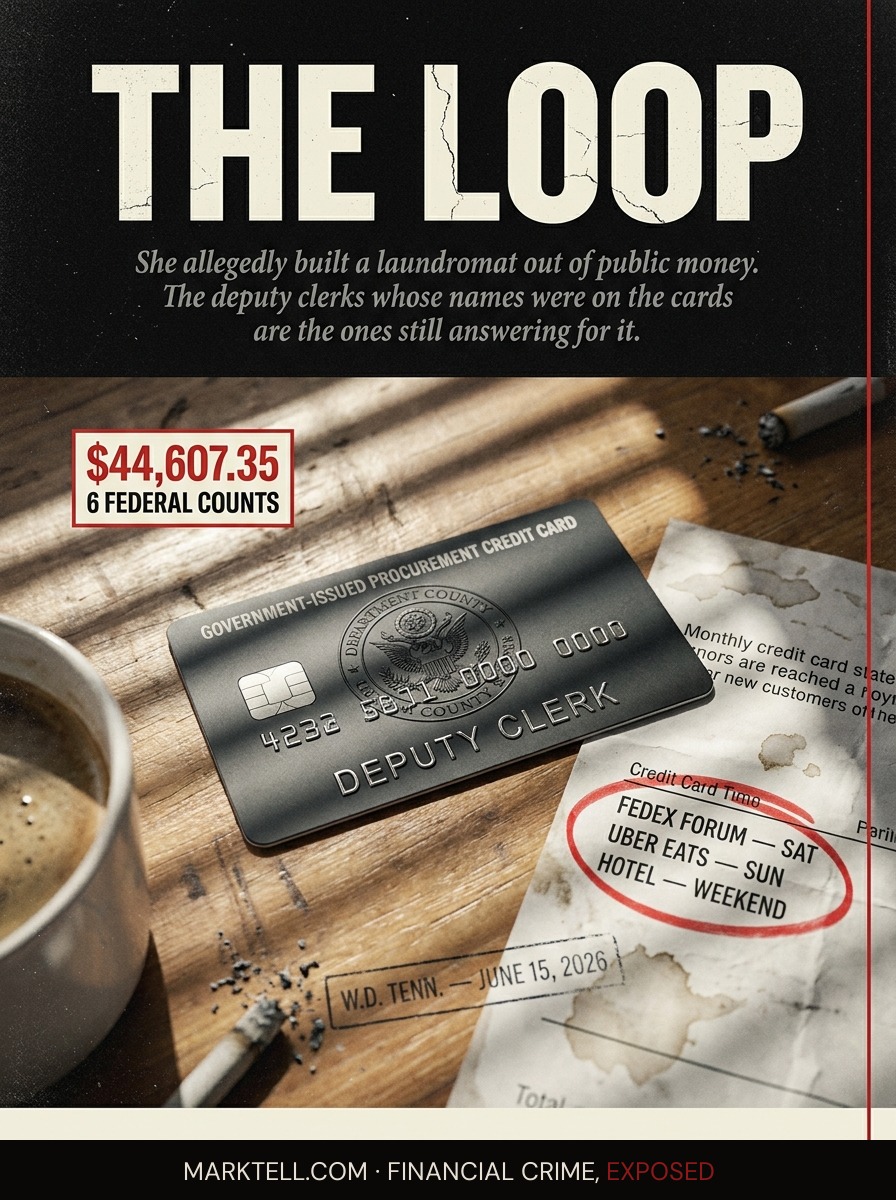
Marcus opened the envelope at his kitchen table on a Tuesday morning before his shift. The statement was the monthly summary on the procurement card the county had issued him. A piece of plastic with the Shelby County seal pressed into one corner and his name embossed across the front.
He was a deputy clerk. He had been one for nine years. The card was for office supplies. Toner. Paper. The occasional working lunch when a docket ran late.
There was a hotel charge on the statement. A weekend night. A place he had never been.
He looked at it for a long time. Then he looked at it again.
This is the part of the story nobody puts on the news. The deputy clerk at the kitchen table, holding a statement, trying to decide whether he was about to start a problem or whether he already had one.
I.
On Monday, June 15, 2026, a federal grand jury in the Western District of Tennessee returned a six-count indictment against Tamara "Tami" Sawyer, the elected Shelby County General Sessions Court Clerk. United States Attorney D. Michael Dunavant announced it.
The counts: conspiracy to commit honest services wire fraud. Conspiracy to commit money laundering. Theft concerning programs receiving federal funds. Honest services wire fraud. Money laundering. Interstate travel in aid of racketeering enterprises.
The number in the indictment is $44,607.35.
That is what prosecutors allege Sawyer embezzled, stole, and converted to her personal use between August 29, 2024, the day she was sworn into office, and June 22, 2025. About ten months. About four thousand four hundred dollars a month.
She has not entered a plea on these charges as of this writing. An indictment is an accusation. The grand jury heard one side. A trial, if one comes, will hear the other.
But the indictment is detailed. The indictment names the categories. Read them slowly.
Alcohol. Food. Uber Eats. Instacart. Bars. Hotels. Restaurants. Memphis Tigers events. FedEx Forum. Turo. Local fundraisers. PayPal transfers, including to an account Sawyer is alleged to have controlled herself.
Many of the transactions, the indictment says, happened on weekends or holidays. The clerk's office was closed. The procurement cards were for the business of the court. The court was not in session.
II.
A procurement card is a credit card the government gives to an employee to make small official purchases without the friction of a purchase order. The card is supposed to be a convenience. A way to buy printer paper without a three-week requisition.
It is also, when the controls fail, a door directly into the public treasury.
The indictment describes a particular method. Prosecutors allege Sawyer used procurement cards issued to other county employees. Not just her own. Her staff's. Cards with someone else's name pressed into the plastic.
Picture what that looks like from inside the office. The card sits in a drawer. The card sits in a wallet. The card sits with the deputy clerk who got it for office supplies. Somebody else is allegedly running the card. Somebody else's name is on the receipt at the hotel on a Saturday.
The deputy clerk gets the statement at the end of the month.
This is where Marcus comes in. The composite. Built from the record's description of "procurement cards issued to other county employees." The deputies whose names sat on receipts they did not generate.
Marcus did what most people do. He told his supervisor. He asked questions. He waited.
The indictment says some of those questions started getting asked aloud inside the office before the federal grand jury ever met.
III.
In November 2025, a man named Jeffrey Allen Walker filed a lawsuit. He had been the Chief Administrative Officer in Sawyer's office. He alleged in his complaint that he had reported questionable purchases on a county procurement card. He named figures. $4,871.05 in one block. $930 in another. He alleged the purchases included political campaign contributions and personal items.
He alleged that after he reported these things, he was fired.
His lawsuit is the public record's first visible crack. The complaint filed on a Wednesday in November in a Memphis courtroom that read, in plain English, that someone inside the office had been watching the cards.
The whistleblower complaint did not allege $44,607. It alleged less than six thousand dollars in specific transactions.
The federal indictment, seven months later, alleges a number more than seven times larger.
That gap is worth sitting with. The whistleblower saw what the whistleblower could see from his desk. The grand jury, with subpoena power, allegedly saw the rest.
IV.
The money laundering count is the one that tells you the operation, as alleged, was not improvisation.
According to the indictment, Sawyer allegedly transferred stolen funds to a PayPal account controlled by a friend. The friend kept a portion. The friend then returned the remainder to Sawyer through CashApp.
That is the structure. Public money to county vendor. County vendor to PayPal. PayPal to friend. Friend to CashApp. CashApp back to the alleged source.
A loop. With a fee.
You do not build that loop the first time you decide to take twenty dollars for lunch. You build that loop because you have been moving money and you need somewhere for the money to land that does not have the county seal on it.
That is the allegation. A friend's PayPal as the laundromat. A CashApp transfer as the towel.
V.
Tami Sawyer is forty-something years old. She is a former Shelby County Commissioner. She is known in Memphis as a civil rights activist. She was the youngest person and the first woman to hold the General Sessions Court Clerk position. She was sworn in on August 29, 2024.
The indictment covers a window that begins the day she took the oath.
She has, in response to other controversies in her tenure, denied wrongdoing and described criticism as politically motivated. She has not, as of this writing, made a public statement specific to the June 15 indictment.
She is presumed innocent. That is the law. That is also the discipline this piece is going to hold.
But the indictment does not need to prove itself yet. The indictment needs to describe a machine. And the machine it describes is one we have seen many times in many counties in many states.
The procurement card. The travel advance. The vendor list that nobody audits in real time because the dollar amounts on any one line are small enough to look like office supplies.
Uber Eats on a Sunday. A bar tab on a Friday. A FedEx Forum charge on a game night. A hotel on a weekend the court was closed.
Each charge, by itself, is a footnote. Forty-four thousand dollars in footnotes is a chapter.
VI.
The maximum penalty, if convicted on all counts, is twenty years in federal prison, a fine of up to $500,000, and three years of supervised release.
That is what is on the table. It is not what will happen. Most federal indictments resolve before they reach a maximum sentence.
What will happen, regardless of how the criminal case ends, is that the deputy clerks of Shelby County General Sessions Court will spend the next several months explaining charges that were not theirs. The county will spend money on the investigation. Public trust in the office that holds the records of Memphis's civil, criminal, drug, and environmental courts will take a hit it did not earn.
Marcus, at the kitchen table on a Tuesday morning, did not steal anything. His name was on the plastic. His statement showed the hotel.
That part may be the saddest. The people whose cards sat in the drawer are the ones who are going to spend the year answering for it.
VII.
If you work in a government office, look at your card statement this month. Look at the weekend charges. Look at the holiday charges. Look at the vendors you do not recognize.
The machine that the indictment describes does not run on sophistication. It runs on the assumption that nobody is going to read line by line.
Somebody read line by line. Then somebody else did. Then a grand jury did.
The card was for office supplies. The statement said FedEx Forum on a Saturday.
That was the door.
- Action News 5 (WMC-TV Memphis) | June 15, 2026 | Exclusive coverage of Sawyer indictment
- United States Attorney's Office, Western District of Tennessee | June 15, 2026 | Indictment announcement, U.S. Attorney D. Michael Dunavant
- Federal grand jury indictment, Western District of Tennessee | June 15, 2026 | Six-count indictment of Tamara Sawyer
- Jeffrey Allen Walker v. Tami Sawyer et al. | November 12, 2025 | Whistleblower/retaliatory discharge civil complaint
- Shelby County District Attorney's Office | December 2025 | Declination of charges regarding October 2025 courthouse incident
Editorial Notice
MarkTell is a true crime publication about financial fraud. Some scenes, dialogue, and sequential details are reconstructed from court filings, enforcement actions, news reports, and public records. Where the public record does not provide exact details, editorial reconstruction is used to convey the documented pattern of events. Names of private individuals may be changed to protect identity. All factual claims are sourced to public documents cited in the Evidence Trail above. MarkTell does not provide investment, legal, or financial advice. Nothing published here constitutes a recommendation to buy, sell, or avoid any investment. Allegations described in active cases have not been adjudicated and defendants are presumed innocent until proven guilty. Readers should conduct their own due diligence before making financial decisions.