The princes of East Cleveland drove a Rolls. The city paid for the gas.
Two brothers from Ohio invented a fake Emirati royal house, a fake hedge fund, and a fake claim on a historic industrial complex. A federal judge in Cleveland just gave them a combined forty-seven years.
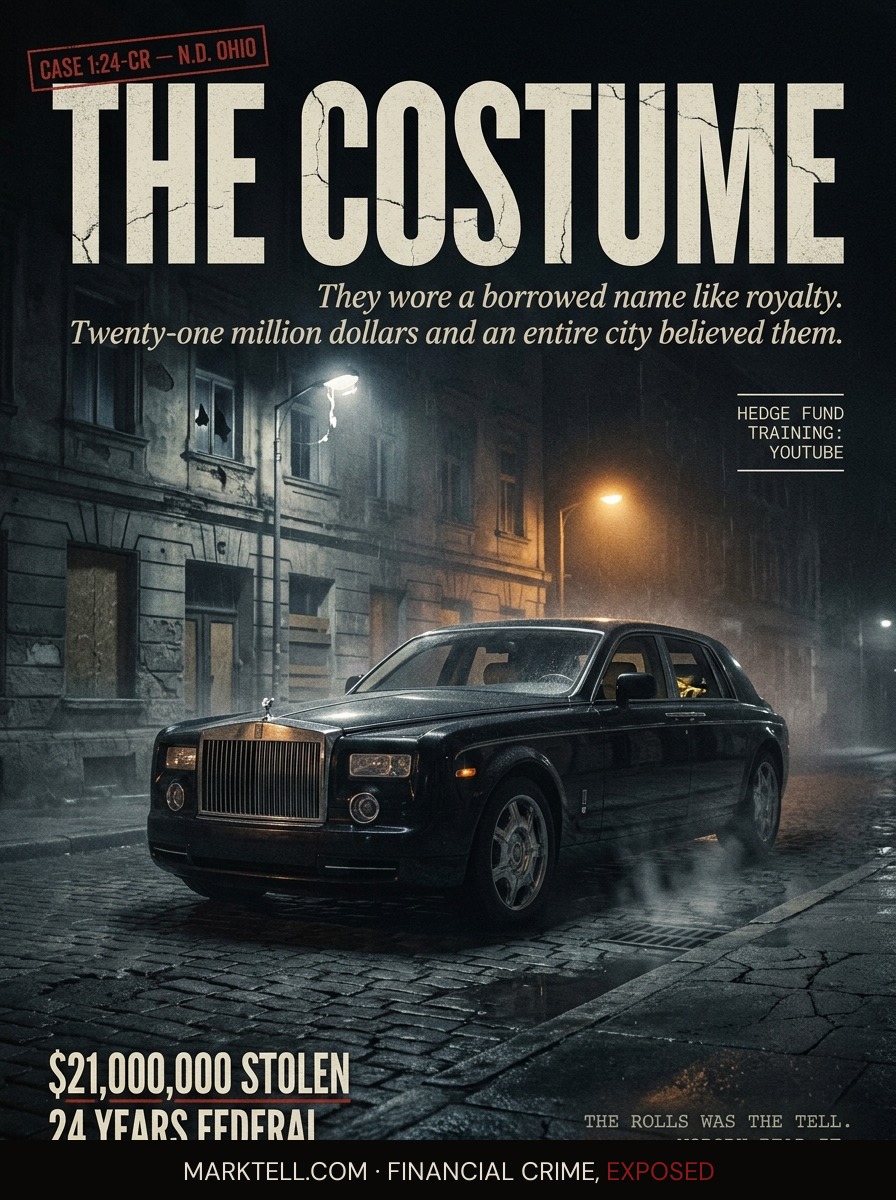
The Rolls-Royce was the tell, but nobody read it as a tell. It sat outside East Cleveland City Hall in a city where the streetlights do not always come on. A car like that, in a place like that, should have been a question. Instead it was an answer. The man who climbed out wore the surname of a real Omani business family he had no relation to, claimed a wife who did not exist, and walked into rooms where elected officials shook his hand.
His name, on his birth certificate, was Zubair Razzaq. He was forty-two. The man with him, eleven years younger, was his brother Muzzammil Muhammad. By the time federal prosecutors in Cleveland were done with them, the brothers had collected something close to twenty-one million dollars from people who believed they were dealing with royalty.
On May 5, 2026, a U.S. district judge named Donald Nugent told them what he thought of that. Twenty-four years for Zubair. Twenty-three for Muzzammil. Restitution of more than $21M. The judge said they had stolen a lot of money, defrauded people, and put East Cleveland in a terrible light. He noted, for the record, the Rolls-Royce and the private planes.
This is a story about a costume.
I.
The costume had a name. Al Zubair. They lifted it from an actual Omani conglomerate, the way a thief lifts a license plate off a parked car. With the new surname they built a company called Dubai Bridge Investments, which is the kind of name that sounds like it should exist. It did not. It was a Word document, a logo, an email address, and a story.
Zubair told people he was married to a princess of the United Arab Emirates. Muzzammil told people he was a hedge fund manager. According to court filings, his entire training in hedge fund management consisted of YouTube videos. A hedge fund is, in plain English, a private investment pool that is allowed to do things ordinary mutual funds are not, like short-sell or use leverage. You need licenses to run one. He did not have them. He had a search history.
Read that slowly. A man watched videos and then sat across the table from people with real money and told them he managed a fund.
To make the costume convincing they needed a stage. They found one in Bratenahl, a small enclave on the eastern edge of Cleveland where the lakefront houses still carry the names of nineteenth-century industrialists. The brothers moved into a mansion there. They did not own it. They did not rent it. According to prosecutors they squatted, and the address became their letterhead.
II.
The first big mark, according to the federal record, was a Chinese investor. The pitch was Nela Park, a historic industrial complex in East Cleveland. General Electric built it in 1911. It is on the National Register of Historic Places. The brothers told the investor they owned it, or were about to, and that they were going to turn it into a cryptocurrency operation.
They did not own it. They were not about to.
The investor wired nearly $18M.
That is the number. Sit with it. $17.8M, in the federal accounting, moved from one continent toward a campus the senders had been told was already in the brothers' hands. It was not in their hands. It was in the hands it had been in for more than a century.
A second Chinese woman, whose cryptocurrency mining business had been outlawed at home, wired about $9M in July 2021 toward a separate venture the brothers were promising. Cryptocurrency mining is the process of running specialized computers around the clock to validate blockchain transactions and earn new coins as a reward. China banned it in stages. She was looking for a place to land. The brothers offered her one. The money landed somewhere, but not where she thought.
A third victim, named in court records as a former girlfriend of Zubair's from the UAE, lost somewhere between $737K and $860K to a fake business venture sold under the Dubai Bridge name.
And then there was the city itself. East Cleveland, a municipality that has been functionally insolvent for years, was defrauded of $10M.
III.
A costume needs a tailor. The brothers found one in a man named Michael Smedley, fifty-six years old, the chief of staff to East Cleveland's mayor. Smedley accepted, according to the federal case, expensive meals, cash, suite tickets to Cleveland Browns games, Japanese wagyu beef, cigars, and the promise of a job later. In exchange he opened doors. City documents. City contracts. City legitimacy.
Smedley was sentenced to just over eight years.
The mayor he worked for, Brandon King, had already been convicted in May 2025 on ten corruption counts including theft in office and unlawful interest in a public contract. Prosecutors established that King had appointed Zubair as East Cleveland's international economics adviser. Picture that title on a business card. Picture it being handed to a man whose princess did not exist.
The brothers also leaned, in the public record, on the memory of their late father, who had been known and respected in the East Cleveland community. The community did the math the way communities do. The father was real. The sons must be real. The royalty must be real. The Rolls must be paid for.
IV.
Where the money went is the part that reads like an inventory from a divorce filing in a tabloid.
Private jets to Aspen. Private jets to Miami. Private jets to London. Private jets to Bucharest. Private jets to Madrid. Luxury watches. A fleet of high-end vehicles including the Rolls. Dozens of firearms. A custom-made, gold-plated AK-47-style rifle, which is the detail that ends up in every news story about this case because it is the detail that resists belief.
A gold-plated rifle is not a hedge against inflation. It is a costume accessory. It is the thing you buy when you are pretending to be the kind of person who would buy it.
That part may be the saddest. Not the rifle itself. The fact that twenty-one million dollars, taken from people who had worked or scraped or hidden it from a regime, ended up purchasing a prop.
V.
The machine here was not complicated. It rarely is. The machine was a name and a house and a man in a city office willing to sign things.
Strip the costume off and what you have is this: two American brothers from Ohio, with American birth certificates and American passports, who understood that in the United States in the 2020s, the appearance of foreign wealth functions as a kind of unaudited credit score. Nobody calls Abu Dhabi to check. Nobody asks for the marriage certificate to the princess. Nobody runs a title search on Nela Park before wiring the second tranche.
The Al Zubair surname was the lien they placed on other people's money. The mansion was the collateral. The mayor's aide was the notary.
VI.
The federal case was investigated by the Internal Revenue Service Criminal Investigation division and the FBI's Cleveland field office. The convictions cover wire fraud, money laundering, and conspiracy. Wire fraud, in plain English, is using any electronic communication, an email, a phone call, a bank wire, to carry out a scheme to obtain money by false pretenses. Money laundering is moving the proceeds of a crime through legitimate-looking transactions to disguise where they came from. Conspiracy is agreeing with someone else to commit the crime. The brothers were convicted of all three families of offense.
Twenty-four years. Twenty-three years. Eight years for the aide.
The restitution order is for more than $21M. Whether the victims will see that money is a separate question. Restitution orders are entered. Collection is another matter. The Chinese investor who wired $17.8M toward Nela Park will get an order on paper. Paper is not a wire.
VII.
A reader sitting with this story is allowed to ask the ugly question. Not the exciting one. Not the television one.
How did a man who learned hedge funds from YouTube get into the room?
The answer is not flattering to the room. The answer is that the room was not asking. The room saw a Rolls and a surname and a mansion and decided the homework had already been done by someone else. It had not been done by anyone.
This is the pattern that matters. The princes-and-princesses fraud is not new. In 2019 a man named Anthony Gignac, who had spent decades posing as a Saudi prince, was sentenced to more than eighteen years for defrauding investors of over $8M. The costume changes. The tailor changes. The room is the same room. Carpet, handshake, deference to a name nobody verified.
The brothers from Ohio bought a gold-plated rifle with the proceeds and posed for photographs with it. The rifle is in evidence now. The mansion has been vacated. The Rolls has been seized.
Picture the car on a flatbed, leaving Bratenahl, headed to a federal auction lot. Picture the surname coming off it like a decal.
They were never princes. The city just needed them to be.
- New York Post | May 2026 | "Ohio brothers who posed as Middle Eastern royalty receive lengthy sentence for $21M fraud scheme"
- U.S. District Court, Northern District of Ohio | May 5-6, 2026 | Sentencing proceedings before Judge Donald Nugent
- U.S. Department of Justice | 2024-2026 | Indictment and conviction records, United States v. Razzaq, et al.
- FBI Cleveland Field Office | investigative materials referenced in DOJ filings
- IRS Criminal Investigation | investigative materials referenced in DOJ filings
- Cuyahoga County / Ohio state court records | May 2025 | Conviction of former East Cleveland Mayor Brandon King on ten corruption counts
- Historical comparison: U.S. v. Anthony Gignac | 2019 | Southern District of Florida sentencing record
Editorial Notice
MarkTell is a true crime publication about financial fraud. Some scenes, dialogue, and sequential details are reconstructed from court filings, enforcement actions, news reports, and public records. Where the public record does not provide exact details, editorial reconstruction is used to convey the documented pattern of events. Names of private individuals may be changed to protect identity. All factual claims are sourced to public documents cited in the Evidence Trail above. MarkTell does not provide investment, legal, or financial advice. Nothing published here constitutes a recommendation to buy, sell, or avoid any investment. Allegations described in active cases have not been adjudicated and defendants are presumed innocent until proven guilty. Readers should conduct their own due diligence before making financial decisions.