The president signed the document. Then he signed a different one.
A South Korean appeals court handed former President Yoon Suk-yeol seven years for obstruction, fabricated paperwork, and using his own bodyguards as a wall between himself and the law. The sentence is the smaller story. The document is the larger one.
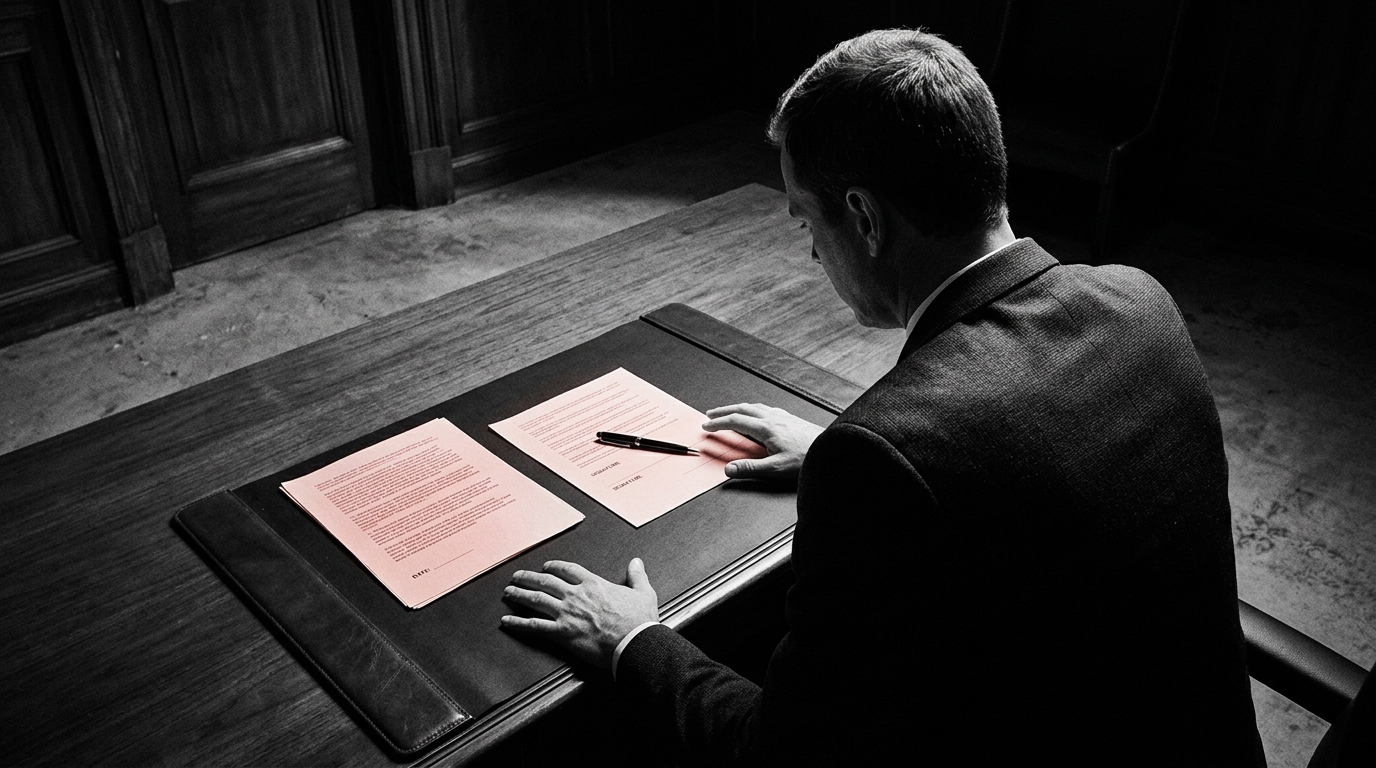
There were two proclamations.
The first one existed on the night of December 3, 2024, when President Yoon Suk-yeol declared martial law in South Korea. That document had a problem. It did not follow the correct procedure. The Cabinet meeting that should have preceded it either did not happen the right way or did not happen at all, depending on who is describing it. Nine Cabinet members, by the appeals court's account, had their deliberation rights bypassed. The first proclamation, as it existed in that moment, was procedurally naked.
So a second one was made.
The Seoul High Court found, in its April 29, 2026 ruling, that Yoon had ordered the creation of a backdated martial law proclamation. A document manufactured to make the past look different from what the past actually was. Then, the court found, that document was destroyed.
Read that slowly.
A sitting president of a democratic republic ordered a government document fabricated to conceal procedural flaws in an extraordinary exercise of power. Then ordered it gone.
That is not a political disagreement about the scope of executive authority. That is the oldest move in the fraud playbook. Make the paperwork say what the moment did not. Then make the paperwork disappear.
---
Before the document, there was the arrest.
After his impeachment in December 2024, after South Korean investigators sought to bring Yoon in for questioning, he did not comply. When arrest warrants were issued, he used the Presidential Security Service, his own protective detail, as a physical barrier. Men whose job was to shield the president from external threats were repositioned to shield the president from the law itself.
Picture a corridor in the presidential residence. Men in dark clothing, professionally trained, standing between a former head of state and officers arriving with lawful warrants. Nobody fired a shot. Nobody needed to. The bodies were the argument.
The Seoul High Court counted that as obstruction. Not a misunderstanding. Not a dispute about jurisdictional authority. Obstruction.
The first trial gave Yoon five years for this cluster of conduct. The appeals court, ruling on April 29, 2026, gave him seven. The prosecution had asked for ten.
His legal team called the ruling "incomprehensible." They said they would appeal to the Supreme Court. They argued the court applied rigid legal principles to what were essentially political acts.
The court disagreed. Judge Yoon Seong-sik wrote that the former president "bore a heavy responsibility to uphold the Constitution, but instead he betrayed that duty."
Seven years for the obstruction case. On top of a life imprisonment sentence, handed down February 19, 2026, for leading an insurrection.
He has been in custody since July 2025. He is one of the men who used to sit at the top of the machine. Now the machine has him.
---
Here is what the backdated proclamation was covering for.
On the night of December 3, 2024, Yoon Suk-yeol declared martial law. South Korea had not seen that in more than forty years. The declaration landed on a country that was not at war, in a legislature that was functioning, in a democracy that had spent decades earning that description.
The legislature voted to lift the martial law within hours. Yoon rescinded it. But the night itself had already done what nights like that do.
The stock market panicked. Allied governments, including the United States, were caught off-guard, according to reporting at the time. Protests filled the streets. A country of fifty million people went to sleep that night not knowing what the morning would look like.
When people ask why any of this belongs in a conversation about financial crime, that is the answer. The night of December 3, 2024, moved capital. Not because of a product launch or a quarterly report. Because the man at the top of the government made a decision in the dark, without the required process, and then tried to make the paperwork say otherwise afterward.
The month after the declaration, Yoon's wife, former First Lady Kim Keon Hee, had her own legal situation deepen. A day before the appeals court increased Yoon's obstruction sentence, the Seoul High Court increased her sentence to four years. The charges included accepting luxury gifts and involvement in a stock price manipulation scheme. An acquittal on the manipulation charge was overturned.
Corruption of official documents. Stock manipulation. Obstruction of law enforcement. Two people. One household.
The machine was not only at the national level. It was domestic. It was in the room.
---
I spent years in rooms where the document was the product.
Not the thing the document described. The document itself. The timeshare contract at hour five, when nobody reads, because nobody was supposed to read. The subscription agreement that disclosed everything material in paragraphs twelve through sixteen, where the typeface got smaller and the language got longer. The promissory note with the due date that assumed the investor would not notice when the due date passed.
The backdated proclamation Yoon ordered is a different scale. A different category. A head of state altering official government records is not equivalent to a boiler room guy adjusting the fine print.
But the mechanism is the same mechanism.
You make something happen. The something has a flaw. You create a document that makes the flaw look like it was not there. Then you destroy the document when it becomes a liability. The gap between what happened and what the paperwork says happened is where the fraud lives. In a phone room in Chicago, that gap is a few thousand dollars and someone's retirement. In a presidential palace in Seoul, that gap is a country's constitutional order and its market stability.
Same gap. Different rooms.
---
Former Prime Minister Han Duck-soo was sentenced to 23 years in January 2026 for his role in the martial law attempt. A former president serving life plus seven. A former first lady sentenced to four years. A former prime minister sentenced to 23 years.
South Korea has been here before. Multiple former presidents have ended their lives in prison or in the shadow of prison. The country keeps prosecuting them. Some observers call it a pattern of political persecution. Others call it the functioning of a young democracy that has not yet decided whether powerful people get to be above the law.
I am not in a position to adjudicate that argument. What I can say is this: the backdated document does not care about the political valence of the man who ordered it. A document made to make the past look different from what the past was is the same instrument whether the person who ordered it is on the left or the right, whether the courts prosecuting him are politically motivated or scrupulously neutral, whether his lawyers are right that it was a political act or the court is right that it was a crime.
The document was designed to close a gap between what happened and what the record showed.
Every fraud I have ever seen runs on that gap.
On April 29, 2026, the Seoul High Court said the gap was worth seven years on top of a life sentence. Yoon's lawyers will ask the Supreme Court to look again.
The proclamation that was fabricated and destroyed cannot ask anything. It is gone.
That part may be the saddest. Not the sentence. The document. The evidence of exactly what happened, made and then unmade by the hand that was supposed to protect the record.
The chair Yoon sits in now faces a different direction than the chairs he used to sit in.
The paperwork still says what it says.
- Reuters | April 29, 2026 | "South Korean appeals court increases jail term for former President Yoon in obstruction case" | https://news.google.com/rss/articles/CBMizgFBVV95cUxPalFZcTRUdHlObmI5MFFvWGFLamFFZmhGeXZSVFhZS3lUYVBnYk84eHNINDJCTTBVSGllNFJLRmRaTkQ5WVJiRXJ5ZE80THZqM281NUZ0U3d3anlKUjlTaVlkS0stNE5DWUJYNzVtQWVzbnc2WHZndFF6clRwLWh4TnpHc0VCU1JkNHJjSE5zNzRka3BNU2o1bmhqc0JvZFRwdHpIMFZrYUkzZE5uMEoxcmVqSWVTcU1FcUQyLU15ckF0aUJPQ3pQTmFWZUROQQ
- Seoul High Court ruling | April 29, 2026 | Adjudicated increase of Yoon Suk-yeol obstruction sentence to seven years; Judge Yoon Seong-sik presiding
- Seoul High Court ruling | April 28, 2026 | Increased sentence for Kim Keon Hee to four years; overturned acquittal on stock price manipulation charge
- Seoul District Court | February 19, 2026 | Life imprisonment sentence for Yoon Suk-yeol on insurrection charges
- Seoul District Court | January 2026 | Han Duck-soo sentenced to 23 years for role in martial law attempt
- Yoon Suk-yeol constitutional petition | March 31, 2026 | Challenge to insurrection tribunal law
- Public record: South Korean legislature vote to lift martial law | December 3-4, 2024
- Public record: Yoon impeachment by legislature | December 14, 2024
- Public record: Constitutional Court removal of Yoon | April 2025
- Public record: Yoon taken into custody | July 2025
Editorial Notice
MarkTell is a true crime publication about financial fraud. Some scenes, dialogue, and sequential details are reconstructed from court filings, enforcement actions, news reports, and public records. Where the public record does not provide exact details, editorial reconstruction is used to convey the documented pattern of events. Names of private individuals may be changed to protect identity. All factual claims are sourced to public documents cited in the Evidence Trail above. MarkTell does not provide investment, legal, or financial advice. Nothing published here constitutes a recommendation to buy, sell, or avoid any investment. Allegations described in active cases have not been adjudicated and defendants are presumed innocent until proven guilty. Readers should conduct their own due diligence before making financial decisions.