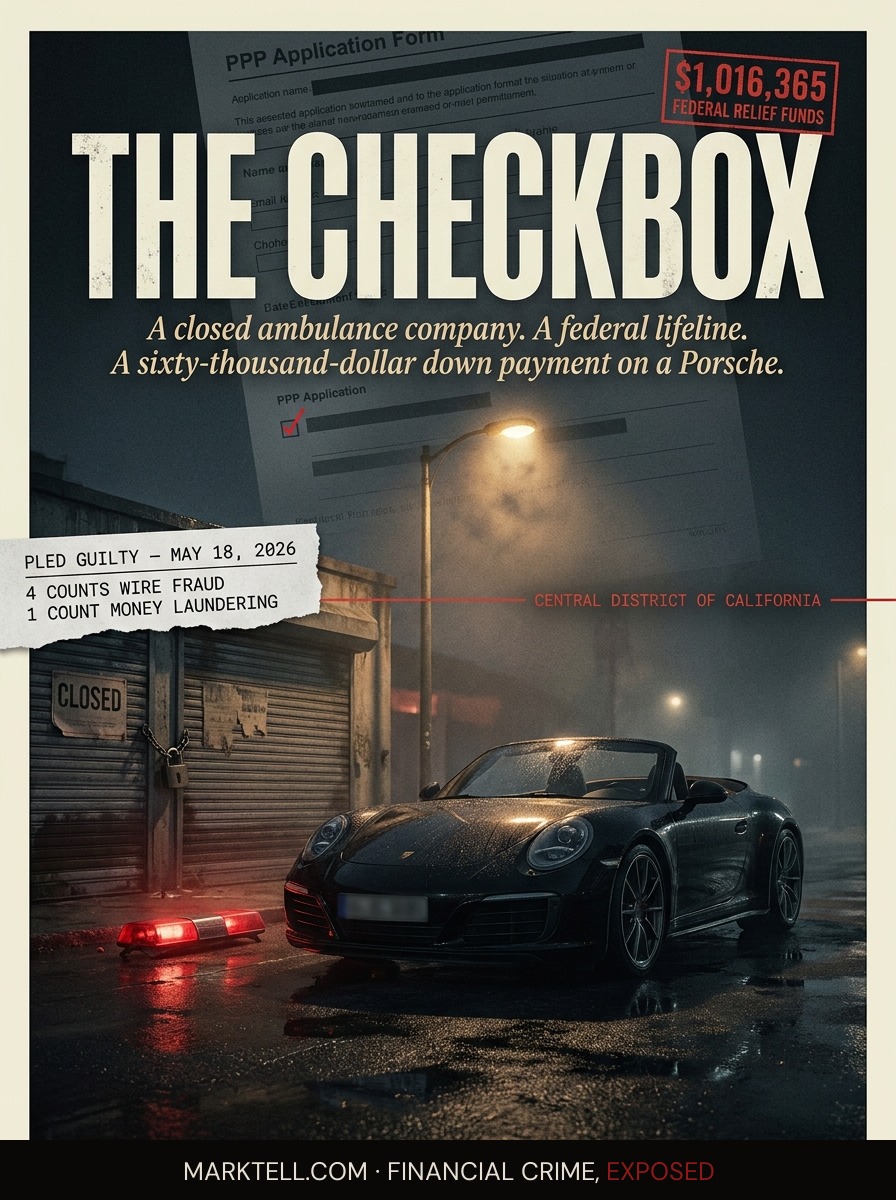
The Porsche cost sixty thousand dollars. The ambulance company had been closed for two years.
Mehrdad Tabrizi pleaded guilty Monday to draining more than a million dollars from federal pandemic relief programs using a non-emergency ambulance company he had already shuttered. The Porsche was the tell.
Diane is fifty-eight and she has been a grants administrator for the better part of two decades. In May 2020 she was working from her kitchen table because everyone was working from their kitchen table. The dining chairs had become office chairs. The fruit bowl had become a printer tray. Her laptop ran hot on the wood and she kept a coaster under it because she had been raised that way.
The queue counter on her screen said 487.
That was the number of small-business relief applications she still had to look at before she could go to bed. The Paycheck Protection Program had been live for a few weeks. The Economic Injury Disaster Loan portal had been live a little longer. Both were federal lifelines, both were administered by the Small Business Administration through banks and direct deposits, and both had been built in a hurry because the country had been built in a hurry that spring.
She opened the next one. A non-emergency ambulance company in Orange County. She had never heard of it. She had not heard of most of them. The form said the company had employees in 2019 and 2020. The form said it was operational. There was a checkbox attesting to all of it under penalty of perjury. The applicant had checked it.
She approved it and moved to the next one.
That is the room where this story begins. Not the Porsche dealership. The kitchen table at 11 p.m. with the queue counter ticking down.
II. The Closed Door
Mehrdad Tabrizi owned two companies on paper. One was called Life Fleet Inc. The other was called Resonante Group. Both were registered as non-emergency ambulatory businesses, which is the polite term for the vans that move people who cannot move themselves, dialysis runs, hospital discharges, the slow traffic of American medicine.
Life Fleet had been shuttered in 2018.
Read that again. The company that submitted a Paycheck Protection Program application in May 2020, claiming employees and payroll and operations, had not had any of those things for almost two years. The door was locked. The vans were gone. The phone, if there was one, rang into nothing.
This is the first fact established by the plea Tabrizi entered on Monday, May 18, 2026, in the Central District of California. He pleaded guilty to four counts of wire fraud and one count of money laundering. He admitted, on the record, that the company he claimed was operational had not been operational. He admitted he submitted a second PPP application in March 2021 making the same claim. According to the DOJ, those two applications produced $696,565 in deposits to bank accounts he controlled.
Then there were the EIDL applications. In June and July 2020 Tabrizi filed two of those, one for Life Fleet and one for Resonante, claiming gross revenues and paid expenses from before January 2020. The SBA, per the plea, sent another $319,800 into accounts he controlled.
Add it up. More than a million dollars. From a federal program designed to keep people on payroll during the worst economic month most Americans had ever lived through.
III. The Car
In May 2020, the same month Diane was approving her 487th application of the day, Tabrizi walked into a dealership and bought a 2019 Porsche Turbo Cabriolet. The down payment was $60,000. The money came from the PPP account.
Picture it.
A federal program meant to keep a small business from laying off a receptionist, converted into a convertible. The roof comes down. The receipt is filed. The car goes home.
You do not need me to tell you this is grotesque. You can feel it without help. What I want you to notice is how mechanical it was. There is no scheme here in the criminal-mastermind sense. There is no laundering through shell companies in the Caribbean. There is a man, a closed business, two government portals, a checkbox, and a car.
The machine ran because the machine had been built to run fast.
IV. The Valve
In the spring of 2020 the federal government had to choose between speed and verification. It chose speed. There were reasons. People were losing jobs by the millions. Restaurants were dark. Hotels were empty. The political pressure to get money out the door was immense and bipartisan, and the relief programs were stood up in days, not months.
The verification was supposed to come later. Lenders relied on attestation. The applicant swore the company was real. The applicant swore the employees existed. The applicant swore the revenue had been earned. The penalty for lying was federal prison, but the penalty was abstract and the money was concrete and the gap between those two things is where the fraud lived.
The Government Accountability Office estimated in April 2025 that fraudulent pandemic relief disbursements likely run into the hundreds of billions of dollars. The Department of Justice, as of April 2024, had charged more than 3,500 defendants and seized or forfeited more than $1.4 billion. By December 2024, per GAO reporting, more than 2,500 of those defendants had been found guilty. Sentences ranged from a single day to thirty years.
Tabrizi is one of more than 3,500. That is the scale of the valve that was opened.
V. The Pattern in Orange County
He is not even the most expensive one in his own county. In February 2023, Mustafa Qadiri of Orange County was sentenced to 54 months in federal prison for fraudulently obtaining $5 million in PPP loans, which he spent on a Ferrari, a Bentley, and a Lamborghini. The same month, Pierre Rogers of Irvine was sentenced to 41 months for using fraudulent PPP funds to buy a Rolls-Royce Ghost and a Porsche.
A Porsche. Another Porsche.
The car appears so often in these cases that you start to wonder whether the car is the point. It is not. The car is the receipt. The car is the visible end of an invisible pipe. The fraud is the pipe. The Porsche is just where the pipe came out.
VI. Back to the Table
Five years later, Diane still thinks about that spring sometimes. She processed more applications in eight weeks than she had in the previous five years combined. She slept badly. She trusted the attestations because there was no other choice. The system was built on trust because the system had to move fast.
She did not know, that May night, that the file she had just approved was a closed ambulance company. She did not know the man on the other end of the wire was going to drive his approval home with the top down.
She would not have known even if she had stared at the form for an hour. The lie was at the level of the attestation. The lie was the checkbox.
That is what Tabrizi pleaded to on Monday. Not a complicated lie. A simple one, made four times, at scale, into a portal designed to move money before anyone could check.
VII. The Sentencing Calendar
Tabrizi is scheduled to be sentenced on September 28. Wire fraud carries up to 20 years per count. Money laundering carries up to 10. The guideline calculation will be somewhere south of those maximums, because it always is, and the final number will depend on restitution, acceptance of responsibility, and whatever the probation report says about his life.
The Porsche, if it still exists, will be forfeited or already has been. The money, most of it, is gone the way these dollars are always gone. Spent. Moved. Absorbed into ordinary American life.
What remains is the record. The plea. The four wire fraud counts. The one money laundering count. The closed business. The checked box. The car.
And Diane, somewhere, still administering grants, still trusting attestations, because the alternative is that no help ever reaches anyone in time.
That is the part that may be the saddest. The machine that let Tabrizi through is the same machine that kept a thousand real businesses alive. You cannot fix one end without breaking the other. The country chose speed. The country got speed, and it got Porsches, and it got a guilty plea on a Monday in May six years after the wire cleared.
The valve is still there. The next emergency will open it again.
- Patch (Anna Schier) | May 18, 2026 | "OC Biz Owner Stole $1M In COVID Relief Funds, Used Money For Porsche"
- U.S. Department of Justice, Central District of California | May 18, 2026 | Guilty plea of Mehrdad Tabrizi to four counts of wire fraud and one count of money laundering
- Government Accountability Office | April 2025 | Report on pandemic relief fraud estimates
- U.S. Department of Justice | April 2024 | Pandemic fraud enforcement update
- U.S. Attorney's Office, Central District of California | February 2023 | Sentencing of Mustafa Qadiri
- U.S. Attorney's Office, Central District of California | February 2023 | Sentencing of Pierre Rogers
Editorial Notice
MarkTell is a true crime publication about financial fraud. Some scenes, dialogue, and sequential details are reconstructed from court filings, enforcement actions, news reports, and public records. Where the public record does not provide exact details, editorial reconstruction is used to convey the documented pattern of events. Names of private individuals may be changed to protect identity. All factual claims are sourced to public documents cited in the Evidence Trail above. MarkTell does not provide investment, legal, or financial advice. Nothing published here constitutes a recommendation to buy, sell, or avoid any investment. Allegations described in active cases have not been adjudicated and defendants are presumed innocent until proven guilty. Readers should conduct their own due diligence before making financial decisions.