The pool was the pitch. The pool was empty. The pool was the room.
Christopher Delgado told a television camera he failed his investors. The federal complaint says he ran a three-year crypto Ponzi that drained more than 2,000 people while he bought houses, watches, and silence. The math of what remained tells the rest.
Marisol opened the laptop on a Sunday in November 2025. Sixty-one years old, a pediatric nurse at a hospital off John Young Parkway, a widow for four years. The kitchen in Kissimmee was quiet because the grandkids were not coming until Thanksgiving. The coffee was already cold. She logged into the Goliath Ventures investor portal the way she had logged in every month for two years, because every month for two years the number had grown by a little bit, and every month for two years the little bit had felt like proof.
The withdrawal button did not load.
She refreshed the page. She tried the app on her phone. She tried the laptop again. The dashboard showed her balance. The balance was a number she could read. The withdrawal button was a gray rectangle that did nothing when she clicked it.
She did not panic that Sunday. She told herself it was a glitch. She emailed support. She waited.
That is where the story starts. Not at the indictment. Not at the apology on television. At a kitchen table in Kissimmee, a cold cup of coffee, and a gray rectangle that did nothing.
I.
The thing Marisol had been putting money into was called a liquidity pool. That is the pot of money that sits behind a cryptocurrency trading screen so that buyers and sellers can swap one coin for another without waiting for a counterparty. Real liquidity pools exist. They pay fees to the people who fund them. The fees are usually small and they fluctuate with trading volume.
Goliath Ventures promised something else. According to the federal criminal complaint filed against its chief executive, Christopher Alexander Delgado, investors were told they would earn monthly returns of three to eight percent from cryptocurrency liquidity pools. Some materials described the returns as guaranteed. Some described them as low risk. Both words appear in the federal allegations.
Read that slowly. Three to eight percent a month. Compounded, that is between thirty-six and ninety-six percent a year. There is no legitimate low-risk investment in the world that pays that. There never has been.
Marisol did not know that. She knew her friend Beatriz from church had been getting paid. She knew Beatriz had shown her a screenshot of a withdrawal that hit her bank account on the second of the month. She knew her husband's life insurance was sitting in a money market account paying four percent a year and she was sixty-one years old and the math of four percent a year was the math of working until she could not.
She wired in $180,000 in March 2024. The minimum, according to investors who have spoken to lawyers, was $100,000.
II.
Goliath Ventures was based in Orlando. Before it was Goliath, it was called Gen-Z Venture Firm. The chief executive, Christopher Delgado, was thirty-four years old at the time of his arrest. He was a public figure in Central Florida. He gave to Republican political action committees. He showed up at charity events. He was photographed.
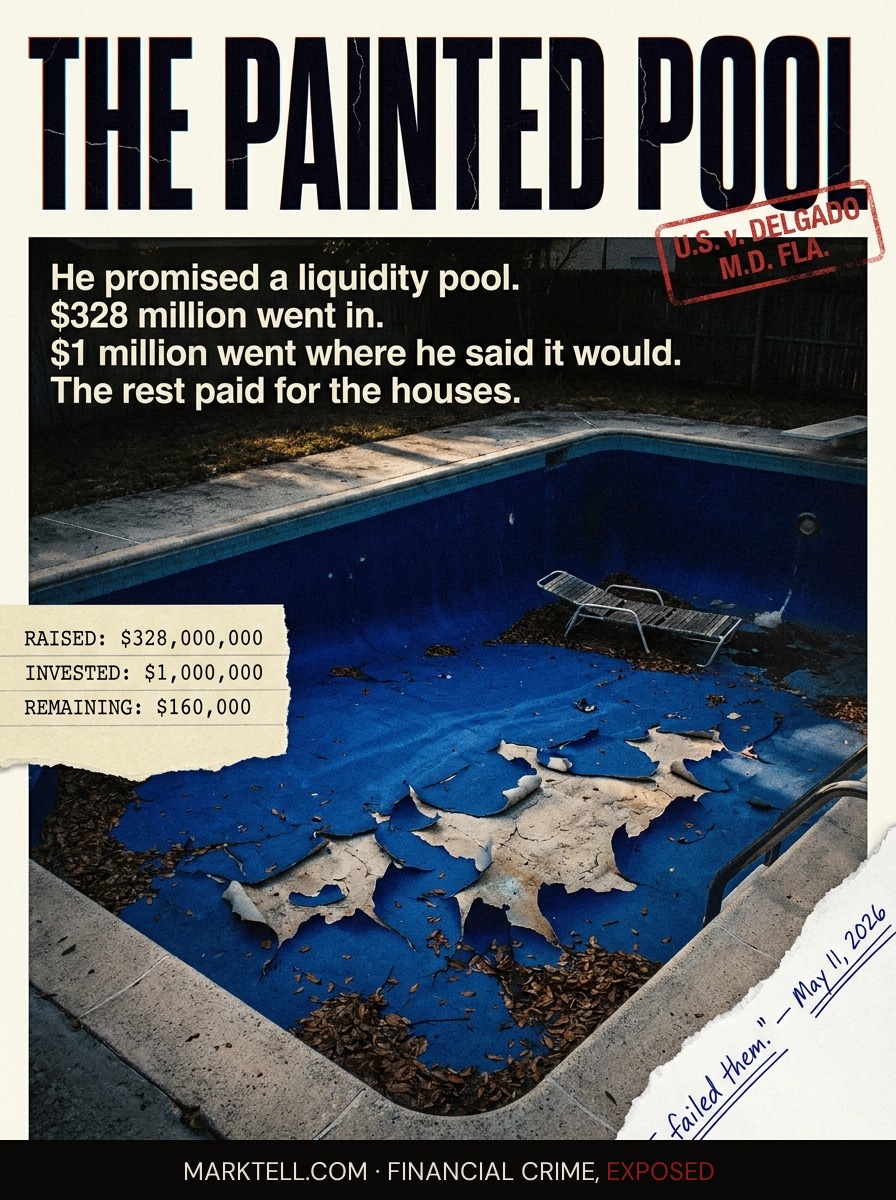
The federal complaint, filed earlier this year by the U.S. Attorney's office in the Middle District of Florida, alleges that from January 2023 through January 2026, Delgado solicited investments from more than 2,000 people across the country. The complaint puts the total raised at at least $328 million.
Federal investigators allege that of that $328 million, roughly $1 million was actually placed into cryptocurrency liquidity pools.
One million out of three hundred and twenty-eight million.
The rest, per the complaint, paid earlier investors the returns Delgado had promised, returned principal to the few who asked for it before the freeze, and funded the chief executive's life. The allegations list four residential properties valued between $1.15 million and $8.5 million. Luxury vehicles. Watches. Jewelry.
This is what a Ponzi scheme is. It is not complicated. New money pays old money. The investment everyone is told they are buying does not exist at the scale they were told. Eventually the new money slows down and the structure collapses because there is nothing underneath it.
Marisol did not know any of this in March 2024. She knew the portal showed her balance growing. She knew Beatriz kept getting paid. She knew Christopher Delgado had a clean website and a charity gala photograph and a confident voice in the YouTube videos Beatriz had sent her.
III.
The first public alarm came not from a regulator but from a man with a camera in New Zealand. In September 2025, the investigative journalist Danny de Hek began publishing videos alleging that Goliath Ventures was a Ponzi scheme. He pointed at the math. He pointed at the returns. He pointed at the absence of any audited evidence of actual crypto deployment.
Five months passed between his first videos and Delgado's arrest.
During those five months, the withdrawal freezes began. Marisol's Sunday in November was one of thousands. Investor complaints to federal authorities mounted. The Internal Revenue Service Criminal Investigation division and Homeland Security Investigations opened the file.
On February 24, 2026, Delgado was arrested. He had returned from Dubai to self-surrender after learning of the federal criminal complaint. He was charged with wire fraud and money laundering.
He told federal agents, according to the complaint, that approximately $160,000 remained in the operating bank account.
Picture that number against the number above it. $328 million in. $160,000 left. Not $160 million. $160,000.
On March 16, 2026, Goliath Ventures filed for Chapter 11 bankruptcy protection. The filing listed assets between $1 million and $10 million and liabilities between $100 million and $500 million. A court-appointed receiver took control of what remained.
IV.
On Monday, May 11, 2026, Christopher Delgado sat for an interview with WFTV in Orlando. He apologized. He said the words "I failed them."
That is the sentence the headline was built around. It is also the sentence to read twice.
A man who, according to federal prosecutors, took $328 million from more than 2,000 people and put $1 million of it into the investment he had promised them did not fail them. The verb is wrong. Failure is what happens when you try something and it does not work. The complaint alleges he did not try. The complaint alleges he ran the pool dry on purpose, for three years, while buying houses.
That is not a failure. That is a different word. The court will decide which one.
Allegation is not adjudication. Delgado has not been convicted. He is entitled to the trial the Constitution promises him. Those proceedings are ongoing.
V.
The civil lawyers have moved faster than the criminal ones. Several class actions are pending. Some name Goliath and Delgado. Some name JPMorgan Chase Bank and Bank of America, alleging that the banks processed enormous capital flows through Goliath accounts and ignored what the civil complaints describe as obvious red flags. The banks have not been charged with crimes. The civil allegations remain unproven. Those cases will take years.
The specific named losses in the civil filings are large. Gregory Wilson, $8.74 million. John Euliano, $1.28 million. Those are real people whose names appear in real court documents.
Marisol is not in those filings. Her loss is too small to make the lead plaintiff list and too large to ever come back to her in the time she has left to work. She is on the creditor schedule somewhere, an entry in a bankruptcy that will pay pennies on the dollar if it pays anything at all.
She still works the pediatric floor. She picked up two extra shifts a week starting in February. The grandkids came for Thanksgiving and she did not tell them. She has not told Beatriz from church that she lost the life insurance. Beatriz lost too, but Beatriz got out one withdrawal before the freeze, and that withdrawal is the wedge that makes the friendship impossible now. Marisol does not know whether to be angry at Beatriz or angry at herself or angry at a man on a television screen who used the word failed.
VI.
The pool was the pitch. The pool was the room everyone was told to step into. The pool was supposed to hold their money and pay them fees and grow slightly each month, the way pools do. The pool, per the federal complaint, never held water. The water was poured in one end and out the other. The bottom was painted to look like depth.
When the last investor wired the last dollar and the inflows slowed, the paint dried. The withdrawal button stopped loading on a Sunday in November. The portal still showed the balance because the portal was the last part of the painting.
Christopher Delgado told a camera he failed them.
The bank account he left behind had $160,000 in it.
Marisol still has the email she sent to support that Sunday. It has never been answered. The chair she was sitting in is the chair she sits in now when she does her shift schedule. The coffee gets cold the same way.
She thought she was an investor. The complaint alleges she was the water.
- WFTV Orlando | May 11, 2026 | Christopher Delgado interview, "I failed them"
- TradingView / Good News Network | May 2026 | aggregation of WFTV report
- U.S. Department of Justice, Middle District of Florida | February 2026 | Criminal complaint against Christopher Alexander Delgado, wire fraud and money laundering charges
- U.S. Attorney Gregory W. Kehoe | February 24, 2026 | announcement of Delgado arrest
- Goliath Ventures Chapter 11 Bankruptcy Petition | March 16, 2026 | U.S. Bankruptcy Court filing
- IRS Criminal Investigation and Homeland Security Investigations | 2026 | investigative agencies of record
- Danny de Hek | September 2025 onward | YouTube investigative video series alleging Goliath Ventures Ponzi structure
- Class action civil complaints | 2026 | filings against Goliath Ventures, Delgado, JPMorgan Chase, and Bank of America
Editorial Notice
MarkTell is a true crime publication about financial fraud. Some scenes, dialogue, and sequential details are reconstructed from court filings, enforcement actions, news reports, and public records. Where the public record does not provide exact details, editorial reconstruction is used to convey the documented pattern of events. Names of private individuals may be changed to protect identity. All factual claims are sourced to public documents cited in the Evidence Trail above. MarkTell does not provide investment, legal, or financial advice. Nothing published here constitutes a recommendation to buy, sell, or avoid any investment. Allegations described in active cases have not been adjudicated and defendants are presumed innocent until proven guilty. Readers should conduct their own due diligence before making financial decisions.