The plea changed on Thursday. The pews in Sonoma did not.
For a few weeks this spring, the retirees who trusted Ken Mattson with their savings were told the trial would not happen. On Thursday, that promise dissolved.
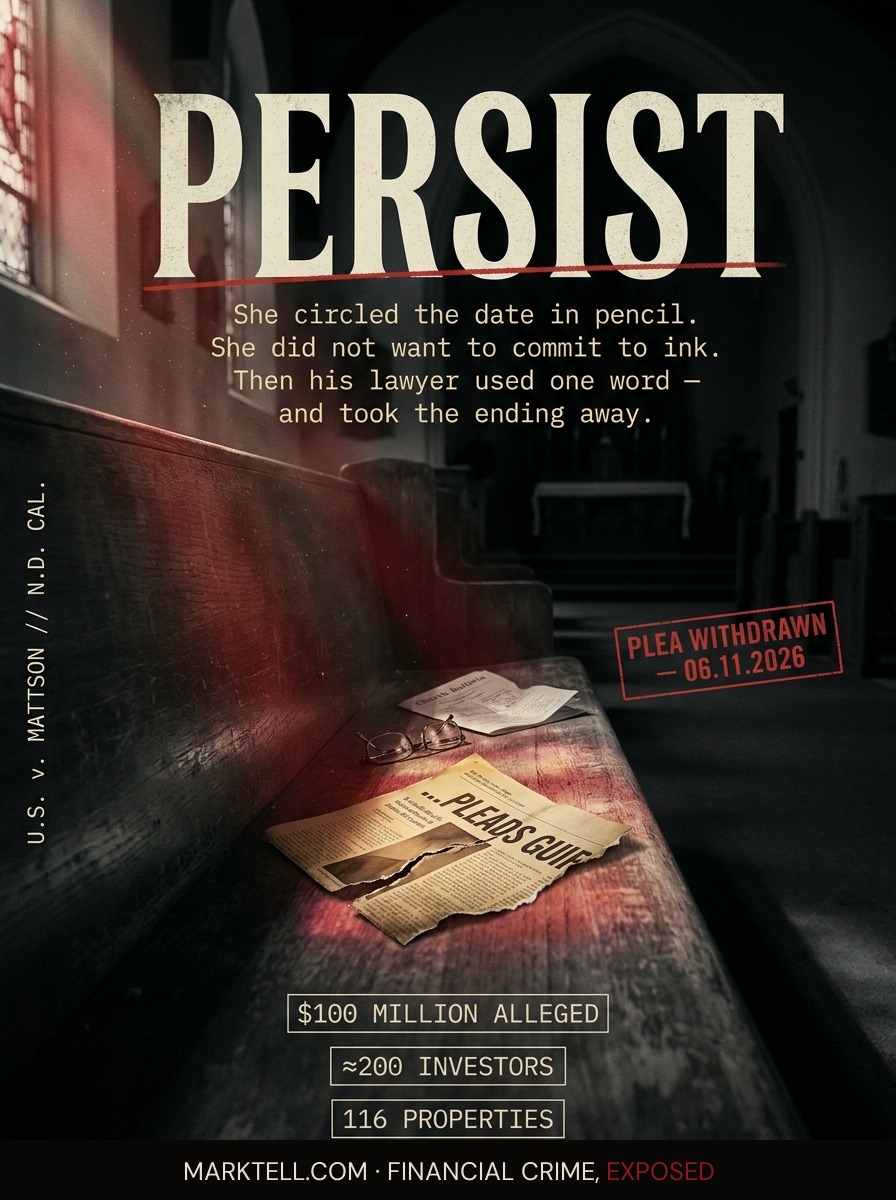
Marlene kept the clipping on the kitchen table for five weeks.
It was the small one from early May, the one that said Ken Mattson would plead guilty. Twelve years. Full restitution. A change-of-plea hearing on the calendar. She had circled the date in pencil because she did not want to commit to ink. After two years of waiting, she had learned not to commit to anything.
She is seventy-one. She taught fourth grade in Santa Rosa for thirty-one years and retired with a pension and a rollover IRA she did not want to manage alone. She met Ken Mattson the way most of the people who lost money to him met him. Through someone she trusted. A woman from Bible study introduced them in a church parking lot in 2017. He was tall and pleasant and spoke about real estate the way a pastor speaks about scripture. He owned buildings in Sonoma. Apartments. Vineyards. Hospitality. He showed her a map of properties his company managed and said he could put her into a partnership that owned a piece of one of them.
She wrote a check for $180,000.
She believed, on the day she signed, that she owned a fractional interest in an apartment building. That is what the paperwork looked like to her. That is what he told her she was buying. According to the federal complaint, that is not what she bought. Prosecutors allege the interests Mattson sold to hundreds of investors like Marlene were off-books. The partnership existed. The building existed. Her ownership did not.
Read that slowly. The building was real. The deed was real. The name on the deed was not hers and was never going to be.
I.
There is a particular kind of fraud that runs in places where people know each other. It runs in Sonoma the way it ran in West Texas in the eighties and the way it ran in Madoff's club. It runs because the introduction does the work the prospectus is supposed to do.
Ken Mattson and his partner Timothy LeFever built LeFever Mattson into a real estate operation that, at its peak, was valued at around $500 million. Between 2015 and 2024, the company acquired 116 properties worth roughly $242 million. The press releases were vineyards and apartment buildings and small-town hospitality. The court filings are something else.
The SEC's civil complaint, filed May 22, 2025, alleges that Mattson raised at least $46 million from approximately 200 investors through what the agency calls off-books partnerships. Federal prosecutors put the broader fraud at around $100 million and hundreds of investors. The criminal indictment charges Mattson with seven counts of wire fraud, one count of money laundering, and one count of obstruction of justice. Each wire fraud count carries a maximum sentence of twenty years.
The mechanics, as alleged, are old. New investor money funded distributions to older investors. Some of it funded a $10 million mansion in Piedmont. Some of it funded a $6 million estate in the Sonoma hills. Some of it funded luxury cars. That is the classic shape, and it is what the U.S. Attorney's Office called it. A classic Ponzi scheme.
The piece prosecutors keep returning to is the 2021 sale of two apartment buildings in Riverside County. Sienna Pointe and Heacock Park. Sold together for $107 million. Net profit, according to court documents, around $42 million. Prosecutors allege Mattson concealed the sale from investors and continued pitching them ownership stakes in the same buildings. They allege he obtained at least $28 million in off-books money for those two companies alone between 2019 and 2024.
He was selling shares of a building he had already sold.
II.
The unraveling did not come from a regulator. It came from inside the partnership.
In 2024, according to filings and reporting, Mattson's business partner Timothy LeFever went to the SEC and the U.S. Attorney's Office. LeFever has said publicly that he believes Mattson acted alone and embezzled funds from the operation they ran together. He has not been criminally charged. He agreed to pay nearly $5 million into a restitution fund and not to contest the SEC's findings that a Ponzi scheme existed.
Prosecutors allege that when Mattson learned in April 2024 that the SEC was investigating, he deleted thousands of relevant files. That is the obstruction count. It is not the count that carries the most prison time. It is the count that tells you what someone does when they think the room is being inventoried.
Mattson was arrested in May 2025. He posted $4 million bail. The court rejected his request to sell properties to fund his legal defense. His Piedmont mansion was sold for $8.4 million. His Sonoma estate carries an eviction notice for June 15, 2026, with the proceeds designated for a victim restitution fund.
That date is three days from when Marlene read the news.
III.
In May, the deal looked done.
According to reporting on the negotiations, prosecutors had presented Mattson with evidence and he had agreed to plead guilty to at least one count of wire fraud. The proposed terms: a twelve-year prison sentence and full restitution. A change-of-plea hearing was scheduled for May 11. The story, for the victims, was about to enter its next phase. No jury. No years of testimony. A number on a sentencing sheet and a long mechanical process of trying to claw money back from a bankruptcy estate.
Then, on Thursday, June 11, 2026, Mattson's defense counsel Randy Sue Pollack notified the U.S. Attorney's office that her client would "persist in his plea of not guilty."
That is the phrase in the filing. Persist. As if the original not-guilty plea had never moved.
The record does not say why. The deal that was on the table is not on the table anymore. The case is going to a jury before U.S. District Judge Jon Tigar. The trial that the proposed plea was designed to avoid is now the trial that will happen.
For the prosecutors, this is a strategic problem they have prepared for. For the victims, it is something else.
IV.
Marlene threw the clipping away on Thursday night.
She did not throw it away because the trial frightens her, exactly. She threw it away because she had let herself, for the first time in two years, imagine an ending. A bad ending, but an ending. Twelve years for him. Some fraction of her IRA back. A hearing she would not have to attend.
A guilty plea is a confession written into a public record. A trial is an argument. In an argument, the defense gets to say things about her. About her judgment. About why she handed over $180,000 to a man she met in a church parking lot. The defense will not call her stupid. They will call her enthusiastic. They will note that she signed a subscription agreement. They will note the page number where it said real estate investments carry risk.
She knows this because her granddaughter is in law school and has explained it to her.
The community that introduced her to Mattson is still her community. Some of the people in the next pew are also in the indictment as victims. Some are not. Some still believe he is innocent. Some have stopped speaking to each other over it. The fraud did not just take her money. It rearranged the room she sits in on Sunday.
That part may be the saddest.
V.
The machine that ran for fifteen years was, in the prosecutors' telling, very simple. Two ledgers. One that existed in the real world, with deeds and tax filings and bank accounts and an audited operation. One that existed alongside it, where the partnerships were sold and the distributions were paid and the investors believed they owned something.
The first ledger gets the SEC filings. The second ledger gets the indictment.
The first ledger gets the press releases about new acquisitions. The second ledger gets the eviction notice.
The first ledger gets the introduction at Bible study. The second ledger gets Marlene's $180,000.
A Ponzi scheme is not a financial product. It is a clock. It runs as long as new money comes in faster than old money has to be paid out. When the clock stops, the people holding the second ledger learn that there was a second ledger.
Mattson's clock began to slow around 2019, when prosecutors allege his personal returns could no longer cover the off-books distributions. It stopped in 2024, when his partner walked into a federal building. The June 15 eviction is what the end of the clock looks like in physical space. A door. A notice. A house someone used to live in.
The trial will be about whether the second ledger existed, and whether Mattson knew it existed, and whether he ran it with the intent to defraud. Those are the questions a jury answers. They are not the questions Marlene is asking.
She is asking why he changed his mind on Thursday.
She is asking what he thinks he has to gain by making her testify.
She is asking whether the man in the parking lot in 2017, who spoke about real estate the way a pastor speaks about scripture, knew on that day that she would still be waiting in 2026.
The plea changed. The pews did not.
She will be sitting in one of them on Sunday. So, probably, will some of the people whose money she is now waiting in line behind.
- The Real Deal | June 12, 2026 | "Ken Mattson reverses course, will plead not guilty in Sonoma Ponzi scheme case"
- U.S. Securities and Exchange Commission | May 22, 2025 | SEC v. Kenneth W. Mattson, civil complaint
- U.S. Department of Justice, Northern District of California | May 2025 | Federal indictment of Kenneth Mattson, nine felony counts
- U.S. Attorney's Office, Northern District of California | Statements from Craig Missakian and Patrick D. Robbins
- Press Democrat / Bay Area reporting | April-June 2026 | Plea negotiation coverage and reversal
- Bankruptcy filings | LeFever Mattson and KS Mattson Partners
- Reporting on June 15, 2026 eviction notice, Sonoma estate
- Reporting on $8.4M sale of Piedmont mansion
Editorial Notice
MarkTell is a true crime publication about financial fraud. Some scenes, dialogue, and sequential details are reconstructed from court filings, enforcement actions, news reports, and public records. Where the public record does not provide exact details, editorial reconstruction is used to convey the documented pattern of events. Names of private individuals may be changed to protect identity. All factual claims are sourced to public documents cited in the Evidence Trail above. MarkTell does not provide investment, legal, or financial advice. Nothing published here constitutes a recommendation to buy, sell, or avoid any investment. Allegations described in active cases have not been adjudicated and defendants are presumed innocent until proven guilty. Readers should conduct their own due diligence before making financial decisions.