The pilot who needed help with customs was never a pilot at all
On May 22, 2026, Thai police walked into a luxury condo in Nonthaburi and found eighteen phones, three laptops, and the machine behind a wave of AI-powered romance scams aimed at older Thai women. The men inside had been overstaying their visas for years. The women on the other end of the screen had been falling in love with people who did not exist.
I.
Malee was sixty-one years old and she taught fourth grade in Nonthaburi for thirty-four years before she retired. She lived alone in a two-bedroom condo a short drive from the river. Her daughter lived in Chiang Mai. Her husband had been dead for nine years.
She kept her phone on the kitchen table at night because that was where she sat with tea after the news.
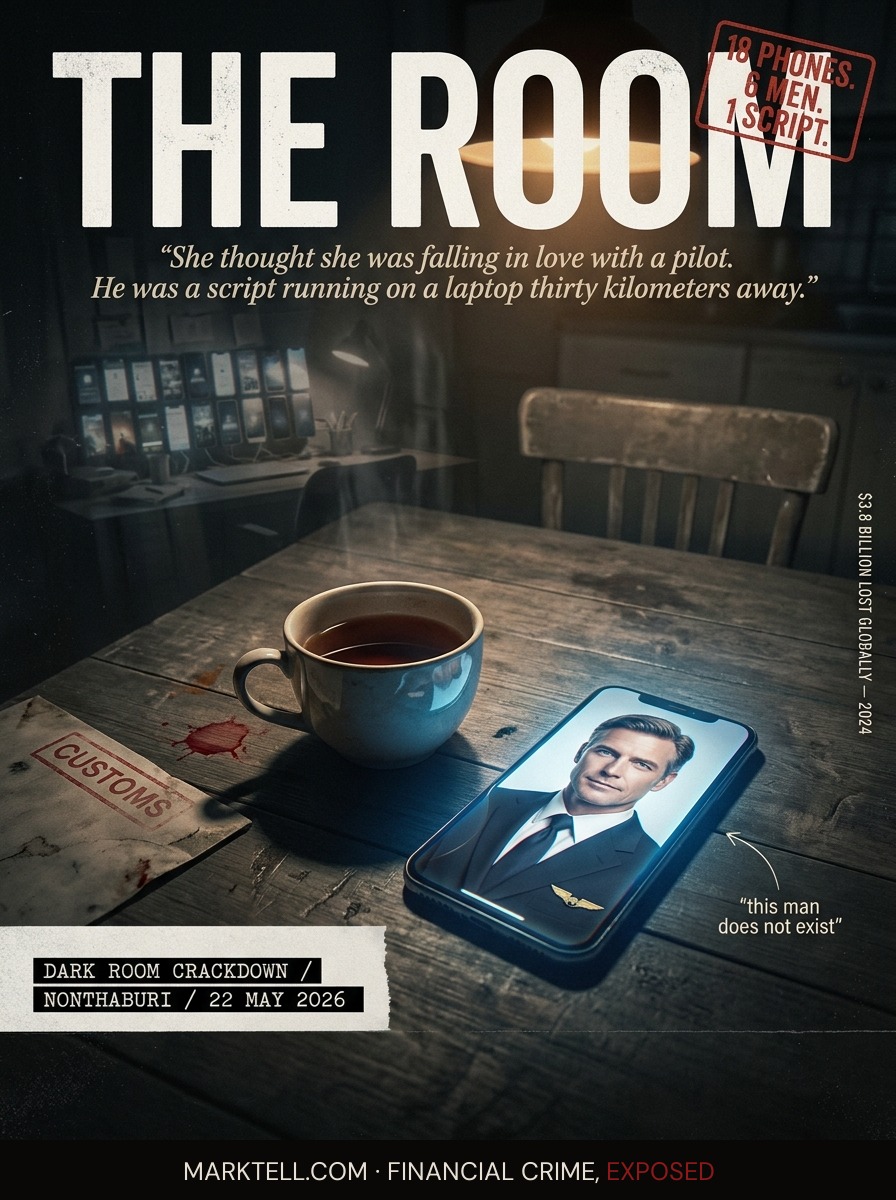
The man she was talking to was a pilot. American. Widower. He flew long-haul out of Doha. He told her he had a daughter in boarding school in Switzerland and a house in Connecticut he was thinking of selling because it was too big for one person now. He sent her photographs. A man in a uniform standing next to a jet. A man at a restaurant holding a glass of wine. A man on a beach, squinting at the camera, the kind of squint a real person does.
The photographs were generated by software. Malee did not know that. Nobody told her that. The face she had been falling in love with for four months did not exist anywhere on earth except inside a laptop in a condominium less than thirty kilometers from her kitchen.
II.
On Friday, May 22, 2026, Thai police walked into a luxury condo in Nonthaburi and arrested six Nigerian men.
Dennis, 23. Ejikeme, 24. Okorom, 26. Ibekwe, 29. Nwosu, 30. Obielu, 35.
All six had entered Thailand on student visas. None of them were attending classes. None of them had jobs the records could find. Nwosu had been overstaying his visa for 1,560 days. That is more than four years. Ibekwe had overstayed for 1,166 days.
The operation was called the Dark Room Crackdown. Pol Maj Gen Theeradej Thammasuthee, deputy commissioner of the Metropolitan Police Bureau, announced it.
Inside the condo, police seized eighteen mobile phones, three laptop computers, and three bank books.
Read that again. Eighteen phones. Six men. Three phones each, on average. That is not a personal-use ratio. That is a workstation.
On the laptops, according to the Thai police statement, investigators found scripts for romance scams and AI-generated images used to build fake profiles. The men, police said, were posing as wealthy foreign men. Pilots. Soldiers. Lawyers. Engineers. Doctors. The kind of professions a sixty-one-year-old retired schoolteacher in Nonthaburi might believe a man could plausibly have.
The condo was the room. The phones were the doors. The script was the floor plan.
III.
Here is how the room worked.
The contact begins on social media or a dating app. The man is handsome but not too handsome. The photographs are slightly too smooth around the eyes if you know what to look for. Most people do not know what to look for.
He is busy. He is overseas. He is grieving. He is impressed by her. He asks about her life. He listens to the answers. He listens for weeks. AI helps him listen. AI helps him remember. AI helps him write back in a voice that sounds like a man who has been hurt before and is trying carefully to trust again.
This is what financial crime analysts call the grooming phase. In the older version of this fraud, the grooming was the bottleneck. One man could only manage so many women at once. He would forget which lie he had told to which target. The grammar would slip. The story would not match.
AI took the bottleneck out. AI lets one operator run dozens of conversations at once, in voices that do not slip, with stories that do not contradict, with photographs that adjust to whatever the target wants to see. Barclays warned about this surge in 2025. Experian named it as a top fraud trend for 2026. The FBI's Internet Crime Complaint Center logged $672 million in romance scam losses in the United States in 2024. The Federal Trade Commission logged $1.14 billion in 2023, with a median individual loss of $2,000.
Those numbers are the visible part. They are what victims reported. The unreported number is larger. It is always larger, because most people who lose money this way do not tell anyone. Shame is the best ally the room ever had.
IV.
Then comes the crisis.
In Malee's case, the crisis was a parcel. The Captain was sending her a gift. Gold jewelry. A watch. Personal items he wanted her to have because he was coming to Bangkok in a few weeks and he wanted her to know he was serious. The parcel was held at customs. There was a fee. He could not pay it from where he was. Could she pay it, and he would reimburse her the moment he landed.
She paid it.
Then there was another fee. An inspection charge. Then a tax. Then a hold on the package because the value was too high and required additional clearance documents and another fee. Each fee was smaller than the value of what was supposedly inside the package, so each fee made sense.
This is the structure. The financial term is sunk cost. The plain English is, every dollar you have already paid makes the next dollar feel like protecting the dollars before it. The room is designed to make stopping feel more expensive than continuing.
Malee continued for four months.
V.
The money did not stay in the condo. The condo was not a vault. It was a control room.
The three bank books found in the raid belonged to accounts that received transfers from victims and then moved the funds out, almost certainly through a layered chain of mule accounts and money-service businesses. This is the part that does not make the headline because it is dull and it is paperwork. It is also where the actual crime lives.
The Thai police got to this particular condo because of another case. In April 2026, they had arrested a man named Patrick and four accomplices in a drug network investigation, seizing assets worth 2.5 million baht (about $70K USD). Financial links from that investigation, according to the Bangkok Post's reporting, led investigators to the Nigerian suspects in the Nonthaburi condo.
That is the pattern worth marking. The romance scam money does not stay inside the romance scam. It crosses into drug networks, into trafficking networks, into the larger Southeast Asia cyberfraud compound economy that Nasdaq estimated drove $3.8 billion in global romance scam losses in 2024 alone.
In February 2026, Nigeria's National Agency for the Prohibition of Trafficking in Persons rescued 23 Nigerian youths who had been trafficked to Thailand specifically to work in online fraud. The compound economy needs labor. It recruits young men with English and IT skills, brings them into the region under student or tourist cover, and puts them in rooms with eighteen phones and a script.
Some of those young men are victims of trafficking themselves. Some are operators. The line between the two is one of the open questions Thai prosecutors will have to answer.
VI.
Malee sat at her kitchen table on a Tuesday night and tried to send Captain David a message and the message did not go through.
She tried again on Wednesday.
On Thursday she called her daughter in Chiang Mai. Her daughter told her, gently, that there was no Captain David. Her daughter asked how much. Malee did not answer.
That part may be the hardest to write about. Not the wire transfers. The grief. She was not just mourning the money. She was mourning a man who had told her, for four months, that he loved her. The fact that the man was a script running on a laptop in a condo across the river did not undo the love she had felt. Love does not know who is on the other end of it. That is what the room counted on.
VII.
The six men are in Thai custody on charges related to visa overstay and participation in a transnational scam network. The allegations have not been adjudicated. The case is open. The phones and laptops are being analyzed.
The room in Nonthaburi has been closed.
There are other rooms. There are always other rooms.
If you have a parent who has met someone online, ask them three ugly questions. Not the polite questions. Not the ones that protect their feelings. The ugly ones.
Have you sent this person money. Have you sent this person money for a fee, a customs charge, a tax, a medical bill, a plane ticket, or an emergency. Have you ever spoken to this person on a video call where you could see their face moving in real time and not on a recording.
If the answer to the first is yes and the answer to the third is no, you are not asking a question anymore. You are reading evidence.
The man in the uniform standing next to the jet was never a pilot. He was a face the machine made to fit the woman it was talking to. He looked like a person because the machine had learned what a person looks like.
He never landed in Bangkok. He was never going to.
- TVC News | May 23, 2026 | "Six Nigerians Arrested In Thailand Over Alleged AI-Powered Romance Scam"
- Bangkok Post | May 22-23, 2026 | reporting on Dark Room Crackdown operation and Patrick drug network financial links
- Peoples Gazette | May 22, 2026 | reporting on suspect identities and visa overstays
- The Straits Times | May 22-23, 2026 | reporting on seized devices and AI-generated profile evidence
- Globe Bangkok News | May 22, 2026 | local reporting on Nonthaburi raid
- Thai Metropolitan Police Bureau statement | May 22, 2026 | Pol Maj Gen Theeradej Thammasuthee press remarks
- FBI Internet Crime Complaint Center (IC3) | 2024 Annual Report | $672M romance scam losses
- Federal Trade Commission | 2023 Consumer Sentinel data | $1.14B romance scam losses, $2,000 median
- Nasdaq Global Financial Crime Report | 2024 | $3.8B global romance scam estimate
- Barclays consumer fraud advisory | 2025 | AI romance scam surge, £7,000 average UK loss
- Experian Fraud Trends Report | 2026 | AI-powered romance scams named top trend
- NAPTIP (Nigeria) | February 2026 | rescue of 23 Nigerian youths trafficked to Thailand for cybercrime
Editorial Notice
MarkTell is a true crime publication about financial fraud. Some scenes, dialogue, and sequential details are reconstructed from court filings, enforcement actions, news reports, and public records. Where the public record does not provide exact details, editorial reconstruction is used to convey the documented pattern of events. Names of private individuals may be changed to protect identity. All factual claims are sourced to public documents cited in the Evidence Trail above. MarkTell does not provide investment, legal, or financial advice. Nothing published here constitutes a recommendation to buy, sell, or avoid any investment. Allegations described in active cases have not been adjudicated and defendants are presumed innocent until proven guilty. Readers should conduct their own due diligence before making financial decisions.