The pill bottle in Lusaka and the cobalt under the floor
A billion-dollar health agreement that 1.3 million HIV patients are counting on stalled past its April 30 deadline. The record suggests the negotiation was never really about health.
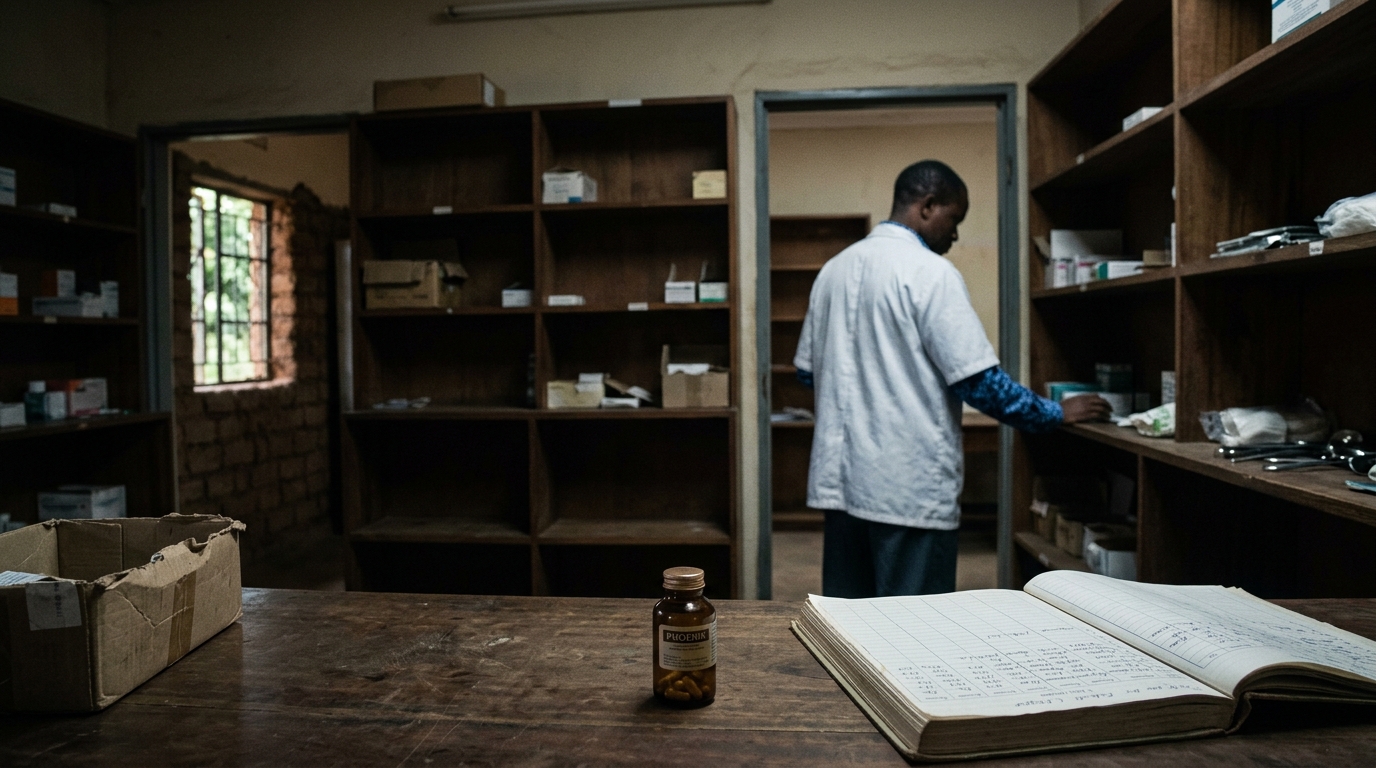
The pill bottle costs almost nothing to make. It costs everything to deliver.
In a clinic outside Lusaka this week, a woman in her forties picked up a thirty-day refill of antiretrovirals. She has been on the same regimen for eleven years. She knows the pharmacist by name. She does not know that the bottle she just slid into her handbag is paid for by a five-year agreement between her government and the United States that, as of yesterday, does not exist on paper.
April 30, 2026 was the deadline. April 30, 2026 came and went.
There is no signed Memorandum of Understanding. There is no implementation plan. There is funding, for now, on what the State Department is calling an ad hoc basis. Ad hoc is the word governments use when nobody wants to say "month to month." Ad hoc is what a clinic runs on when nobody is sure if next quarter exists.
Roughly 1.3 million Zambians are on US-funded HIV treatment. That is the number you have to hold while you read the rest of this.
I. THE NUMBER THAT MOVED
In November 2025, Zambia's Health Minister Elijah Muchima announced the country would receive a $1.5 billion grant from the United States over five years. HIV. Malaria. Maternal care. TB. Polio. Measles. The signing was scheduled for December.
December came. The signing did not.
By the time health activists got a look at the draft Memorandum of Understanding in March 2026, the number had moved. Not to $1.4B. Not to $1.3B.
To $1.012B.
That is a $488 million cut from what was announced five months earlier. Measured against FY24 levels, the draft represents a 53% reduction. The same draft requires the Zambian government to put up roughly $340M in co-financing of its own, hire an additional 40,000 health workers by 2030, and lift annual health spending from about $628M today to over $1B by the end of the decade.
A number that was supposed to be a gift had grown teeth.
II. THE ROOM NOBODY DESCRIBES THE SAME WAY
On November 17, 2025, US Secretary of State Marco Rubio met with Zambian President Hakainde Hichilema and proposed what was called a bilateral compact. According to multiple reports, the compact tied health cooperation to mining collaboration. Zambia sits on copper. Zambia sits on cobalt. Zambia sits on lithium. The Copperbelt is not a poetic name. It is a description.
In December, a senior State Department official named Caleb Orr reportedly conveyed mining conditions directly to the Zambian president.
In the months that followed, a memo prepared for Secretary Rubio surfaced. The memo, according to reporting, suggested withholding HIV funding as a negotiating tactic to secure mineral access.
Read that again slowly. Withholding HIV funding. As a negotiating tactic.
The outgoing US Ambassador to Zambia, Michael Gonzales, has publicly rejected the claim that aid is being linked to minerals. He called the allegation "disgusting and patently false." He also said, on the record, that since January 2026 there has been "effectively zero substantive engagement" from Zambian officials. Unanswered calls. Cancelled meetings.
Both things are in the public record. The denial and the memo. The ambassador's frustration and the leaked draft. You are allowed to hold them in the same hand.
III. WHAT A VALVE LOOKS LIKE
Call this what it appears to be in the record. A valve.
A valve is not a wall. A valve does not say no. A valve says: turn this, and water moves. Turn it back, and it stops.
The pill bottle in the Lusaka clinic is downstream of the valve.
Health GAP, an advocacy group, called the structure "shameless exploitation." Asia Russell, who runs it, has been blunt: mining interests are being prioritized over health. Owen Mulenga of the International AIDS Society used a sharper word. Colonialism. Josiah Kalala of Chapter One Foundation flagged a separate problem buried in the draft, a ten-year data-sharing agreement that flows in one direction, out of Zambia and into US systems.
Ten years of patient data. One direction.
Julius Kachidza of Zambia's Civil Society Self-Coordinating Mechanism said what the clinicians know already. If the funding stays ad hoc, HIV programs will degrade. Patients will be missed. Some Zambian hospitals have already reported an increase in AIDS cases following earlier aid disruptions. That is not a forecast. That is a measurement.
IV. THE PATTERN, NOT THE INCIDENT
Zambia is not alone in the pattern.
On April 29, 2026, Ghana rejected a similar US health deal over data-sharing concerns. Zimbabwe and Kenya have pushed back on comparable terms. Global health funding, taken as a whole, dropped 21% from 2024 to 2025.
This is the part where the machine gets visible. The machine is not a single bad deal. The machine is a model. Bilateral compacts replacing multilateral programs. Aid tied to strategic minerals. Health budgets routed through the same conversation as supply chains. The Trump administration calls this "America First." Inside the affected countries, it is being called something else.
A presidential spokesperson in Lusaka, Clayson Hamasaka, said Zambia remains willing to engage through diplomatic channels. President Hichilema, for his part, has framed the cuts as an opportunity for Zambia to manage its own affairs. That is the language a head of state uses when the room is on fire and he does not want to be photographed running.
The draft also arrives against a real history. The US has previously cut aid to Zambia over the theft of donated medicines. Governance failures inside Zambia's health system are part of the record. None of that, however, is what stalled the deal this week. What stalled the deal is what is upstream of the valve.
V. THE PILL BOTTLE, AGAIN
Back to the clinic.
The woman with the eleven-year prescription does not read leaked memos. She reads the label on the bottle. The label tells her how many milligrams. It does not tell her where the milligrams come from, or what they are negotiating for, or which mineral under which province is being weighed against her next refill.
This is not a fraud story in the legal sense. Nobody is being indicted. There is no SEC filing. There is no boiler room. The mark is not one retiree at a kitchen table. The mark is a country, and the closer is a memo, and the contract is an MOU that was supposed to be signed by yesterday and was not.
But the mechanics rhyme.
Urgency. A deadline. A pen waiting at hour five. A product that looks like one thing on the cover page and reads like another on page nine. A list of conditions added late. A number that shrank quietly between the press release and the draft. A counterparty that is told, gently, that engagement is the only path forward.
I have sat in rooms where a contract changed between hour two and hour five. I know what it looks like when the thing being sold is not the thing being signed.
The US State Department says the actual funding under the Health MOU should have started in May. May is now. The funding, in any structured sense, has not.
The pill bottle is still on the counter. The MOU is still on the desk. The cobalt is still under the floor.
One of those three things is going to move first. The patient does not get to choose which.
- Reuters | May 1, 2026 | "US criticises Zambia for lack of engagement as $1 billion health deal stalls"
- US Department of State / Ambassador Michael Gonzales public statements | April-May 2026
- Health GAP statements (Asia Russell) | March-April 2026
- International AIDS Society (Owen Mulenga) commentary | 2026
- Chapter One Foundation (Josiah Kalala) commentary on data-sharing terms | 2026
- Zambia Civil Society Self-Coordinating Mechanism (Julius Kachidza) | 2026
- Reports on Rubio-Hichilema bilateral compact proposal, November 17, 2025
- Reporting on State Department memo recommending HIV funding be used as leverage | April 28, 2026
- Reports on Ghana rejecting parallel US health deal | April 29, 2026
- Zambia Health Minister Elijah Muchima announcement | November 2025
- Draft MOU details released by health activists | March 2026
Editorial Notice
MarkTell is a true crime publication about financial fraud. Some scenes, dialogue, and sequential details are reconstructed from court filings, enforcement actions, news reports, and public records. Where the public record does not provide exact details, editorial reconstruction is used to convey the documented pattern of events. Names of private individuals may be changed to protect identity. All factual claims are sourced to public documents cited in the Evidence Trail above. MarkTell does not provide investment, legal, or financial advice. Nothing published here constitutes a recommendation to buy, sell, or avoid any investment. Allegations described in active cases have not been adjudicated and defendants are presumed innocent until proven guilty. Readers should conduct their own due diligence before making financial decisions.