The phone was not listening. The salesman was lying.
Cox Media Group will pay $880,000 to settle FTC charges that it sold small businesses an AI service it claimed listened to consumers through their phones. The service did not listen. It resold email lists.
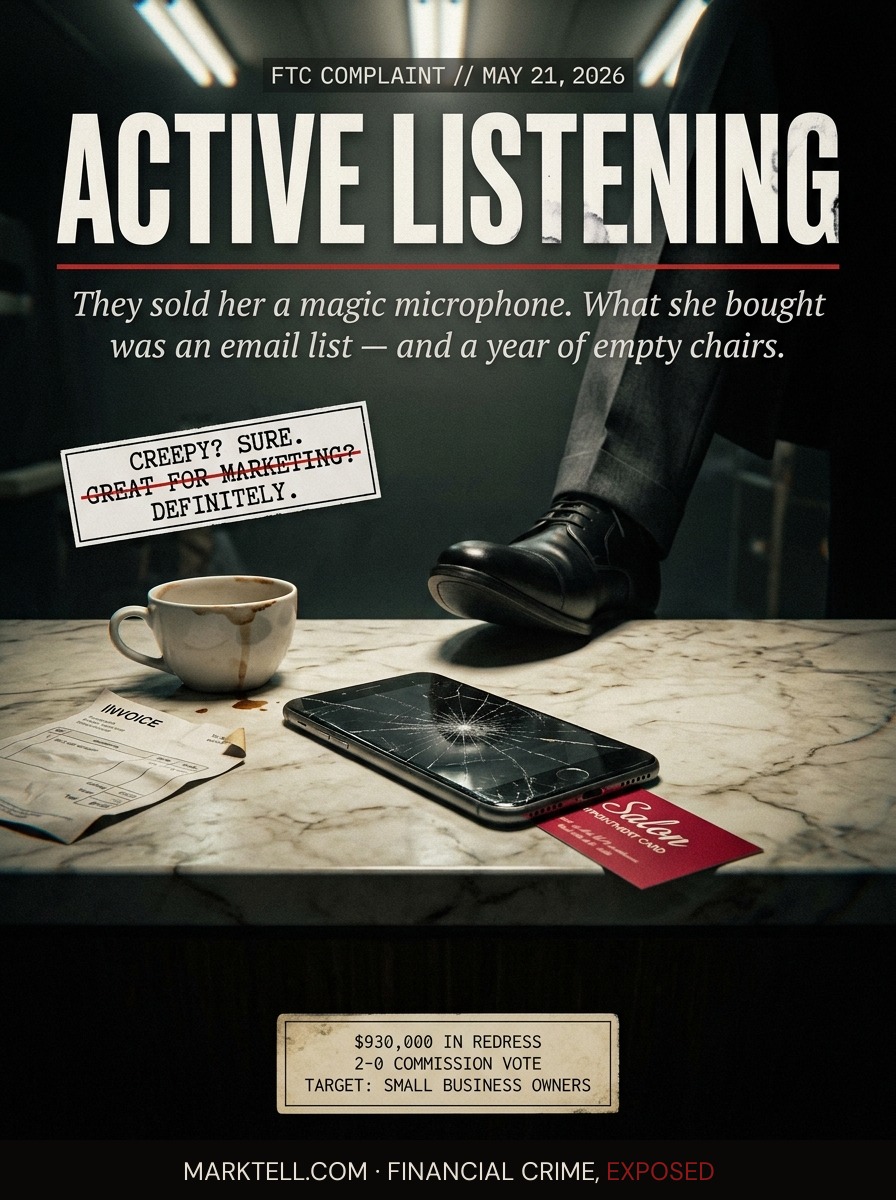
Renee is forty-seven and she owns two chairs in a strip mall north of Tampa, between a nail place and a vape shop. She has been refreshing her booking app for the better part of a year. The booking app does not refresh into anything. The chairs are mostly empty on Tuesdays.
She is not stupid. She wants to be clear about that, even if no one is asking. She runs her own books. She knows her cost per cut. She knows that when a man with a clean haircut and a Cox Media Group business card sat at her front desk last spring and told her there was a new kind of advertising, she did the thing a small business owner is supposed to do. She asked questions.
He told her the system listened.
Not in a creepy way, he said. Well. He laughed. Creepy in a good way. He showed her a slide. The slide said, more or less, that yes, it was creepy, and yes, it was great for marketing. The exact phrase, according to the Federal Trade Commission complaint filed on May 21, 2026, was "Creepy? Sure. Great for marketing? Definitely." Cox Media Group put that on a deck and sent it out to people like Renee.
The pitch was this. A woman is in her car. She tells her friend on the phone that her roots are showing. Her phone hears her. Her phone tells a system. The system tells Renee's ad to find that woman's screen. The woman sees a coupon for Renee's salon while she is still in the car. Magic. Laser-sharp targeting, the materials called it. Active Listening.
Renee signed up. She put the charge on her business card. She told two other women she knew in the same plaza. One of them signed up too.
Nothing happened.
I.
Here is what was actually being sold, according to the FTC.
Not a microphone. Not an AI. Not a real-time voice-data pipeline from your customer's pocket to your storefront. The service did not listen to anyone. Cox Media Group, working with two small marketing firms called MindSift LLC and 1010 Digital Works LLC, was buying email lists from other data brokers and reselling them at a markup. That is the entire product. An email list. The kind anyone with a credit card can buy on a Tuesday.
The "Active Listening" part was the wrapper.
That is the machine in this story. Not the email list. The Wrapper. A real, cheap, boring product, dressed in a story about a magic microphone, and sold to small business owners who do not have a CMO and cannot afford one. Renee did not buy data. She bought the story wrapped around the data.
The FTC will require Cox Media Group to pay $880,000 in redress. MindSift and 1010 Digital Works will each pay $25,000. Total: $930,000. The proposed orders will prohibit the companies from making future misrepresentations about advertising service qualities, about voice data collection and consent, and about geographic targeting capabilities. Future violations could cost up to $53,088 per occurrence. The Commission voted 2-0. The orders become final after a 30-day public comment period.
Cox Media Group did not admit the allegations. A spokesperson said the company was "pleased to have this matter resolved" and pointed at a third-party vendor whose materials, the spokesperson said, the company has since withdrawn.
II.
The consent question matters and the FTC was specific about it.
Cox Media Group's pitch told small businesses that consumers had opted in to having their voice data collected. The FTC says that claim was false. The basis for the "opt-in," to the extent there was one, was the routine click-through where a user accepts the terms of service for an app. You know the box. Everyone has clicked it. Nobody has read it.
That click, the FTC said in plain language, is not consent to have your conversations recorded for ad targeting. Acceptance of a terms-of-service screen does not unlock your microphone for a marketing vendor. The Commission is drawing a line in 2026 that should not have needed drawing, but here we are.
So the product was fake and the consent was fake. The only real thing was the invoice.
III.
The story did not start in 2026.
In September 2024, Senator Marsha Blackburn of Tennessee sent letters to Cox Media Group, to Google, and to Meta. She had seen reporting on the "Active Listening" pitch. She asked CMG for a copy of the slide deck the company was showing to investors. She asked the platforms what they knew. That was the first time the wrapper was pulled at in public.
Almost two years passed between Blackburn's letter and the consent order. In those two years, Renee paid her monthly invoice. So did other small business owners. The FTC complaint does not tell us how many. The complaint says CMG "marketed this service, primarily to small businesses." Read that sentence slowly. Small businesses. Not Procter and Gamble. Not Ford. The target customer was the woman with two chairs in the strip mall.
That part may be the saddest part. The machine was not built to fool the big rooms. The big rooms have lawyers. The machine was built to fool Renee.
IV.
Here is what was happening on both ends of the wire at the same time.
Renee was at her front desk, watching the door.
A vendor was downloading an email list from a data broker, marking it up, and invoicing her for AI.
Renee was telling her friend in the nail place next door that she had signed up for a new kind of advertising.
A pitch deck was being emailed to another salon owner two zip codes over.
Renee was clicking through her booking app, wondering if maybe it was the season.
A slide that said "Creepy? Sure. Great for marketing? Definitely." was being shown to a roofer in Ohio.
That is the wrapper running at scale. The product is so cheap and so boring that the only way to charge a premium for it is to tell a story about magic. The story does not have to be true. The story has to be exciting enough that the customer feels modern for buying it.
V.
The interesting thing about this case, for anyone who has ever sat in a sales chair or stood in front of one, is what it confirms.
For years, every American with a smartphone has had the same uneasy experience. You say the word "boots" out loud in your kitchen. Twenty minutes later, an ad for boots shows up in your Instagram feed. You assume your phone is listening. The assumption is so common that it is almost cultural.
Researchers have argued for years that the listening explanation is technically unlikely. The actual targeting, they say, runs on your search history, your location data, the apps you opened that morning, the products your spouse Googled on the shared Wi-Fi, the ad networks that share your behavior across sites. The microphone is not necessary. The data exhaust is enough.
But the listening story is sticky. It feels true. It feels like the modern world.
Cox Media Group, the FTC alleges, sold that feeling. Not the technology. The feeling. Renee did not buy a microphone. She bought the public's belief that microphones were already on, plus a story that said she could harness them.
VI.
Renee is still in the chair. She has not closed the salon. The booking app refreshed this morning into one appointment, a regular, a perm at three.
She read the news about the FTC settlement on her phone, on her break, in the back room where the boxes of color come in. She did the math in her head. Eight hundred and eighty thousand divided by however many small businesses. Whatever check eventually arrives, if one arrives, will not cover the year she spent paying for a ghost.
What she keeps coming back to is not the money. It is the part where she told her friend next door. The friend signed up too. Renee was the one who said it was working. She did not know yet that it was not. She was the one who said the word "AI" out loud over coffee, the way the man with the business card had said it to her.
That is how a wrapper travels. Not through the ad budget. Through the woman who trusted it.
The phone, it turns out, was not listening.
The salesman was.
- Federal Trade Commission | May 21, 2026 | FTC administrative complaint and proposed consent orders against CMG Media Corporation, MindSift LLC, and 1010 Digital Works LLC
- MediaPost | May 22, 2026 | "Cox Media Group Falsely Claimed To Target Ads Based On Conversations, FTC Charges"
- Office of Senator Marsha Blackburn | September 2024 | Letters to Cox Media Group, Google, and Meta regarding "Active Listening" software
- FTC Bureau of Consumer Protection | May 21, 2026 | Statement of Director Christopher Mufarrige
- Cox Media Group | May 21, 2026 | Public statement on FTC settlement
Editorial Notice
MarkTell is a true crime publication about financial fraud. Some scenes, dialogue, and sequential details are reconstructed from court filings, enforcement actions, news reports, and public records. Where the public record does not provide exact details, editorial reconstruction is used to convey the documented pattern of events. Names of private individuals may be changed to protect identity. All factual claims are sourced to public documents cited in the Evidence Trail above. MarkTell does not provide investment, legal, or financial advice. Nothing published here constitutes a recommendation to buy, sell, or avoid any investment. Allegations described in active cases have not been adjudicated and defendants are presumed innocent until proven guilty. Readers should conduct their own due diligence before making financial decisions.