The pharmacy counter was the crime scene. The receipt was the confession.
For years, the price on the pharmacy receipt was not the price of the drug. It was the price of a rebate game played above the patient's head. On February 4, 2026, one of the three companies running that game agreed to stop.
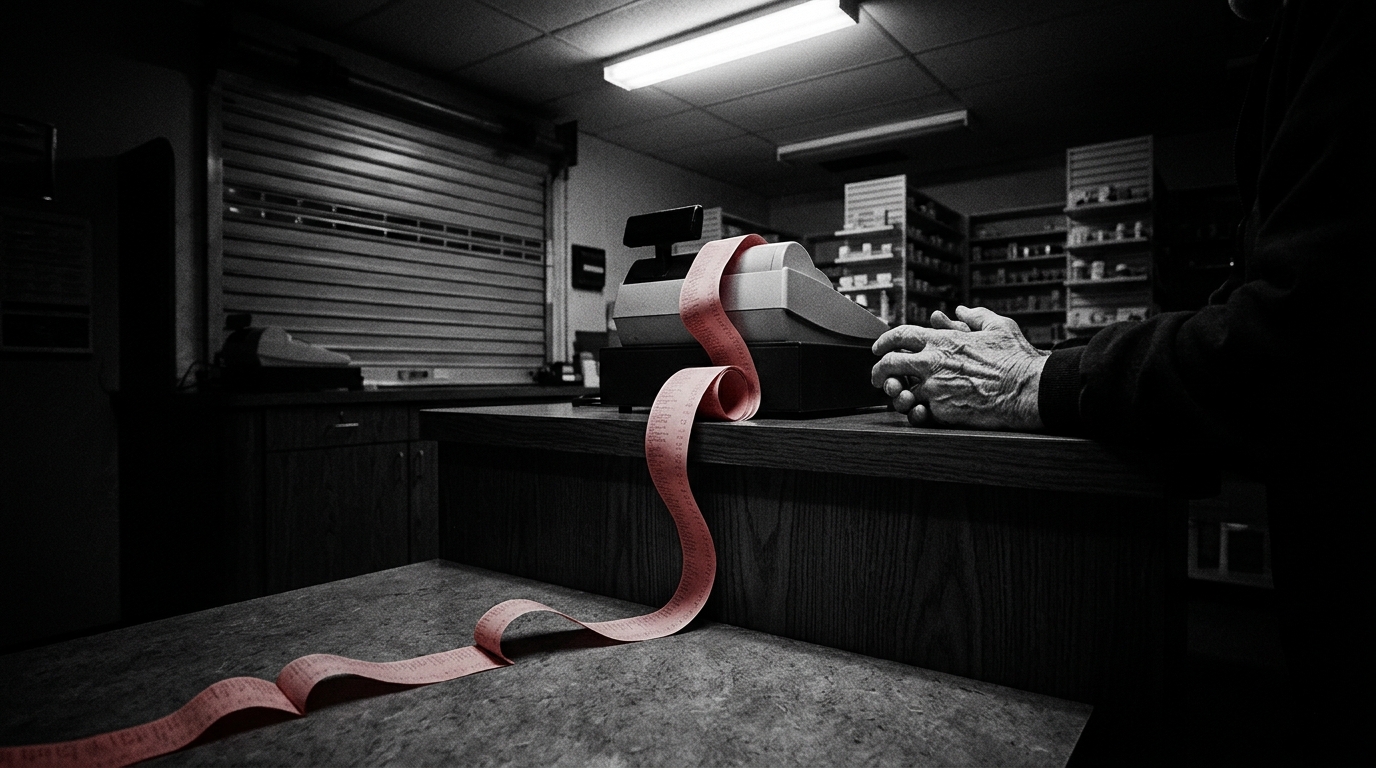
The woman at the pharmacy counter is sixty-one. She has had Type 1 diabetes since she was nine. She is wearing the jacket she wears to every appointment because it has a deep inside pocket where she keeps her insurance card and a folded paper with her medication list in her own handwriting.
She is waiting to see the number.
The cashier slides the box of insulin pens across the scanner. There is a small pause while the system thinks. The screen turns toward her. She has been doing this for fifty-two years and the number on the screen is the only part of the transaction she does not know in advance.
Some months it is forty dollars. Some months it is three hundred. She has never been able to predict which.
That gap between what she pays and what she expected to pay is not a glitch. It is the product. For years, the number on that screen was not the price of insulin. It was the price of a deal she was never invited to.
I.
The deal has a name. Pharmacy benefit manager. PBM for short. Three companies do most of it in this country. Express Scripts, owned by Cigna. CVS Caremark, owned by CVS. OptumRx, owned by UnitedHealth. Together they sit between the people who make drugs and the people who take them. They build the formulary, which is the list of what your insurance will cover and at what tier. They negotiate rebates with manufacturers. They tell the pharmacy what to charge you when you walk up to the counter.
Read that again. They tell the pharmacy what to charge you.
Now hold that thought next to a second one. They get paid, in part, from rebates calculated as a percentage of the list price of the drug. The higher the list price, the bigger the rebate. The bigger the rebate, the bigger their cut.
You see it already. So did the FTC.
II.
On September 20, 2024, the Federal Trade Commission sued all three of them. The complaint laid out what the agency called a rebate system that pushed list prices up, particularly for insulin, and shifted the cost of those inflated prices onto the patients standing at the counter.
The complaint described a ladder. Each rung was a list price. Each rebate negotiation pulled the next rung higher. The PBMs kept a slice. The plan sponsors got a slice. The manufacturers kept their net price roughly stable by raising the list price to cover the rebate they were paying.
The patient paid coinsurance on the top rung.
A vial of insulin that cost ten dollars to make was listed at three hundred. The manufacturer rebated back two hundred. The PBM kept some, the plan got some, and the woman at the counter paid twenty percent of three hundred, not twenty percent of one hundred.
That is not a metaphor. That is the mechanic the FTC described in the filing.
III.
On February 4, 2026, Express Scripts settled.
The settlement is the first of the three. CVS Caremark and OptumRx remain in litigation. Allegation is not adjudication. Both companies have denied wrongdoing.
But the Express Scripts terms are worth reading slowly.
The company agreed to stop preferring high-list versions of a drug over identical low-list versions on its standard formulary. Translate that. Two vials of insulin, same molecule, same manufacturer, one priced at three hundred and one priced at thirty. The PBM was alleged to have steered patients toward the three hundred dollar version because the three hundred dollar version came with a bigger rebate.
That stops.
The company agreed to offer plan sponsors a standard option in which member out-of-pocket costs are calculated off the net price of the drug, not the list price. Translate that. The number on the screen at the counter will track what the drug actually costs after rebates, not the inflated rung the rebate was built on.
The company agreed to expand its Patient Assurance Program, the one that caps insulin out-of-pocket at twenty-five dollars a month, and to make that cap a standard benefit unless a plan explicitly opts out.
Twenty-five dollars. Per month. For insulin.
The settlement runs ten years. An independent monitor will watch compliance. The FTC projects up to seven billion dollars in patient savings over that decade, though the agency has not published its full methodology for that figure.
IV.
Go back to the woman at the counter.
She does not know any of this yet. She is watching the screen. The cashier is waiting. The plastic bag is open.
What she does know is the obituary section. She knows the names. The young man in Minnesota who rationed his insulin and died in his apartment. The diabetic in Ohio whose sister found him beside an empty pen. The GoFundMe pages with the same headshot, the same dates, the same words from the same parents. She knows because she reads them. She knows because every diabetic she has ever met reads them.
That part may be the saddest. The dead were not collateral. They were inside the math. The list price was set at a level that priced them out, and the rebate ladder kept lifting because the ladder was where the money lived.
Picture it.
A vial sitting on a shelf. Behind the vial, a list price. Behind the list price, a rebate. Behind the rebate, a contract between a manufacturer and a PBM. Behind the contract, an analyst running a model that asks how high the list can go before the patient stops filling the prescription. The model does not include the obituaries. The model does not have a column for the funerals.
The model is the machine.
V.
What changes now.
For Express Scripts members, if the settlement holds and the implementation works, the screen at the counter will start showing a different number. Lower for a lot of people. Capped at twenty-five dollars a month for insulin if their plan does not opt out.
That is real. It is not nothing. After years of the rebate ladder climbing, one of the three operators of the ladder has agreed to stop climbing.
But hold the celebration for a second and look at what did not change.
The list prices themselves. Largely intact. Manufacturers can still set them where they want. The settlement reshapes how Express Scripts handles them. It does not require the manufacturer to lower them.
The other two PBMs. Still in litigation. Their rebate practices, as alleged, continue while the cases proceed. The FTC's allegations against CVS Caremark and OptumRx have not been adjudicated. Both companies dispute the agency's account.
The broader machine. PBMs are paid by plans, by manufacturers, and by themselves through affiliated specialty pharmacies and group purchasing organizations. The Express Scripts settlement closes one valve. There are other valves.
VI.
The woman at the counter pays. She does not know yet whether her plan is an Express Scripts plan, or whether her employer has opted out of the standard offering, or whether the settlement will reach her by next refill or in eighteen months.
She takes the bag. She walks to her car. She puts the insulin in the small cooler she keeps on the passenger seat because the pharmacy is twenty minutes from her house and she does not trust the spring sun.
She drives home.
The number on the screen today was one hundred and forty dollars. Last month it was sixty. The month before it was two hundred and twenty. She does not know why and she has stopped asking the cashier because the cashier does not know either. The cashier is reading what the system tells her to read.
The system was the crime scene.
The receipt was the confession.
For ten years, if the settlement holds and the monitor does its job and the other two cases land somewhere similar, that receipt will read differently. Not because the drug got cheaper. The drug did not get cheaper. The ladder got shorter.
That is the win. It is a real one. It is also the smallest version of the win that was available.
The machine is still there. One of its three operators agreed to run it differently. The other two are still in court.
She gets home. She puts the insulin in the refrigerator. She opens the kitchen drawer where she keeps the explanation of benefits, the ones she has never been able to read. She closes it again.
She has been paying for the rebate her whole life. She just was not the one getting it.
- Federal Trade Commission | February 4, 2026 | FTC announcement of consent agreement with Express Scripts, Inc.
- Federal Trade Commission | September 20, 2024 | FTC complaint against Caremark Rx, Express Scripts, OptumRx and affiliated GPOs
- MSN / Google News | April 2026 | "How a major FTC settlement could lower your out-of-pocket drug costs"
- Federal Trade Commission | April 17, 2026 | FTC public statement on settlement significance
- Industry commentary | April 6, 2026 | Analysis of settlement impact on PBM industry
- CMS data referenced in industry reporting | April 28, 2026 | Medicare Part D preferred network composition
Editorial Notice
MarkTell is a true crime publication about financial fraud. Some scenes, dialogue, and sequential details are reconstructed from court filings, enforcement actions, news reports, and public records. Where the public record does not provide exact details, editorial reconstruction is used to convey the documented pattern of events. Names of private individuals may be changed to protect identity. All factual claims are sourced to public documents cited in the Evidence Trail above. MarkTell does not provide investment, legal, or financial advice. Nothing published here constitutes a recommendation to buy, sell, or avoid any investment. Allegations described in active cases have not been adjudicated and defendants are presumed innocent until proven guilty. Readers should conduct their own due diligence before making financial decisions.