The pension he earned on Sundays is the only thing left for the people he took.
John Robert Leake pitched gold mines in Ghana and villas in Costa Rica. Six investors gave him roughly $8.1 million. Federal prosecutors are now asking a California court to garnish the NFL benefits he earned as a linebacker to pay back what the court says he stole.
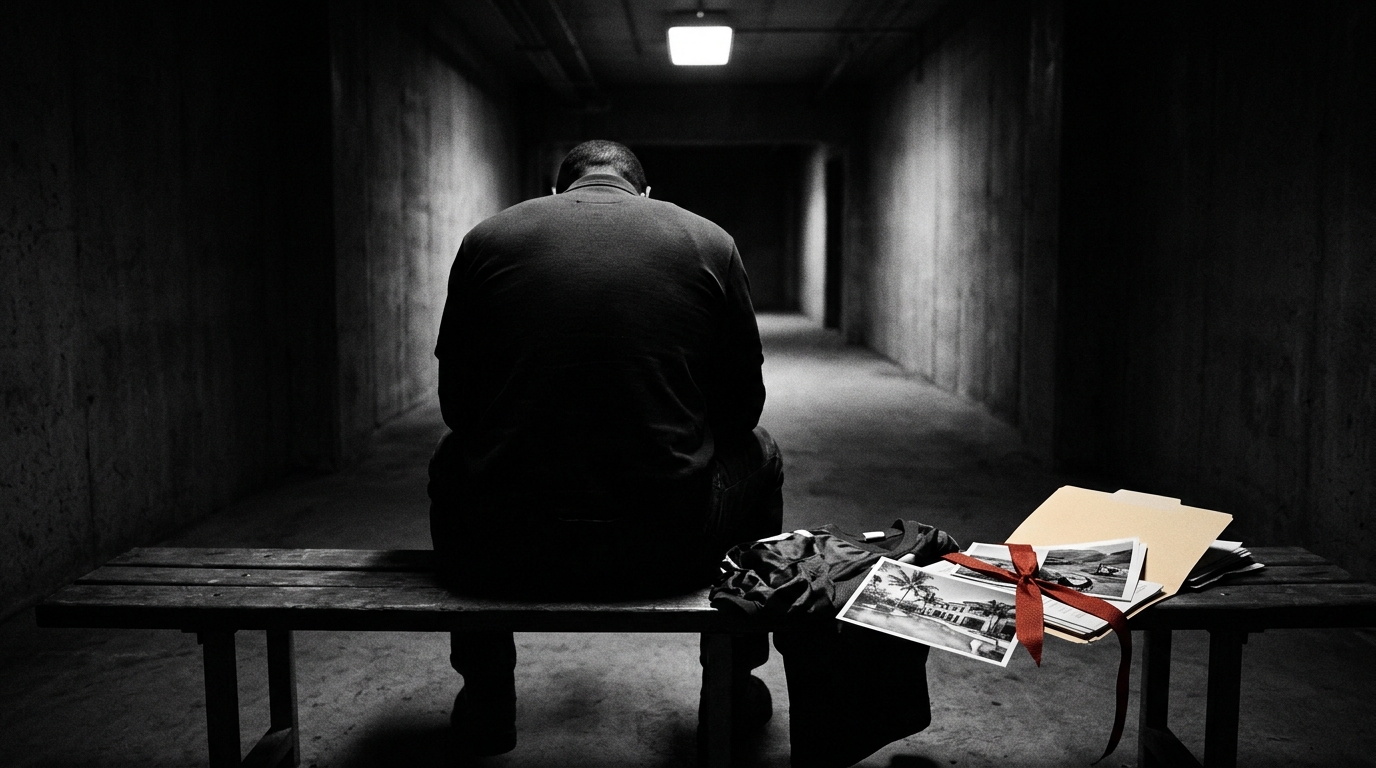
Picture a kitchen counter in Los Angeles County. A check from a man you trust, a man whose name you can find on an old NFL roster, sitting next to the coffee. The amount on the check is not the principal. It is what the cover letter calls "interest." You photograph the front and the back for your records and you deposit it through your phone. The check clears. You feel, for a moment, like a person who made a smart decision.
That check cleared because the day before, someone you have never met wired new money into the same account.
This is not a metaphor. According to the plea agreement John Robert Leake signed in federal court in California, this is what the operation was. New money in. Old money out. The polite name is a Ponzi scheme. The blunt name is that the people earlier in the line are paid with the money of the people later in the line, and at some point the line ends, and the people standing at the back of the line are the ones who lose everything.
Six people stood in this line. The Department of Justice puts the gross take at roughly $8,129,450. The actual losses, the number the court ordered Leake to repay, came to $5,314,059. Read that number slowly. It is not a round number. It is a number that came out of a forensic accountant's spreadsheet, a survivor's count of what was actually gone after every claw of recovery.
Leake played linebacker. Atlanta Falcons. Green Bay Packers. The kind of career that does not make a man rich on its own but does give him something more useful for the work that came later. It gave him a story. The man across the table from you played in the National Football League. He has been on the field at Lambeau. The credentials are real. You can verify them. That is the point.
The pitch, according to the indictment and the plea, was built out of places far enough away to be hard to check.
Gold mining in Ghana.
Gold mining in Alaska.
Luxury real estate and land development in Costa Rica.
Dubai.
Southern California.
Read that list and notice what it does. Each entry is exotic enough to feel like access. Together they are a portfolio. None of them are within driving distance of an investor in Los Angeles. None of them are easy to walk through with a flashlight on a Saturday afternoon.
The money, the government says, did not go to any of those places. It went to credit card bills. It went to car payments. It went to rent. It went to a casino floor. And it went to earlier investors, in the form of those "interest" and "capital" checks that made the people earlier in the line feel like geniuses and made the people later in the line feel safe handing over the next wire.
The machine ran from June 2015 through 2020. Five years. That is not a hit-and-run. That is a job.
In September 2024, Leake pleaded guilty to one count of wire fraud and one count of transactional money laundering. Wire fraud is the act of using an electronic communication, a wire, an email, a phone call, in furtherance of a scheme to defraud. Transactional money laundering is moving the proceeds of a crime through ordinary financial channels in a way designed to disguise where they came from. The plea was not a settlement. It was an admission.
In March 2025, U.S. District Judge John F. Walter sentenced him to 30 months in federal prison and signed the restitution order. $5,314,059. Owed to six people who had once written him a check.
That is where most of these stories end. The plea, the sentence, the restitution number on a piece of paper that the victims will never see paid in full, because the man who took the money has, on average, already spent it.
This story has one more chapter, and the chapter is the reason it is worth telling on a Tuesday in May 2026.
On May 3, federal prosecutors in California filed a motion asking the court to let them garnish Leake's NFL retirement benefits to satisfy the restitution order. The pension. The thing he earned on Sundays. The thing that was supposed to be his retirement and not theirs.
The legal authority is the Mandatory Victims Restitution Act, a federal statute that allows the government to enforce restitution orders against essentially all of a defendant's property. The MVRA is written broadly enough that it overrides the usual federal protections that keep retirement plans out of creditors' reach. In plain English: the law that normally builds a wall around a pension does not build that wall around a pension when the person inside it owes restitution to victims of a federal crime.
So here is the reframing. Read it slowly.
The career was the credential that made the pitch work. The pitch took $8 million from six people. The career also generated a pension. The pension is now the asset the government wants to point at the victims.
The same career that opened the door is the only thing left in the room.
It is not a clean ending. The pension will not make the six investors whole. NFL benefits, even for veterans of two clubs, are not large enough to refund $5.3 million. Garnishment is slow. It comes in monthly increments measured against a debt that will outlive the monthly increments. The motion is also still a motion. Until Judge Walter signs it, it is a request, not a recovery.
But it is something. And it is something because the federal restitution statute is one of the few places in American law where a victim's claim outranks the protections an offender would otherwise have. The wall comes down. The pension becomes reachable.
There is a pattern under all of this and it is worth naming, because the pattern is the part that protects the next person. The roster of athletes and former athletes accused of running or being caught inside financial schemes is not short. A former college player was charged in April 2026 in a $20 million identity theft case. Ten former NFL players were indicted in 2019 for defrauding a league health care benefits plan of over $3.9 million. The locker room is not a moral category. It is a population. Some of them are marks. Some of them are operators. The same credential, the helmet, the highlight reel, the verified Wikipedia page, can put a person on either side of the table.
The credential is not the diligence. The credential is the door. What happened inside the room is the question.
If you are reading this because someone you know is being pitched by a person whose name you can confirm on an old roster, the questions are the unglamorous ones.
Where, specifically, is the gold being mined.
Who is the operator of the mine.
Where is the land in Costa Rica recorded.
Who is the developer in Dubai.
What audited financials exist for the venture.
What does the subscription agreement say about how money will be returned, and who has signed off on the books.
Not the exciting questions. The ugly ones. The ones the pitch is built to make you feel rude for asking.
Six people did not ask enough of them, or asked them and were given answers they had no way to verify. Five years of "interest" payments cleared. Five years of statements arrived. The line moved.
In a federal courtroom in California, a judge will now decide whether the pension John Robert Leake earned on Sunday afternoons gets pointed back at the people he took on weekdays.
That is the only restitution the machine left behind.
- New York Post | May 2026 | "Ex-NFL linebacker convicted of $8M Ponzi scheme should have league benefits garnished, feds say"
- U.S. Department of Justice, Central District of California | September 2024 | Plea agreement, United States v. John Robert Leake (wire fraud, transactional money laundering)
- U.S. District Court, Central District of California | March 10, 2025 | Sentencing and restitution order, Judge John F. Walter presiding
- U.S. Department of Justice | May 3, 2026 | Motion for writ of garnishment against NFL retirement benefits
- Mandatory Victims Restitution Act | 18 U.S.C. § 3663A | Statutory authority for restitution enforcement
- IRS-Criminal Investigation | investigative agency of record
Editorial Notice
MarkTell is a true crime publication about financial fraud. Some scenes, dialogue, and sequential details are reconstructed from court filings, enforcement actions, news reports, and public records. Where the public record does not provide exact details, editorial reconstruction is used to convey the documented pattern of events. Names of private individuals may be changed to protect identity. All factual claims are sourced to public documents cited in the Evidence Trail above. MarkTell does not provide investment, legal, or financial advice. Nothing published here constitutes a recommendation to buy, sell, or avoid any investment. Allegations described in active cases have not been adjudicated and defendants are presumed innocent until proven guilty. Readers should conduct their own due diligence before making financial decisions.