The patriot economy paid thirteen percent. The interest came from the next believer.
Edwin Brant Frost IV built a faith-flavored finance company in Newnan, Georgia, that promised conservative investors safe returns on bridge loans. On May 12, 2026, he pleaded guilty to wire fraud. About 300 people had already learned what the notes were really paying with.
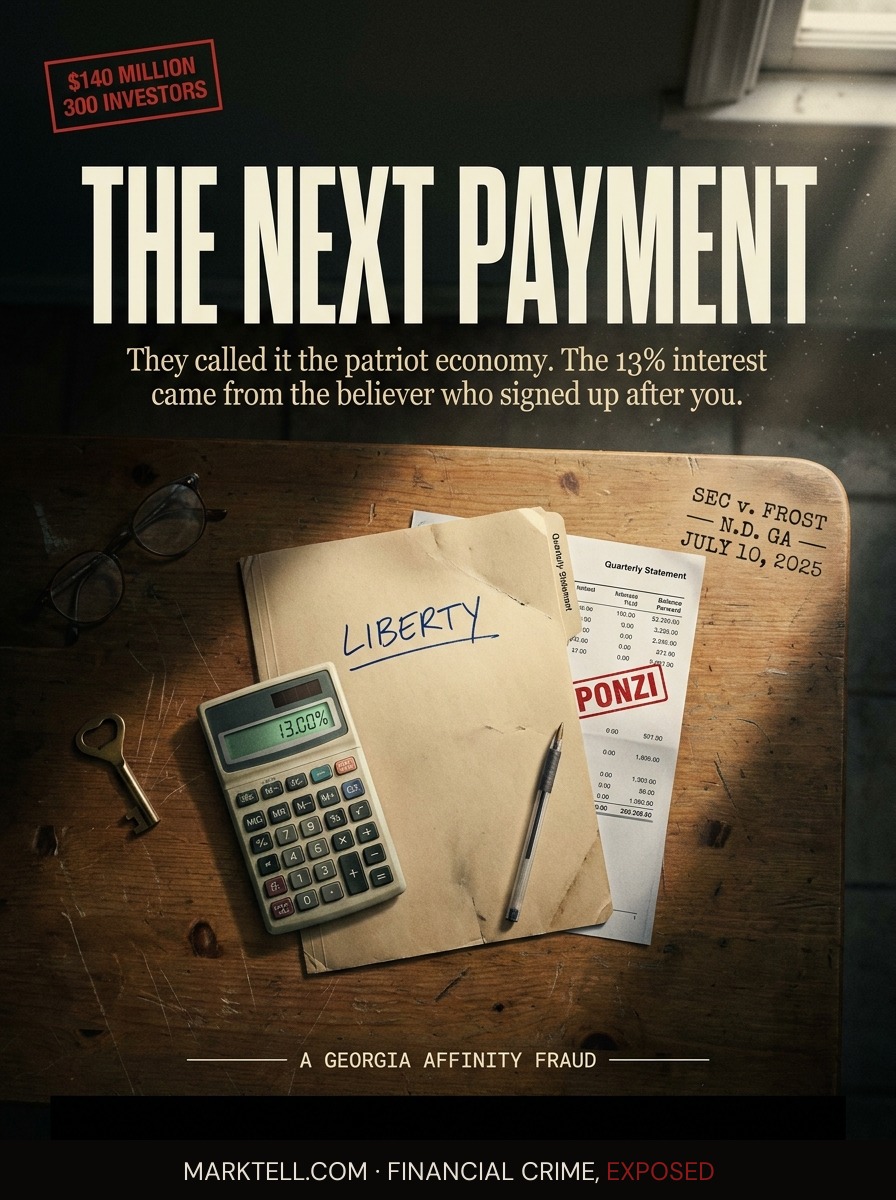
Carol kept the folder in the second drawer of the kitchen desk, the one with the warped runner that always stuck. The folder was labeled Liberty in blue ballpoint, in her own handwriting, because she was the one in the house who kept track of things like that. Her husband Ron handled the truck and the lawn. She handled the paper.
She was seventy-one. She had spent thirty-four years as the office administrator at a small Baptist school outside Newnan, and she knew what a real ledger looked like. The quarterly statements from First Liberty Building and Loan looked like real ledgers. Letterhead. Account number. Interest paid. Balance forward. The numbers added up when she ran them on the calculator she kept next to the folder.
That part may be the most painful. The numbers added up. They always added up. That is how the machine worked.
She had first heard about First Liberty at a men's breakfast at the church. Ron came home with a brochure and a name. A nice young man, he said. Brant's son. The Frosts were Frosts. Everybody in that part of Georgia knew the Frosts. Conservative. Faith-driven. The kind of people who used the word stewardship without irony.
The pitch was not really a pitch. It was a conversation about the patriot economy. About lending money to small American businesses instead of feeding it to Wall Street. About bridge loans, which the brochure explained as short-term loans to companies waiting on a bigger deal to close. Thirteen percent annual. Sometimes more. Backed by the loans themselves.
Carol read the brochure twice. She liked that the company was in Newnan. She liked that the office was on a street she had driven past for forty years. She liked that the man at the breakfast had said the word safe.
She signed the loan participation agreement at her kitchen table on a Tuesday afternoon. The pen was warm in her hand by the end because she had been holding it through the whole conversation. Ron was in the next room watching the weather. She wrote the check from the money market account they had been growing since she retired.
The check was for forty thousand dollars. It was not all of it. It was the part she was willing to risk on something new.
II. The patriot economy
Edwin Brant Frost IV founded First Liberty Building and Loan in Newnan, Georgia, and ran it for roughly a decade before the structure collapsed in June of 2025. The company sold two products to retail investors: First Liberty Notes and loan participation agreements. Both were marketed as conservative investments. Both promised annual returns between thirteen and eighteen percent.
A loan participation agreement, in plain English, is a piece of paper that says you own a slice of a loan somebody else made. The borrower pays interest. The interest flows back to you. If the borrower defaults, you lose your slice.
First Liberty told its investors that the underlying loans were bridge loans to American businesses. Short. Secured. Conservative.
The SEC's civil complaint, filed July 10, 2025, in the Northern District of Georgia, alleges that beginning around 2021, the bridge loans largely defaulted and stopped paying interest. After that, the complaint alleges, First Liberty operated as a Ponzi scheme. Money from new investors was used to pay returns to earlier investors. The underlying business was not generating the yield. The next investor was.
About 300 people put money in. The complaint puts the total at roughly $140 million.
Frost pleaded guilty on May 12, 2026, to a single count of wire fraud. He admitted under oath, according to court reporting, that he knowingly participated in the scheme.
III. What the money bought
Federal filings list what the money did instead of what investors were told it would do. Read this slowly.
Over $2.4 million in credit card payments. $335,000 to a rare coin dealer. $230,000 on family vacations. $140,000 on jewelry, including a Patek Philippe watch valued at $20,800. $320,000 to rent a vacation home in Kennebunkport, Maine. At least $570,000 in political contributions, according to federal officials.
Reports vary on how much Frost personally took. Some put it at $5 million. Others, counting funds routed through relatives and affiliated companies, put it at $17 million to $19 million.
The receiver appointed to recover funds, S. Gregory Hays, has already warned that most investors will not get most of their money back.
Picture the Patek Philippe in a federal exhibit. Then picture Carol's calculator on the kitchen desk. Both of those things existed in the same machine.
IV. The wrapper
The pitch was not really about returns. It was about belonging.
First Liberty did not market itself as a high-yield product. It marketed itself as a moral product. A conservative, faith-driven alternative to the banks. Money for American small businesses. Money kept inside a community of believers. The patriot economy.
Frost was, according to reporting, an influential figure in conservative evangelical political circles in Georgia. Donations from the company and its principals flowed into Georgia GOP politics. Victims include a company run by former Georgia GOP chairman David Shafer and the Alabama state auditor Andrew Sorrell.
Affinity fraud, in plain English, is when a fraud is sold inside a group of people who already trust each other. Church. Synagogue. Veterans. Ethnic community. Political tribe. The trust does the selling. The pitchman is just standing in the room where the trust already exists.
That is what was sitting on Carol's kitchen table on a Tuesday afternoon. The trust did the selling. The pen was warm because she did not need to be convinced. She had already been convinced by the church, by Ron, by the street the office sat on, by the word stewardship.
V. The day it stopped
First Liberty abruptly ceased operations in June 2025. The SEC filed its civil complaint and obtained asset freezes on July 10, 2025. Federal criminal charges followed in April 2026. The guilty plea came on May 12, 2026, in Atlanta. Sentencing is scheduled for August 2026.
In April of 2026, Georgia Secretary of State Brad Raffensperger announced a separate agreement under which Bankers Life Advisory Services and Bankers Life Securities would repay nearly $6.7 million to 46 investors who lost money in First Liberty through a former advisor named Timothy Nathaniel Darnell. Frost's son, Brant Frost V, was fined $500,000 by the state and barred from selling securities. His case was referred for criminal prosecution. He has not been charged in the federal case as of this writing.
U.S. Attorney Theodore S. Hertzberg said in announcing the plea that Frost "abused the trust of his clients, family, and friends" and that the investigation is ongoing.
Allegation is not adjudication. Frost's plea is adjudicated. The rest is still moving.
VI. The folder
Carol still has the folder. It still says Liberty in blue ballpoint. The statements inside it still add up on the calculator.
She has not told Ron how much was in the account. She told her pastor. Her pastor told her he had invested too. He told her the number he was in for and they sat in the church office without speaking for a long time.
That is what the patriot economy paid for. Not the watch. Not the rental in Kennebunkport. The silence in a pastor's office between two people who had given their savings to a man who used the word safe.
The bridge loans were not bridges. The notes were not notes. The interest was not interest. It was somebody else's check, made out the month before, redirected through a Newnan office with a scripture verse on the wall.
Carol thought she was a lender. She was the next payment.
- AJC.com | May 12-13, 2026 | "Georgia First Liberty founder pleads guilty in $140M fraud case"
- U.S. Department of Justice, Northern District of Georgia | May 12, 2026 | Guilty plea announcement, U.S. v. Edwin Brant Frost IV
- U.S. Securities and Exchange Commission | July 10, 2025 | SEC civil complaint against First Liberty Building & Loan, LLC and Edwin Brant Frost IV, N.D. Ga.
- Georgia Secretary of State, Office of Brad Raffensperger | April 1, 2026 | Announcement of Bankers Life settlement; prior action against Brant Frost V
- WSB-TV, WABE, CBS Atlanta | 2025-2026 | Contemporaneous reporting on First Liberty collapse and federal charges
Editorial Notice
MarkTell is a true crime publication about financial fraud. Some scenes, dialogue, and sequential details are reconstructed from court filings, enforcement actions, news reports, and public records. Where the public record does not provide exact details, editorial reconstruction is used to convey the documented pattern of events. Names of private individuals may be changed to protect identity. All factual claims are sourced to public documents cited in the Evidence Trail above. MarkTell does not provide investment, legal, or financial advice. Nothing published here constitutes a recommendation to buy, sell, or avoid any investment. Allegations described in active cases have not been adjudicated and defendants are presumed innocent until proven guilty. Readers should conduct their own due diligence before making financial decisions.