The patent expired in 2027. The machine made sure 2021 cost you anyway.
A Boston jury found Takeda liable for paying a generic rival to stay off the market, delaying a cheaper version of Amitiza by roughly six years. The single-damages number is $885 million. Antitrust law triples it.
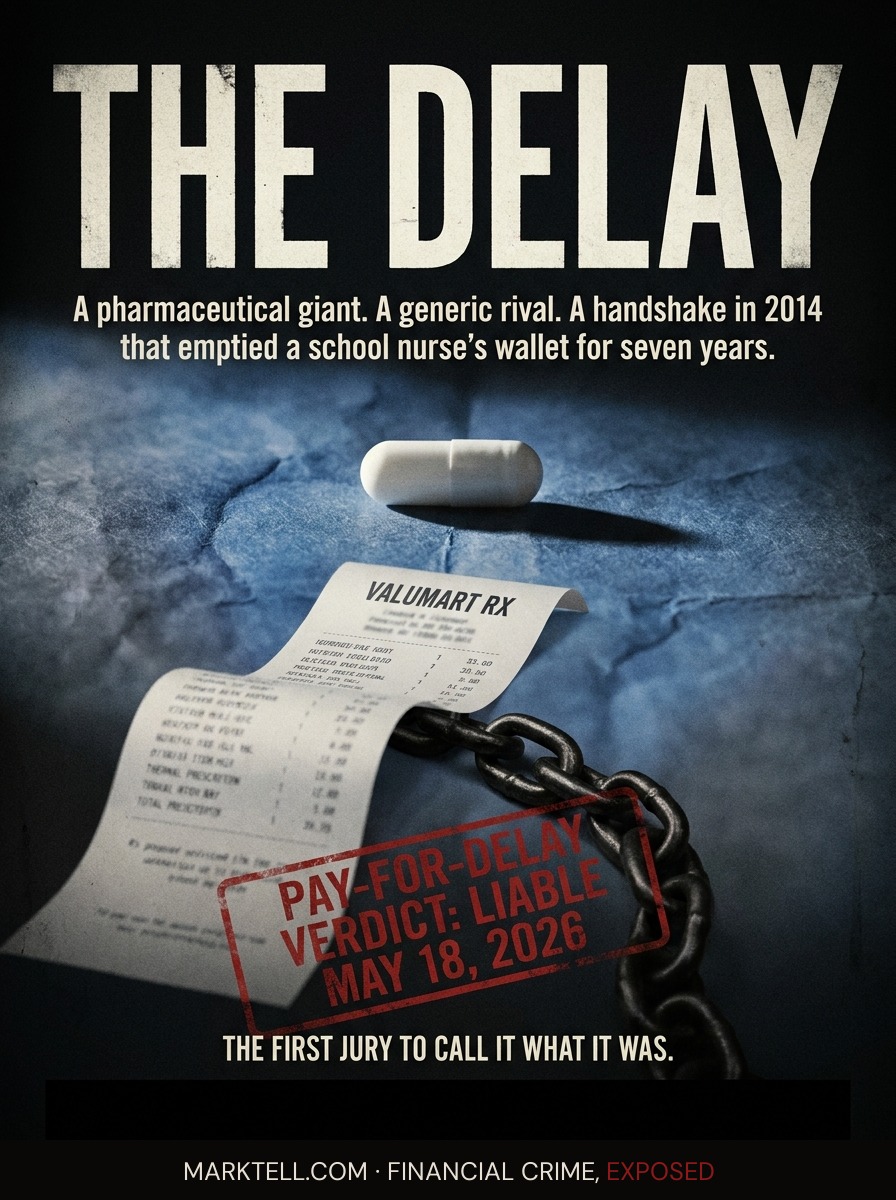
Marta is sixty-eight. She worked thirty-one years as a school nurse in Albuquerque, mostly elementary, and she knows the smell of a bandage drawer better than the smell of her own perfume. She retired in 2018 with a pension that covered the mortgage and a Medicare Part D plan that covered most of what her doctor wrote down.
Most of what. Not all.
One of the things it did not fully cover was a small white capsule called Amitiza. Her gastroenterologist prescribed it after a long stretch of medications for something else had stopped her body from doing what bodies do. She took one in the morning. One at night. She had been on it for years.
In the fall of 2019 she stood at a CVS counter in a strip mall off Montgomery Boulevard and watched the price come up on the little screen by the card reader. She slid her card. She did not say anything to the technician, who was maybe twenty-five and had her hair pulled back. Marta said thank you. She walked to her car. She sat for a minute before she turned the key.
She did not know that the price on the screen had a structure behind it. She did not know that the structure had a name.
The name was pay-for-delay.
\#
Here is what that means in plain English. When a brand-name drug company has a patent on a medicine, no one else is allowed to sell a copy of that medicine until the patent runs out or until a court says the patent does not block them. Generic drug companies file with the FDA to make cheaper versions. The brand company usually sues them for patent infringement. Sometimes those lawsuits go to trial. Sometimes they settle.
A pay-for-delay settlement is a particular kind of settlement. The brand company pays the generic company. The generic company agrees to wait. Both sides walk away with money. The patient at the counter pays brand prices for the extra years.
The U.S. Supreme Court ruled in 2013 that these deals can violate antitrust law. The Federal Trade Commission has estimated they cost American consumers and taxpayers about $3.5 billion a year in higher drug costs.
The deal at issue in Marta's case was signed in 2014.
\#
Amitiza, generic name lubiprostone, was developed by Sucampo Pharmaceuticals and approved by the FDA in 2006. Takeda, the Japanese pharmaceutical company, marketed it in the United States. In 2012, Par Pharmaceutical filed with the FDA to make a generic version. Takeda and Sucampo sued Par for patent infringement. In 2014, the three companies settled.
The terms of that settlement are the heart of this case. Plaintiffs' lawyers told the jury that Takeda paid Par roughly $210 million in value to stay out of the market. In exchange, Par agreed to wait until January 2021 to launch an authorized generic, with a 50-50 profit split when it did.
Takeda's position, argued by attorney Joshua Barlow over a five-week trial in Boston, was that the settlement was lawful and pro-competitive. The patents on Amitiza ran until October 2027. The settlement let a generic come to market years before that. From Takeda's chair, that was a win for competition.
The plaintiffs' chair looked different. Kristen Johnson and Thomas M. Sobol of Hagens Berman represented the direct purchasers, the wholesalers who actually bought Amitiza from Takeda. Jonathan Stratton represented the retailers, the big pharmacy names: Walgreens, Kroger, Albertsons, H-E-B, CVS. Their argument was simpler. If Par had launched when it could have launched, prices would have fallen sooner. Six years of brand pricing flowed to Takeda. Six years of brand pricing flowed out of the pockets of everyone in the supply chain.
The jury sat in federal court in Boston. The trial began April 13, 2026. Closing arguments were May 14. On May 18, the jury came back.
Liable.
$474,897,965 to the wholesaler class.
$346,837,646 to the retailer plaintiffs.
End-payor damages, the part that includes insurance plans and self-insured employers and, eventually, the patients, still to be sorted out before final judgment.
Read those numbers slowly. They are single damages. Federal antitrust law automatically triples them. The full exposure could approach $2.5 billion.
\#
This is the first time, since the 2013 Supreme Court ruling, that a jury has found a pharmaceutical company liable in a class action over a reverse-payment settlement. Cases like this one have mostly resolved in settlement. Teva paid $1.5 billion in 2015 to make a similar one go away. Takeda chose trial.
Takeda announced on May 19 that it would "vigorously pursue post-trial motions and an appeal." The company cited what it described as "evidentiary and legal errors made during the trial." The license agreement that gave Takeda the right to sell Amitiza in the United States ended on March 31, 2024. Takeda no longer sells the drug. The verdict landed against a company that had already moved on from the product.
The day after the verdict, Takeda's American depositary shares ticked up 0.6 percent. The market read the appeal as a long process. The bill is real but not due Tuesday.
\#
Marta does not read pharmaceutical antitrust complaints. Most people do not. The machinery of how a price gets set sits behind a wall of patent law and FDA filings and settlement agreements that are sometimes sealed and sometimes not. The pill is on the counter. The price is on the screen. The card reader beeps.
What the jury found, after five weeks of testimony, was that the price on Marta's screen in the fall of 2019 had been arranged. Not by a market. By an agreement. The brand company and the generic company had sat in a room in 2014 and decided when the cheaper version would arrive. The decision was January 2021.
For Marta, that meant something specific. It meant that between 2014 and January 2021, every refill she paid for at full brand price was a refill that, in a different version of the same facts, might have cost a fraction of that. It meant that the choices she made in those years, the things she did not buy because the prescription came first, were choices the structure made on her behalf.
She did not see the structure. She saw the receipt.
That is the design.
\#
The pay-for-delay machine is older than this verdict and will outlast it. It is not one person. It is a contract template. It is a litigation strategy. It is a way that two companies, sitting across a table with patent lawyers between them, can convert a patent fight into a private agreement that the patient at the counter pays for without ever being in the room.
The 2013 Supreme Court decision gave plaintiffs a way to challenge those agreements. The May 18 verdict gave plaintiffs a jury saying yes, this one crossed the line. Takeda will appeal. The end-payor class damages will be argued. The final number, if it survives, will not arrive for years.
January 2021 was when the generic finally came. By then, Marta had been buying Amitiza at brand price for the entire arc of the delay. She did not know there had been a delay. She knew only that the price had been what it had been.
The patent was set to expire in October 2027. The jury found that the years between 2014 and January 2021 were the years the machine bought for itself.
She paid for those years. She just did not see the invoice.
- Reuters | May 19, 2026 | "Takeda engaged in antitrust scheme to delay generic constipation drug, US jury finds"
- U.S. District Court, District of Massachusetts | May 18, 2026 | Jury verdict, In re Amitiza Antitrust Litigation
- U.S. Supreme Court | June 17, 2013 | FTC v. Actavis, Inc.
- Federal Trade Commission | Pay-for-Delay reports | estimates of annual consumer cost
- Takeda Pharmaceutical Company | May 19, 2026 | Public statement on verdict and appeal
- Takeda Pharmaceutical Company | March 31, 2024 | End of Amitiza license agreement disclosure
- FDA | 2006 | Approval of lubiprostone (Amitiza)
- Hagens Berman | Counsel of record, direct purchaser class
Editorial Notice
MarkTell is a true crime publication about financial fraud. Some scenes, dialogue, and sequential details are reconstructed from court filings, enforcement actions, news reports, and public records. Where the public record does not provide exact details, editorial reconstruction is used to convey the documented pattern of events. Names of private individuals may be changed to protect identity. All factual claims are sourced to public documents cited in the Evidence Trail above. MarkTell does not provide investment, legal, or financial advice. Nothing published here constitutes a recommendation to buy, sell, or avoid any investment. Allegations described in active cases have not been adjudicated and defendants are presumed innocent until proven guilty. Readers should conduct their own due diligence before making financial decisions.